FREE SHIPPING BOTH WAYS
ON EVERY ORDER!
LIST PRICE:
$122.66

Sorry, this item is currently unavailable.

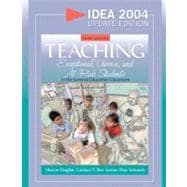
Teaching Exceptional, Diverse, and at-Risk Students in the General Education Classroom, IDEA 20...

ISBN: 9780205470365 | 020547036X
Edition: 4th
Format: Paperback
Publisher: Allyn & Bacon
Pub. Date: 1/1/2007

Why Rent from Knetbooks?

Because Knetbooks knows college students. Our rental program is designed to save you time and money. Whether you need a textbook for a semester, quarter or even a summer session, we have an option for you. Simply select a rental period, enter your information and your book will be on its way!

Top 5 reasons to order all your textbooks from Knetbooks:

  • We have the lowest prices on thousands of popular textbooks
  • Free shipping both ways on ALL orders
  • Most orders ship within 48 hours
  • Need your book longer than expected? Extending your rental is simple
  • Our customer support team is always here to help
SummaryTable of Contents
What is an IDEA 2004 Update Edition? The Vaugh/Bos/Schumm text has been updated to reflect this long-anticipated legislation in two ways: Relevant discussion throughout the book has been revised to reflect IDEA 04. These revisions have been made while still preserving the original pagination of the text, so no changes to lecture notes or reading assignments are necessary, and all supplementary materials (and page references therein) remain accurate. An IDEA 2004 icon appears in the margins adjacent to the updates. A Guide to IDEA 2004 has been ... MORE
... MORE
Special Education and Inclusive Schooling
IDEA and the Vocational Rehabilitation Act
Responsibilities of Classroom Teachers
Role of Collaboration in Meeting Students' Special Needs
Inclusion
Teaching Students with Learning Disabilities or Attention Deficit Hyperactivity Disorder
Learning Disabilities
Definitions and Types of Learning Disabilities
Characteristics of Students with Learning Disabilities
Prevalence of Learning Disabilities
Identification and Assessment of Students with Learning Disabilities
Instructional Techniques and Accommodations with Students with Learning Disabilities
Attention Deficit Hyperactivity Disorder
Definitions and Types of Attention Deficit Hyperactivity Disorder
Characteristics of Students with Attention Deficit Hyperactivity Disorder
Prevalence of Attention Deficit Hyperactivity Disorder
Identification and Assessment of Students with Attention Deficit Hyperactivity Disorder
Instructional Guidelines and Accommodations for Students with Attention Deficit Hyperactivity Disorder
Teaching Students with Communication Disorders and with Pervasive Developmental Disorders
Communication Disorders
Prevalence of Communication Disorders
Identification and Assessment of Students with Communication Disorders
Instructional Guidelines and Accommodations for Students with Communication Disorders
Pervasive Developmental Disorders
Prevalence of Pervasive Developmental Disorders
Identification and Assessment of Students with Pervasive Developmental Disorders
Instructional Guidelines and Accommodations for Students with Pervasive Developmental Disorders
Addressing Challenging Behaviors
Teaching Students with Emotional and Behavioral Disorders
Definitions of Emotional and Behavioral Disorders
Prevalence of Students with Emotional or Behavioral Disorders
Types and Characteristics Emotional or Behavioral Disorders
Causes of Emotional and Behavioral Disorders
Identification and Assessment of Students with Students with Emotional and Behavioral Disorders
Teaching Guidelines and Accommodations for Students with Emotional or Behavioral Disorders
Teaching Students with Mental Retardation and Severe Disabilities
Definition and Types of Mental Retardation and Severe Disabilities
Prevention of Mental Retardation
Prevalence of Mental Retardation and Severe Disabilities
Characteristics of Students with Mental Retardation and Severe Disabilities
Identification and Assessment of Students with Mental Retardation and Severe Disabilities
Instructional Guidelines and Accommodations for Teaching Students with Mental Retardation and Severe Disabilities
Teaching Students with Visual Impairments, Hearing Loss, Physical Disabilities, Health Impairments, or Traumatic Brain Injury
Students with Visual Impairments
Definition and Types of Visual Impairments
Characteristics of Students with Visual Impairments
Prevalence of Visual Impairments
Identification and Assessment of Students with Visual Impairments
Instructional Guidelines and Accommodations for Students with Visual Impairments
Students with Hearing Loss
Definition and Types of Hearing Loss
Characteristics of Students with Hearing Loss
Prevalence of Hearing Loss
Identification and Assessment of Students with Hearing Loss
Instructional Guidelines and Accommodations for Students with Hearing Loss
Students with Physical Disabilities and Health Impairments
Definition and Types of Physical Disabilities and Health Impairments
Prevalence of Physical Disabilities and Health Impairments
Characteristics of Students with Physical Disabilities and Health Impairments
Identification and Assessment of Students with Physical Disabilities and Health Impairments
Instructional Guidelines and Accommodations for Students with Physical Disabilities and Health Impairments
Planning and Grouping Strategies for Special Learners
Model of the Planning Process
Long-Term Planning
Unit Planning
Lesson Planning
An Overview of Instructional Grouping
Grouping Patterns
Managing Student Behavior
Basic Principles of Managing Student Behavior
Establishing the Classroom Climate
Practices for Providing Positive Behavioral Support
Enhancing Students' Self-Concepts
Teaching Social and Self-Management Skills
Collaborating and Coordinating with Other Professionals and Family Members
Consultation and Collaboration
Cooperative Teaching
Critical Communication Skills
Working with Parents
Teaching Culturally and Linguistically Diverse Students
Diversity in Classrooms and Schools
Multicultural Education
Linguistic Diversity and Second Language Acquisition
Instructional Guidelines and Accommodations for Culturally and Linguistically Diverse Students
Accommodating for Other Special Needs: Students At Risk and Students with Special Talents
Defining Students At Risk
Conditions That Place Students At Risk
Prevalence of Students At Risk
Identifying Students At Risk
Programs for Students At Risk
Defining Giftedness
Characteristics of Students Who Are Gifted and Talented
Prevalence of Giftedness
Identifying Students Who Are Gifted and Talented
Programs for Students Who Are Gifted and Talented
Instructional Guidelines and Accommodations
Teaching All Students to Succeed in Reading
Current Trends in Reading Programs
Effective Reading Instruction for Struggling Readers
Strategies for Helping All Students with Phonological Awareness, Letter-Sound Correspondence, and the Alphabet Principle
Strategies for Teaching Word Identification
Strategies for Helping All Students Develop Fluency
Strategies for Helping All Students Improve Reading Comprehension
Teaching All Students to Succeed in Writing
Current Trends in Writing Curriculum and Instruction
Teaching Writing as a Process
Strategies for Establishing an Environment That Promotes Writing
Strategies for Conducting a Writing Workshop
Strategies for Teaching Narrative Writing
Strategies for Teaching Expository Writing
Strategies for Helping All Students Acquire Spelling Skills
Strategies for Helping All Students Develop Handwriting Skills
Teaching All Students to Succeed in Mathematics
Current Trends in Mathematics Curriculum and Instruction
Difficulties in Learning Mathematics
Effective Math Instruction for All Learners
Strategies for Helping All Students Acquire Basic Math Skills
Strategies for Helping All Learners Acquire and Use Computation Skills
Strategies for Helping All Students Develop Problem Solving Skills
Teaching All Students to Succeed in the Content Areas Critical Issues in Content Area Instruction
Learning Difficulties in the Content Areas
Effective Content Area Instruction for All Learners
Effective Content Area Reading Instruction for All Learners
Effective Content Area Assignments, Homework, and Tests for All Learners
Planning Interdisciplinary Thematic Units
Glossary
Appendix: What Every Teacher Should Know About IDEA 2004
Index
Table of Contents provided by Publisher. All Rights Reserved.

Related Products


  • Teaching Students Who are Exceptional, Diverse, and At Risk in the General Education Classroom, LLV with eText
    Teaching Students Who are Exce...
  • Teaching Mainstreamed, Diverse, and At-Risk Students in the General Education Classroom
    Teaching Mainstreamed, Diverse...
  • Teaching Exceptional, Diverse, and At-Risk Students in the General Education Classroom
    Teaching Exceptional, Diverse,...
  • Teaching Exceptional, Diverse, and At-Risk Students in the General Education Classroom
    Teaching Exceptional, Diverse,...
  • MyEducationLab with Pearson eText -- Standalone Access Card -- for Teaching Students Who Are Exceptional
    MyEducationLab with Pearson eT...
  • Outlines & Highlights for Teaching Students Who are Exceptional, Diverse, and at Risk in the General Education Classroom 5th by Sharon R. Vaughn; Candace S. Bos; Jeanne Shay S. Schumm
    Outlines & Highlights for Teac...
  • Teaching Students Who Are Exceptional, Diverse, and at Risk in the General Education Classroom
    Teaching Students Who Are Exce...
  • Teaching Students Who are Exceptional, Diverse, and at Risk in the General Education Classroom
    Teaching Students Who are Exce...
  • Teaching Exceptional, Diverse, and At-Risk Students in the General Education Classroom, MyLabSchool Edition
    Teaching Exceptional, Diverse,...
  • Teaching Students Who are Exceptional, Diverse, and at Risk in the General Education Classroom (with MyEducationLab)
    Teaching Students Who are Exce...


Please wait while this item is added to your cart...