Free Shipping On Every Order



Amazon no longer offers textbook rentals. We do!
Interaction Design: Beyond Human - Computer Interaction, 3rd Edition
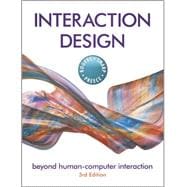
Interaction Design: Beyond Human - Computer Interaction, 3rd Edition
- ISBN 13:
9780470665763
- ISBN 10:
0470665769
- Edition: 3rd
- Format: Paperback
- Copyright: 06/01/2011
- Publisher: Wiley
- Newer Edition
Used From $60.71
Sorry, this item is currently unavailable.
 Free Shipping On Every Order
List Price $82.66 Save $21.95
Used
$60.71
Usually Ships in 24-48 Hours
 We Buy This Book Back!
Included with your book
.svg "Free Shipping On Every Order") Free Shipping On Every Order
Free Shipping On Every Order
Note: Supplemental materials are not guaranteed with Rental or Used book purchases.
Extend or Purchase Your Rental at Any Time
Need to keep your rental past your due date? At any time before your due date you can extend or purchase your rental through your account.
Summary
Rogers, Preece and Sharp are a bestselling author team, acknowledged leaders and educators in their field, with a strong global reputation.They bring depth of scope to the subject, encompassing the latest technologies and devices including facebook and YouTube. Interaction Design offers a cross-disciplinary, practical and process-oriented approach to Human Computer Interaction, showing not just what principals ought to apply to Interaction Design, but crucially how they can be applied. Motivating examples are included to illustrate both technical, but also social and ethical issues, making the book approachable and adaptable for both Computer Science and non-Computer Science users. Interviews with key HCI luminaries are included and provide an insight into current and future trends The text comes with a lively and highly interactive companion web site containing a rich set of resources enabling students to collaborate on experiments and designs, take part in competitions, find resources and communicate with others.