FREE SHIPPING BOTH WAYS
ON EVERY ORDER!
LIST PRICE:
$21.28

OUR PRICE:
$10.00

You may extend rentals at any time.


Writing Philosophy : A Student's Guide to Writing Philosophy Essays
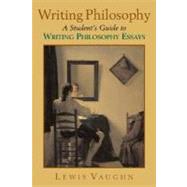
ISBN: 9780195179569 | 0195179560
Format: Paperback
Publisher: Oxford University Press, USA
Pub. Date: 11/10/2005

Why Rent from Knetbooks?

Because Knetbooks knows college students. Our rental program is designed to save you time and money. Whether you need a textbook for a semester, quarter or even a summer session, we have an option for you. Simply select a rental period, enter your information and your book will be on its way!

Top 5 reasons to order all your textbooks from Knetbooks:

  • We have the lowest prices on thousands of popular textbooks
  • Free shipping both ways on ALL orders
  • Most orders ship within 48 hours
  • Need your book longer than expected? Extending your rental is simple
  • Our customer support team is always here to help
SummaryTable of Contents
Writing Philosophy: A Student's Guide to Writing Philosophy Essays is a concise, self-guided manual that covers the basics of argumentative essay writing and encourages students to master fundamental skills quickly, with minimal instructor input. Opening with an introductory chapter on how toread philosophy, the book then moves into the basics of writing summaries and analyzing arguments. It provides step-by-step instructions for each phase of the writing process, from formulating a thesis, to creating an outline, to writing a final draft, supp... MORE
Prefacevii
PART I READING AND WRITING1(102)
Chapter 1 How to Read Philosophy
3(18)
What Is Philosophy?
... MORE3(4)
Reading Philosophy
7(6)
Rule 1-1 Approach the Text with an Open Mind
8(1)
Rule 1-2 Read Actively and Critically
9(1)
Rule 1-3 Identify the Conclusion First, Then the Premises
10(1)
Rule 1-4 Outline, Paraphrase, or Summarize the Argument
11(1)
Rule 1-5 Evaluate the Argument and Formulate a Tentative Judgment
12(1)
Writing a Paraphrase or Summary
13(3)
Applying the Rules
16(5)
Chapter 2 How to Read an Argument
21(22)
Premises and Conclusions
21(6)
Judging Arguments
27(12)
Rule 2-1 Know the Basics of Deductive and Inductive Arguments
27(3)
Rule 2-2 Determine Whether the Conclusion Follows from the Premises
30(8)
Rule 2-3 Determine Whether the Premises Are True
38(1)
Applying the Rules
39(4)
Chapter 3 Rules of Style and Content for Philosophical Writing
43(12)
Rule 3-1 Write to Your Audience
43(1)
Rule 3-2 Avoid Pretentiousness
44(2)
Rule 3-3 Keep the Authority of Philosophers in Perspective
46(1)
Rule 3-4 Do Not Overstate Premises or Conclusions
46(1)
Rule 3-5 Treat Opponents and Opposing Views Fairly
47(2)
Rule 3-6 Write Clearly
49(2)
Rule 3-7 Avoid Inappropriate Emotional Appeals
51(1)
Rule 3-8 Be Careful What You Assume
52(1)
Rule 3-9 Write in First Person
53(1)
Rule 3-10 Avoid Discriminatory Language
53(2)
Chapter 4 Defending a Thesis in an Argumentative Essay
55(30)
Basic Essay Structure
56(12)
Introduction
56(2)
Argument Supporting the Thesis
58(1)
Assessment of Objections
59(1)
Conclusion
60(1)
A Well-Built Essay
60(8)
Writing the Essay: Step by Step
68(12)
Step 1 Select a Topic and Narrow It to a Specific Issue
69(1)
Step 2 Research the Issue
70(1)
Step 3 Write a Thesis Statement
71(1)
Step 4 Create an Outline of the Whole Essay
72(3)
Step 5 Write a First Draft
75(3)
Step 6 Study and Revise Your First Draft
78(1)
Step 7 Produce a Final Draft
79(1)
An Annotated Sample Paper
80(5)
Chapter 5 Avoiding Fallacious Reasoning
85(11)
Straw Man
86(1)
Appeal to the Person
86(1)
Appeal to Popularity
87(1)
Appeal to Tradition
88(1)
Genetic Fallacy
88(1)
Equivocation
89(1)
Appeal to Ignorance
90(1)
False Dilemma
91(1)
Begging the Question
91(1)
Hasty Generalization
92(1)
Slippery Slope
93(1)
Composition
94(1)
Division
94(2)
Chapter 6 Using, Quoting, and Citing Sources
96(7)
Rule 6-1 Know When and How to Quote Sources
96(3)
Rule 6-2 Do Not Plagiarize
99(2)
Rule 6-3 Cite Your Sources Carefully
101(1)
Rule 6-4 Build a Bibliography if Needed
101(2)
PART 2 REFERENCE GUIDE103(23)
Chapter 7 Writing Effective Sentences
105(13)
Rule 7-1 Make the Subject and Verb Agree in Number and Person
105(2)
Rule 7-2 Express Parallel Ideas in Parallel Form
107(1)
Rule 7-3 Write in Complete Sentences, Not Fragments
108(1)
Rule 7-4 Connect Independent Clauses Properly
109(2)
Rule 7-5 Delete the Deadwood
111(1)
Rule 7-6 Put Modifiers in Their Place
112(2)
Rule 7-7 Be Consistent in Tense, Voice, Number, and Person
114(1)
Rule 7-8 Communicate Pronoun References Clearly
115(3)
Chapter 8 Choosing the Right Words
118(8)
Rule 8-1 Select Nouns and Verbs Precisely
118(1)
Rule 8-2 Prefer the Active Voice
118(1)
Rule 8-3 Use Specific Terms
119(1)
Rule 8-4 Avoid Redundancy
119(1)
Rule 8-5 Be Aware of the Connotations of Words
120(1)
Rule 8-6 Learn to Distinguish Words That Writers Frequently Mix Up
121(2)
Rule 8-7 Strive for Freshness; Avoid Clichés
123(1)
Rule 8-8 Do Not Mix Metaphors
124(1)
Rule 8-9 Beware of Awkward Repetition
124(2)
Appendix A Formatting Your Paper126(7)
Appendix B Documenting Your Sources133(13)
Index146


Please wait while this item is added to your cart...