FREE SHIPPING BOTH WAYS
ON EVERY ORDER!
LIST PRICE:
$70.00

OUR PRICE:
$27.72

You may extend rentals at any time.


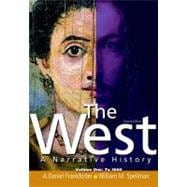
West,The A Narrative History, Volume One: To 1660

ISBN: 9780205180936 | 0205180930
Edition: 3rd
Format: Paperback
Publisher: Pearson
Pub. Date: 12/27/2011

Why Rent from Knetbooks?

Because Knetbooks knows college students. Our rental program is designed to save you time and money. Whether you need a textbook for a semester, quarter or even a summer session, we have an option for you. Simply select a rental period, enter your information and your book will be on its way!

Top 5 reasons to order all your textbooks from Knetbooks:

  • We have the lowest prices on thousands of popular textbooks
  • Free shipping both ways on ALL orders
  • Most orders ship within 48 hours
  • Need your book longer than expected? Extending your rental is simple
  • Our customer support team is always here to help
SummaryTable of ContentsAuthor Biography
The book students will read: Concise. Relevant. Accessible. The West: A Narrative History is a concise but not abridged introduction to the West, encompassing all cultures that trace their ancestry to the ancient Mediterranean world. It is not a reduced version of a larger study, but a full narrative of the West written concisely. This learning program is built around a Key Question in every chapter, a feature that shows students why western civilization is relevant for them. Students will discover the key questions that define the past are in ... MORE

Found in this section:

1. Brief Table of Contents

2. Full Table of Contents


1. BRIEF TABLE OF CONTENTS


Introduction


Part I Departure Prehisto... MORE

Chapter 1 The Birth of Civilization 

Chapter 2 The Rise of Empires and the Beginning of the Iron Age


Part II The Classical Era 2000 B.C.E. to 30 C.E.

Chapter 3 Aegean Civilizations

Chapter 4 The Hellenic Era  

Chapter 5 The Hellenistic Era and the Rise of Rome

Chapter 6 Rome’s Empire and the Unification of the Western World


Part III The Division of the West 300 to 1300

Chapter 7 The West’s Medieval Civilizations

Chapter 8 The Emergence of Europe

Chapter 9 Europe Turns Outward

Chapter 10 Europe’s High Middle Ages


Part IV Challenges, Conflicts, and Departures 1300 to 1700

Chapter 11 Challenges to the Medieval Order

Chapter 12 Renaissance and Exploration

Chapter 13 Reformation, Religious Wars, and National Conflicts 


2. FULL TABLE OF CONTENTS


Introduction


Part I — Departure Prehistory to 1000 B.C.E.


Chapter 1: The Birth of Civilization

Key Question: How do environments shape human communities and human communities alter environments?

    The Evolution of the Prehistoric Cultures 

    The Archaic States  

    The Origin of Civilization in Mesopotamia: Sumer  

    The Rise of Civilization in Egypt


Chapter 2: The Rise of Empires and the Beginning of the Iron Age

Key Question: Does civilization promote or intensify divisions among peoples?

    The Transition States

    Imperial Egypt: The New Kingdom 

    The Indo-Europeans and the Clash of Empires

    The Bible and History


Part II —  The Classical Era 2000 B.C.E. to 30 C.E.


Chapter 3: Aegean Civilizations

Key Question: When does civilization in the West become “Western” civilization?

    Minoan Mentors

    The Mycenaeans, Greece’s First Civilization 

    The Aegean Dark Age

    The Hellenic Era

    The Rise of the Mainland Powers

    The Persian Wars: Crucible of a Civilization


Chapter 4: The Hellenic Era

Key Question: What did the Greeks contribute to the development of modern civilization?

    Persian Wars as Catalyst

    The Peloponnesian War 

    Intellectual and Artistic Life in the Polis


Chapter 5: The Hellenistic Era and the Rise of Rome

Key Question: What circumstances are likely to undermine governments by the people?

    The Hellenistic Era

    The Origin of Rome

    The Roman Republic

    Rome’s Civil War


Chapter 6: Rome ’s Empire and the Unification of the Western World

Key Question:  Do people prefer order to liberty?

    The Augustan Era 

    Order and Continuity: The Dynastic Option 

    Order and Continuity: The Elective Option 

    Life in an Imperial Environment 

    The Decline of Rome


Part III — The Division of the West 300 to 1300


Chapter 7: The West’s Medieval Civilizations

Key Question:  Should freedom of religion be limited?

    The Christian Element 

    The German Element 

    The Byzantine Empire of Constantinople 

    Islam


Chapter 8: The Emergence of Europe

Key Question: How did Europe build on its legacies from the ancient world?

    The Merovingian Kingdom: Europe’s Nucleus

    The Franks’ Neighbors 

    The Carolingian Era 

    Retrenchment and Reorganization 

    The Culture of Europe’s Dark Age


Chapter 9: Europe Turns Outward

Key Question: Was conflict among the medieval civilizations inevitable?

    Islam’s Crest and Byzantium’s Resurgence

    The Reorganization of Feudal Europe

    The Eleventh-Century Turning Point


Chapter 10: Europe ’s High Middle Ages

Key Question: Why are some societies more open to change than others?

    The Renaissance of the Twelfth Century

    Universities and Scholasticism

    Religious Revival and Diversity of Opinion

    The Artistic Vision of the High Middle Ages

    Government in the High Middle Ages


Part IV — Challenges, Conflicts, and Departures 1300 to 1700


Chapter 11: Challenges to the Medieval Order

Key Question: What did the crises of the late medieval era reveal about the strengths and weaknesses of Europe’s civilization?

    Challenges from Nature  

    Turmoil in the Middle East 

    Spiritual Crises 

    Political Responses: The Burdens of War


Chapter 12: Renaissance and Exploration

Key Question: How should a society use its history?

    The Context for the Renaissance  

    The Culture of the Renaissance 

    The Northern Renaissance  

    The Middle East: The Ottoman Empire 

    Europe and Atlantic Exploration


Chapter 13: Reformation, Religious Wars, and National Conflicts

Key Question: How do civilized societies justify war?

    The Lutheran Reformation

    The Swiss Reformation 

    The Catholic Reformation 

    The Habsburg-Valois Wars 

    England’s Ambivalent Reformation 

    Convergence of Foreign and Domestic Politics: England, Spain, and France 

    The Final Religious Upheaval 

A. Daniel Frankforter is Professor of History at the Pennsylvania State University, where he has taught for four decades. His undergraduate work was in the history of ideas and philosophy at Franklin and Marshall College. He earned a Master of Divinity degree from Drew University, did graduate work at Columbia University and the University of Göttingen, and completed master’s and doctoral degrees in medieval history and religious studies at Penn State. His research interests are in English ecclesiastical history, the evolving status of women in medieval Europe, and textual criticism. Articles on these topics have appeared in such journals as Manuscripta, Church History, The British Studies Monitor, The Catholic Historical Review, The American Benedictine Review, The International Journal of Women’s Studies, and The Journal of Women’s History. His books include A History of the Christian Movement: An Essay on the Development of Christian Institutions, Civilization and Survival, The Shakespeare Name Dictionary (with J. Madison Davis), The Medieval Millennium: An Introduction, The Western Heritage, brief edition (with Donald Kagan, Stephen Ozment, and Frank Turner), The Heritage of World Civilizations, brief third edition (with Albert Craig, William Graham, Donald Kagan, Stephen Ozment, and Frank Turner), an edition and translation of Poullain de la Barre’s De L’Égalité des deux Sexes, and Stones for Bread: A Critique of Contemporary Worship. His most recent work is: Word of God/Words of Men: The Use and Abuse of Scripture. Over the course of his career he has developed 15 courses dealing with aspects of the ancient and medieval periods of Western civilization, the Judeo-Christian tradition, and gender issues. His service in the classroom has been acknowledged by the Penn State Behrend Excellence in Teaching Award and the prestigious Amoco Foundation Award for Excellence in Teaching Performance.


William M. Spellman is Professor of History at the University of North Carolina Asheville and Director of the Council of Public Liberal Arts Colleges, a constorium of twenty-six institutions in the United States and Canada.  He is a graduate of Suffolk University, Boston, and holds a PhD from the Maxwell School of Citizenship and Public Affairs at Syracuse University.  He is the author of John Locke and The Problem of Depravity (Oxford, 1988); The Latitudinarians and the Church of England (Georgia, 1993); John Locke (Macmillan, 1995): European Political Thought, 1600-1700 (Macmillan, 1997); Monarchies, 1000-2000 (Reaktion, 2000); The Global Community: Migration and the Making of the Modern World (Sutton, 2002): A Concise History of the World Since 1945 (Palgrave, 2006); Uncertain Identity: International Migration Since 1945 (Reaktion, 2008); and A Short History of Western Political Thought (Palgrave, 2011).

Related Products


  • Study Guide for the West : A Narrative History (Combined Volume and Volume 1)
    Study Guide for the West : A N...
  • The West A Narrative History, Volume 1: To 1600
    The West A Narrative History, ...
  • West, The: Culture and Ideas, Prentice Hall Portfolio Edition, Volume One: to 1660
    West, The: Culture and Ideas, ...
  • West,The A Narrative History, Volume One: To 1660 Plus NEW MyHistoryLab with eText -- Access Card Package
    West,The A Narrative History, ...


Please wait while this item is added to your cart...