FREE SHIPPING BOTH WAYS
ON EVERY ORDER!
LIST PRICE:
$106.66

Sorry, this item is currently unavailable.

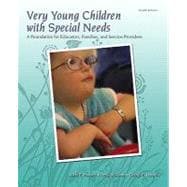
Very Young Children with Special Needs: A Foundation for Educators, Families, and Service Provi...

ISBN: 9780131127951 | 0131127950
Edition: 4th
Format: Paperback
Publisher: Prentice Hall
Pub. Date: 1/1/2010

Why Rent from Knetbooks?

Because Knetbooks knows college students. Our rental program is designed to save you time and money. Whether you need a textbook for a semester, quarter or even a summer session, we have an option for you. Simply select a rental period, enter your information and your book will be on its way!

Top 5 reasons to order all your textbooks from Knetbooks:

  • We have the lowest prices on thousands of popular textbooks
  • Free shipping both ways on ALL orders
  • Most orders ship within 48 hours
  • Need your book longer than expected? Extending your rental is simple
  • Our customer support team is always here to help
SummaryTable of Contents
For courses in Early Childhood Special Education and Early Intervention. Through narrative, case studies, and unique "close ups," this introductory, inclusive text provides a foundation in working with very young children with exceptional needs. Written for professionals in education, social work, health care, and physical therapy, this interdisciplinary book offers a review of the history of early childhood special education, followed by detailed coverage of typical child development, the domains of early childhood education, and the causes of disabling conditions. In conclusion, the authors address how educators and others can best provide intervention and support to young children and their families.
Philosophy of Early Education
1(50)
The Importance of an Attitude of Science
3(4)
... MORE
What Is an Attitude of Science?
4(3)
Personalization
7(1)
The History of Disability Rights
8(8)
Individualization
10(2)
Inclusion
12(4)
Personalization, a Way to Move into the Next Century
16(3)
What Is Meant by Personalization in Early Education and Intervention?
17(1)
The Implications of Personalization
18(1)
The Importance of Being Culturally Sensitive
19(8)
Population Trends
21(1)
Economics
22(1)
Family Composition
23(3)
Summary on Diversity
26(1)
The Importance of Serving Children in the Context of a Family
27(8)
What Is a Family?
30(2)
Empowerment
32(3)
The Importance of Working Collaboratively
35(6)
Teaming Models
37(1)
Collaboration in Early Intervention
38(3)
The Importance of Ethical Conduct and Advocacy
41(4)
Advocacy Issues
42(1)
How to Get Involved in Advocacy
43(2)
In Conclusion
45(1)
Study Guide Questions
45(1)
References
46(5)
Early Childhood Services---Yesterday, Today, and Around the World
51(52)
A Historical Perspective
52(1)
The History of Childhood in Western Civilization
52(24)
Stage 1: From Bad to Worse
54(1)
Stage 2: Children Will Be Children
55(1)
Stage 3: Church and State Mix
56(4)
Stage 4: Parents Know Best
60(9)
Stage 5: Children Know Best
69(3)
The ``Trilemma'' of Child Care
72(1)
The Future of Child Care
73(3)
The History of Special Education
76(8)
Families Bear All
76(1)
The Asylum Movement
77(1)
Social Darwinism
77(1)
First Generation Modern Era
78(1)
Second Generation of the Modern Era
79(1)
Communal Perspective
79(1)
Early Education for Children with Disabilities
80(2)
IDEA of 1975 and Implications for Early Childhood
82(2)
Current Philosophy of Early Intervention
84(2)
Cross-Cultural History of Childhood Education
86(8)
International Research on Early Childhood Programs
89(1)
North America
89(1)
Western Europe
89(1)
The Pacific Rim
90(1)
Developing Nations
90(2)
Summary of World Cultures
92(2)
Issues and Challenges in Early Intervention
94(3)
In Conclusion
97(1)
Study Guide Questions
98(1)
References
98(5)
Relationship-Based Teaming with Families
103(52)
Relationship-Based Services to Families
106(13)
Understanding Families
109(3)
Parental Responses to the Diagnosis of a Disability
112(4)
Family Hardiness
116(1)
Barriers to Relationships
117(2)
Communication Between Parents and Professionals
119(7)
Active Listening
120(3)
Communicating Well
123(3)
Special Skills for Communicating with Parents at the Time of Diagnosis
126(5)
Conferencing with Parents
130(1)
Responding to Family Priorities
131(8)
Constraints and Conflicts
131(2)
Cultural Constraints
133(6)
Forming Collaborative Teams
139(9)
Teaming and IDEA
143(1)
Responsibilities of Collaborative Teams
144(4)
Summary of Building Collaborative Teams
148(1)
Study Guide Questions
149(1)
References
150(5)
Human Development
155(76)
Importance and Use of Knowledge of Human Development
156(1)
Prenatal Growth and Development
156(4)
Child Growth and Development
160(13)
Patterns of Growth
162(1)
Size
163(1)
Developmental Patterns
163(1)
Physical Growth
163(6)
Theories of Development
169(4)
Principles and Patterns of Development
173(5)
Infants Are Highly Competent Organisms
174(1)
Infants Are Socially Interactive
175(1)
Infants Are Active Learners
175(1)
Infant Development Is Multidimensional
175(1)
Developmental Sequencing Is Universal
176(1)
Skills Become More Specialized
176(1)
Plasticity
177(1)
Critical Learning Periods
177(1)
Infant Relationships Are the Key to Cognitive Development
177(1)
Children Undergo Several Transitions
177(1)
Individual Differences Among Children
178(1)
Factors Influencing Development
178(7)
Family Structure
179(1)
Child Care
180(1)
Psychological Factors
180(4)
Education
184(1)
Culture
184(1)
Technology
185(1)
Milestones of Development
185(1)
Motor Development
186(6)
Gross Motor Development
186(2)
Fine Motor Skills
188(4)
Language Development
192(14)
Language Form
194(4)
Morphological Development
198(1)
Language Content
199(3)
Language Use
202(1)
Factors Affecting Language Development
203(3)
Cognition
206(7)
Theories of Cognition
208(5)
Social Development
213(7)
Social Play
215(5)
Self-Help Skills
220(4)
Independent Eating and Drinking Skills
222(1)
Dressing Skills
223(1)
Toileting Skills
223(1)
Personal Responsibility
223(1)
The Future of Human Development
224(1)
Study Guide Questions
225(2)
References
227(4)
Development and Risk During Prenatal, Natal, and Postnatal Stages
231(44)
Prenatal Growth and Development
232(3)
Effects of Prematurity on Body Systems
232(3)
Maternal Conditions Affecting Pregnancy Outcomes
235(7)
Preconceptual Maternal Conditions
235(1)
Prenatal Maternal Conditions
235(2)
Common Conditions of Gestation
237(5)
Maternal/Infant Natal Complications
242(2)
Prolapsed Cord/Entangled Cord
243(1)
Neonatal Conditions
244(3)
Hypoxic--Ischemic Perinatal Brain Injury
244(1)
Meconium Aspiration Syndrome
245(2)
Postnatal Conditions
247(12)
Prematurity
247(3)
Respiratory Distress Syndrome (RDS)
250(1)
Bronchopulmonary Dysplasia (BPD)
251(1)
Patent Ductus Arteriosus (PDA)
252(1)
Hyperbilirubinemia
252(1)
Neutral Thermoregulation
253(1)
Intraventricular Hemmorhage (IVH)
253(1)
Apnea of Prematurity
254(1)
Infections
255(1)
Retinopathy of Prematurity (ROP)
255(1)
Anemia
256(1)
Nutrition
257(1)
Failure to Thrive
258(1)
Intervention for Infants and Children Born Prematurely
259(1)
Substance Abuse and Pregnancy Outcomes
260(9)
Fetal Alcohol Syndrome
260(2)
Prenatal Exposure to Drugs
262(5)
Implications for Infants and Children Prenatally Exposed to Drugs
267(2)
In Conclusion
269(1)
Study Guide Questions
270(1)
References
270(5)
Conditions Affecting the Neurological Function
275(54)
Diagnostic Tools
276(4)
X rays
276(1)
Computerized Axial Tomography
277(1)
Magnetic Resonance Imaging
277(1)
Functional Imaging
278(1)
Ultrasonography
279(1)
Electroencephalography
279(1)
Neurological Disabilities
280(30)
Cerebral Palsy
280(16)
Seizures
296(7)
Attention Deficit Hyperactivity Disorder (ADHD)
303(4)
Traumatic Brain Injury
307(3)
Congenital Physical Malformations
310(12)
Neural Tube Defects
310(6)
Microcephaly
316(1)
Hydrocephalus
317(5)
In Conclusion
322(1)
Study Guide Questions
322(1)
References
323(6)
Inborn Variations of Development
329(60)
Genetics
330(11)
Cellular Activity of Genetics
332(1)
Single Gene Disorders
333(5)
Chromosome Disorders
338(1)
Multifactorial Disorders
338(2)
Genetic Testing
340(1)
Gene Therapy
341(1)
Genetic Variations in Development
341(23)
Cystic Fibrosis
341(4)
Down Syndrome
345(4)
Other Trisomy Disorders
349(1)
Fragile X Syndrome
350(3)
Muscular Dystrophy
353(4)
Phenylketonuria
357(2)
Sickle Cell Disease
359(3)
Turner Syndrome
362(2)
Syndromes with Unknown Causes
364(11)
Autism
364(7)
Tourette Syndrome
371(4)
Physical Anomalies
375(6)
Congenital Heart Defects
375(3)
Cleft Lip and Cleft Palate
378(3)
In Conclusion
381(1)
Study Guide Questions
382(1)
References
383(6)
Sensory Impairments and Infections
389(52)
Hearing Impairments
390(9)
Hearing Process
390(1)
Hearing Loss
391(2)
Identification of Hearing Loss
393(2)
Developmental Implications and Resolutions
395(3)
Informing and Working with Parents
398(1)
Visual Impairments
399(13)
Visual Process
400(2)
Causes of Visual Impairment
402(3)
Developmental Implications and Resolutions
405(1)
Informing and Working with Parents
405(7)
Infections in Early Childhood
412(23)
Bacterial Infections
413(2)
Viral Infections
415(14)
Meningitis/Encephalitis
429(6)
In Conclusion
435(1)
Study Guide Questions
436(2)
References
438(3)
Discretionary Programs for Infants and Toddlers with Special Needs
441(42)
IDEA, Part C Regulations
445(3)
Family-Centered Early Intervention
448(8)
Service Coordination
449(2)
Interagency Services
451(1)
Eligible Children
452(1)
Procedural Safeguards
453(3)
Assessment
456(20)
IDEA Guidelines for Assessment
456(2)
Eligibility Determination
458(2)
Program Planning
460(1)
Family Assessment
461(3)
IFSP Development
464(3)
Services Delivered
467(3)
A Sample IFSP
470(6)
Effective Family-Centered Early Intervention
476(1)
Evidence-Based Practice
477(1)
In Conclusion
478(1)
Study Guide Questions
479(1)
References
479(4)
Mandated Services for Young Children
483(39)
A Change of Perspective
486(1)
Parent Rights and Responsibilities
487(2)
The Individualized Education Program
489(21)
Present Levels of Performance
490(4)
Instructional Objectives
494(2)
Guidelines for Developing Good Objectives
496(1)
Special Education and Related Services
497(1)
Least Restrictive Environment
498(5)
Instructional Methods
503(3)
Experiences and Activities
506(1)
Generalization
506(1)
The Physical Environment
506(1)
Material Adaptations
507(1)
Data Collection and Evaluation
507(1)
Assistive Technology
508(1)
Supplementary Aids and Services
508(1)
Challenging Behavior
509(1)
Creating Quality IEPs
510(1)
Best Practices in Preschool Intervention
511(4)
Successful Inclusion
514(1)
In Conclusion
515(1)
Reauthorization of IDEA
516(3)
The President's Commission on Excellence in Special Education
516(2)
Other Input
518(1)
Public Debate
518(1)
Summary
519(1)
Study Guide Questions
519(1)
References
520(2)
Glossary522(12)
Author Index534(10)
Subject Index544

Related Products


  • Outlines and Highlights for Precalculus : A Problems-Oriented Approach, Enhanced Edition by David Cohen, ISBN
    Outlines and Highlights for Pr...
  • Very Young Children with Special Needs : A Formative Approach for the 21st Century
    Very Young Children with Speci...
  • Very Young Children with Special Needs : A Formative Approach for the 21st Century
    Very Young Children with Speci...
  • Very Young Children with Special Needs : A Foundation for Educators, Families, and Service Providers
    Very Young Children with Speci...
  • Very Young Children with Special Needs, Loose-Leaf Version with Pearson eText -- Access Card Package
    Very Young Children with Speci...


Please wait while this item is added to your cart...