FREE SHIPPING BOTH WAYS
ON EVERY ORDER!
LIST PRICE:
$17.99

OUR PRICE:
$14.25

You may extend rentals at any time.


The Unschooled Mind: How Children Think and How Schools Should Teach
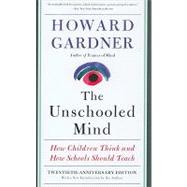
ISBN: 9780465024384 | 0465024386
Edition: 20th
Format: Paperback
Publisher: Perseus Books Group
Pub. Date: 3/29/2011

Why Rent from Knetbooks?

Because Knetbooks knows college students. Our rental program is designed to save you time and money. Whether you need a textbook for a semester, quarter or even a summer session, we have an option for you. Simply select a rental period, enter your information and your book will be on its way!

Top 5 reasons to order all your textbooks from Knetbooks:

  • We have the lowest prices on thousands of popular textbooks
  • Free shipping both ways on ALL orders
  • Most orders ship within 48 hours
  • Need your book longer than expected? Extending your rental is simple
  • Our customer support team is always here to help
SummaryTable of ContentsAuthor Biography
Merging cognitive science with educational agenda, Gardner makes an eloquent case for restructuring our schools by showing just how ill-suited our minds and natural patterns of learning are to the prevailing modes of education. This reissue includes a new introduction by the author.
... MORE
Acknowledgmentsp. xi
The Unschooled Mind After Twenty Yearsp. xiii
Introduction: The Central Puzzles of Learningp. 1
Intuitive Learning and Scholastic Learningp. 2
Three Characters in Search of a Frameworkp. 6
The Seven Intelligencesp. 12
The Framework Foundp. 14
Human Nature, Institutions, and Values: The Plan for This Bookp. 16
The ôNaturalö Learner
Conceptualizing the Development of the Mindp. 25
Early Studies of the Mindp. 25
Jean Piaget's Pioneering Studies of Cognitive Developmentp. 27
The Mind After Piagetp. 32
Spanning Biology and Culturep. 39
Initial Learnings: Constraints and Possibilitiesp. 45
The Philosophical Agendap. 45
The Finely Tuned Infantp. 47
Piaget's Portrait of Infant Cognitionp. 50
Knowing the Social Worldp. 53
Five Footnotes to Sensorimotor Knowledgep. 55
Knowing the World Through Symbolsp. 59
Scholars of Symbolsp. 59
Language as a Symbol Systemp. 62
Categorizing Objects and Eventsp. 69
Play, Imagination, and the Birth of Theoryp. 73
A Study of Early Symbolizationp. 76
Pluralizing and Individualizing the Ways of Knowingp. 86
The Worlds of the Preschooler: The Emergence of Intuitive Understandingsp. 91
The Child's Intuitive Theoriesp. 93
Other Early Predispositionsp. 106
Five Constraints on Later Learningp. 110
A Developmental Forecastp. 113
The Powers and Limits of the Five-Year-Old Mindp. 118
Understanding Educational Institutions
The Values and Traditions of Educationp. 125
Educational Options I: What Is to Be Taught?p. 125
Aspects of Understandingp. 127
Educational Options II: How Is Knowledge to Be Taught?p. 129
An Institution That Educates: The Apprenticeshipp. 131
The Institution Called Schoolp. 137
The Early Schoolp. 138
The Burdens of Schoolp. 141
The Three Assignments of Modern Secular Schoolsp. 142
Assessing Learningp. 143
The Effects of Schoolp. 145
Institutional Constraintsp. 149
The Difficulties Posed by School: Misconceptions in the Sciencesp. 155
Varieties of Understandingp. 157
Misconceptions in Physicsp. 164
Misconceptions in Biologyp. 171
Problems in Mathematics: Rigidly Applied Algorithmsp. 173
More Difficulties Posed by School: Stereotypes in the Social Sciences and the Humanitiesp. 181
Problems in Economics and Statisticsp. 181
Stereotypes and Simplifications in the Humanistic Disciplinesp. 184
Problems in Historical and Literary Studiesp. 186
Simplifications in the Artsp. 190
Some Concluding Comments About Misconceptions and Stereotypesp. 194
Toward Education for Understanding
The Search for Solutions: Dead Ends and Promising Meansp. 199
The Limits of Basic Skillsp. 200
Cultural Literacy for the Nationp. 202
A Traditional Strand in Educationp. 203
The Progressive Strand in Educationp. 205
The Limits of Progressive Educationp. 209
Education for Understanding During the Early Yearsp. 215
Educational Environments for Young Childrenp. 216
The Example of Project Spectrump. 220
Developing Literacies in the Early School Yearsp. 226
Middle Childhood: Apprenticeships and Projectsp. 230
Schooling for Understanding in Middle Childhoodp. 236
Education for Understanding During the Adolescent Yearsp. 243
Innovations Across the Curriculump. 245
The Nurturing of Individual Understanding: Five Entry Pointsp. 263
Toward National and Global Understandingsp. 269
The Tale So Farp. 270
The Four Nodes of School Reformp. 274
Community Versus National Control of Educationp. 275
The Definition and Achievement of National Understandingsp. 278
Constraints and Possibilities: A Developmentally Attuned Educationp. 283
Notesp. 287
Indexp. 311
Table of Contents provided by Ingram. All Rights Reserved.
Howard Gardner is the John H. and Elisabeth A. Hobbs Professor of Cognition and Education at the Harvard Graduate School of Education and Senior Director of Harvard Project Zero. The recipient of a MacArthur Fellowship and twenty-seven honorary degrees, he is the author of more than twenty books. He lives in Cambridge, Massachusetts.


Please wait while this item is added to your cart...

