Because Knetbooks knows college students. Our rental program is designed to save you time and money. Whether you need a textbook for a semester, quarter or even a summer session, we have an option for you. Simply select a rental period, enter your information and your book will be on its way!
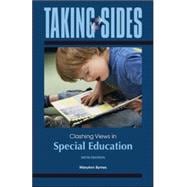
| Taking Sides: Clashing Views in Special Education, 4e | |
| Table of Contents | |
| Taking Sides: Clashing Views in Special Education, 4e | |
| Special Education and Society | |
| Has the ADA Accomplished Its Goals? | |
| YES | |
| “Yes, You Can,” Parade Magazine (July 24, 2005) | |
| NO | |
| “Adults with Learning Disabilities and the Underutilization of the Americans wit... MORE | |
| an award-winning television commentator, radio host, and foreign correspondent, who happens to use a wheelchair, celebrates the increased access brought about by implementation of the Americans with Disabilities Act | |
| (university faculty members and researchers) and Robert Mulligan (a district special education administrator) contend that the opportunities for ADA-mandated access are underused by individuals with learning disabilities | |
| Does IDEA 2004 Contain Substantial Changes? | |
| YES | |
| “Individuals with Disabilities Education Act Reauthorization: Accountability and Personal Responsibility,” Remedial and Special Education (November/December 2005) | |
| NO | |
| “IDEA 2004: Another Round in the Reauthorization Process,” Remedial and Special Education (November/December 2005) | |
| co-founder and co-director of the Beach Center on Disability at the University of Kansas, sees major changes in IDEA 2004 | |
| In line with the Bush administration's priorities, Turnbull identifies a shift toward requiring parents and students to take more responsibility for their own behavior and for relationships with schools | |
| professor at the University of Arkansas, focuses his research on disability law and inclusion | |
| Reflecting on IDEA 2004, Smith believes that, although some changes seem significant, they will make little difference in the daily practice of special education | |
| Is Eliminating Minority Overrepresentation Beyond the Scope of Public Schools? | |
| YES | |
| “The Committee on Minority Representation in Special Education,” Minority Students in Special and Gifted Education (National Academy Press, 2002) | |
| NO | |
| Racial Inequity in Special Education (Harvard Education Press, 2002) | |
| researchers representing the findings of a National Research Council study on minority students in special and gifted education, believe overrepresentation issues are complex and not easily resolvable | |
| While teachers can make a difference, environmental factors and poverty have a large impact and require interventions beyond schools | |
| both policy experts, present the results of research commissioned by the Civil Rights Project of Harvard University | |
| While agreeing with some of the NRC recommendations, these findings suggest that patterns will change with stricter enforcement of federal and state | |
| Table of Contents provided by Publisher. All Rights Reserved. |