FREE SHIPPING BOTH WAYS
ON EVERY ORDER!
LIST PRICE:
$131.20

OUR PRICE:
$20.24

You may extend rentals at any time.


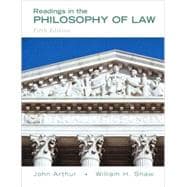
Readings in the Philosophy of Law

ISBN: 9780205708093 | 0205708099
Edition: 5th
Format: Paperback
Publisher: Pearson
Pub. Date: 10/26/2009

Why Rent from Knetbooks?

Because Knetbooks knows college students. Our rental program is designed to save you time and money. Whether you need a textbook for a semester, quarter or even a summer session, we have an option for you. Simply select a rental period, enter your information and your book will be on its way!

Top 5 reasons to order all your textbooks from Knetbooks:

  • We have the lowest prices on thousands of popular textbooks
  • Free shipping both ways on ALL orders
  • Most orders ship within 48 hours
  • Need your book longer than expected? Extending your rental is simple
  • Our customer support team is always here to help
SummaryTable of ContentsAuthor Biography
This anthology of classical, contemporary, philosophical and legal essays/cases focuses on legal philosophy as its own subject rather than being a part of social/political philosophy or applied ethics. The essays within this reader focus on how law is organized and the particular philosophical issues that it raises. The book requires students to think through actual debatesmany of them still currently in the courts.

I. LAW IN ACTION.  

1. The Adversary System and the Practice of Law.  

Lawyers' Ethics in an Adversary System, Monroe H. Freedman.

An Alternative to the Adversary System, John H. Langbein.

Pure Legal Advocates and Moral Agents: Two Concepts  of a Lawyer in an Adversary System, Elliot D. Cohen. [new

 ... MORE

2. The Rule of Law.  

Rule of Law and the English Constitution, A.V. Dicey. [new]  

Eight Ways to Fail to Make Law, Lon Fuller.

The Rule of Law and Its Virtues, Joseph Raz.

Grudge Informers and the Rule of Law, H.L.A. Hart.

The Problem of the Grudge Informer, Lon Fuller.

Detention of Enemy Combatants, Hamdi v. Rumsfeld. [new


3. The Moral Force of Law.  

Crito, Plato.

The Justification of Civil Disobedience, John Rawls.

On Not Prosecuting Civil Disobedience, Ronald Dworkin. 


II. LEGAL REASONING.

4. Statutes. 

Interpreting the Adultery Clause of the Ten Commandments, Sanford Levinson.

Interpreting the Small Bird Act, Regina v. Ojibway.

A Case Study: Interpreting the Mann Act, Edward H. Levi.

Cases Interpreting the Mann Act, Caminetti v. U.S.; Mortensen v. U.S.; and Cleveland v. U.S.

Interpretation, Tony Honore.

Who is a Drunk Driver? Kentucky v. Whitt.

What is a Vegetable? Nix v. Hadden.

“Use” of a Firearm, Smith v. U.S. [new]

Can a Murderer Inherit? Riggs v. Palmer.


5. Precedents.  

Stare Decisis: The Use of Precedent, C. Gordon Post.

Constrained by Precedent, Larry Alexander.

Precedent and Ligitimacy, Planned Parenthood v. Casey.


6. Constitutional Interpretation [new section and readings]

“Vague” Constitutional Clauses, Ronald Dworkin.

Due Process, Rochin v. California

Interpreting the Constitution, Antonin Scalia.

A Response to Scalia, Ronald Dworkin.

The Second Amendment, District of Columbia v Heller.

Defense of Looseness: The Supreme Court and Gun Control, Richard A. Posner.


III. THE NATURE OF LAW  

7. Natural Law and Legal Positivism: Classical Perspectives.  

Traditional Natural Law Theory, Bix.

Natural Law: Summa Theologica, Thomas Aquinas.

Natural Law: Blackstone’s Commentaries, William Blackstone.

Legal Positivism, John Austin.


8. Formalism and Legal Realism.  

The System of Law, Joseph H. Beale.

The Path of the Law, Oliver Wendell Holmes.

Realism and the Law, Jerome Frank.


9. Morality and the Law. 

Positivism and Separation of Law and Morals, H. L.A.Hart.

Law as the Union of Primary and Secondary Rules, H.L.A. Hart.

The Model of Rules, Ronald Dworkin.

“Natural” Law Revisited, Ronald Dworkin.

The Dependence of Morality on Law, Tony Honore.


10. International Law.  

International Law, H.L.A. Hart.

The African Slave Trade, U.S. v. La Jeune Eugenie; The Antelope; The Armistad.

International Law and Individual Responsibility, The International Military Tribunal at Nuremberg.


11. Law and Economics [new section]  

The Economic Approach to Law, Richard A. Posner.

Law and Economics: An Analysis and Critique, Andrew Altman.


IV. PHILOSOPHICAL ISSUES IN CRIMINAL LAW.  

12. The Justification of Punishment.  

Who Should Be Punished? The Case of the Dog Provetie.

The Utilitarian Theory of Criminal Punishment, Richard B. Brandt.

Persons and Punishment, Herbert Morris.

The Message of Punishment, Jean Hampton.

Restitution: A New Paradigm of Criminal Justice, Randy E. Barnett.


13. The Rights of Defendants.  

Criminal Justice and the Negotiated Plea, Kenneth Kipnis.

Convicting the Innocent, James McCloskey.

The Dirty Harry Problem, Carl B. Klockars.

A Debate on the Exclusionary Rule, Malcolm Richard Wilkey and Stephen H. Sachs.

Interrogation and the Right to Counsel: Miranda v. Arizona, Brewer v. Williams, and Rhode Island v. Innis.

Entrapment, United States v. Tobias.


14. Sentencing.  

Capital Punishment, Gregg v. Georgia.

Electric Shock: The Fairest Punishment of All, Graeme Newman.

Racial Bias in Sentencing, McClesky v. Kemp.

Three Strikes, Rummell v. Estelle.


15. Criminal Responsibility.  

Survival on a Lifeboat, The Queen v. Dudley and Stephens.

The Principles of Criminal Law, Richard B. Brandt.

Intention, H.L.A. Hart.

Attempting the Impossible: The Crime That Never Was, Leo Katz.

Drunkenness, People v. Koerber.  [new]

Rape, Consent and Mens Rea, Regina v. Morgan. [new]

The Battered Woman Syndrome, State v. Leidholm.

Rape, Force, and Consent, Susan Estrich.

Is the Insanity Defense Insane? R.J. Gerber.

What Is So Special about Mental Illness? Joel Feinberg.

Executing Mentally Retarded Murderers, Atkins v. Virginia.


V. PHILOSOPHICAL ISSUES IN CIVIL LAW.  

16. Compensating for Private Harms: The Law of Torts. 

The Efficiency of the Common Law, Andrew Altman.

Negligence, William Prosser.

Economic Efficiency and the “Hand Formula,” U.S. v. Carroll Towing Company.

Foreseeable Risk, Stone v. Bolton.

Tort Liability and Corrective Justice, Jeffrie G. Murphy and Jules L. Coleman.

Negligence and Due Care: Palsgraf v. Long Island Railroad Co.

Loss, Agency, and Responsibility for Outcomes, Stephen R. Perry.

Liability without Causation? Summers v. Tice.

Legal Causation and the Desert Traveler, Amy Shapiro.

A Duty to Rescue? Yania v. Bigan, Farwell v. Keaton, and McFall v. Shimp.

Assessing Damages: Wrongful Life and Wrongful Birth, Berman v. Allan.


17. Private Ownership: The Law of Property.  

Property, John Locke.

Property and Sovereignty, Morris Raphael Cohen.

Intellectual Property, Richard A. Posner.

Property Acquisition, Haslem v. Lockwood.

Regulation of Private Property, Pennsylvania Coal Co. v. Mahon.

Eminent Domain, Kelo v. City of New London [new


18. Private Agreements: the Law of Contract.

The Basis of Contract, Morris Raphael Cohen.

Contract as Promise, Charles Fried.

Unconscionable Contracts, Williams v. Walker-Thomas Furniture Co.

Surrogate Mother Contracts, In the Matter of Baby M.

Employment Contracts, Lochner v. New York; Muller v . Oregon; Coppage v. Kansas; and West Coast Hotel Co. v. Parrish.


VI. PHILOSOPHICAL ISSUES IN CONSTITUTIONAL LAW.  [new sections w/ existing material]

19. Church and State.

A Letter Concerning Religious Toleration, John Locke.

School Prayer, Engel v. Vitale.

Religious Freedom and Public Education, Wisconsin v. Yoder.

Secular Humanism and Religious Establishment, Smith v. Board of Education.


20. Personal Liberty and Privacy

On Liberty, John Stuart Mill.

The Right to Privacy, Griswold v. Connecticut.

Homosexuality and the Right to Privacy, Lawrence v. Texas.

Same-Sex Marriage, Goodridge v. Massachusetts Department of Public Health.

Judicial Activism and Gay Marriage: A Debate, Lawrence Tribe and Richard Parker.


21. Personal Liberty and Privacy

Of the Liberty of Thought and Discussion, John Stuart Mill.

Flag Burning, Texas v. Johnson.

Nazi Marches, Village of Skokie v. National Socialist Party.

Obscenity, Paris Adult Theatre v. Slaton.

Free Speech at School, Morse v. Frederick  [new]


22. Equality.

Separate but Equal, Plessy v. Fergueson   [new]

The Great School Desegregation Case, Brown v. Board of Education. [new]

Wartime Internment of Japanese Americans, Korematsu v. United States.

Racial Equality and Affirmative Action, Ronald Dworkin.

Affirmative Action in Universities, Grutter v. Bollingerand  Gratz v. Bollinger. [new]

Gender Discrimination, Michael M. v. Sonoma County Superior Court.


Appendix: The Bill of Rights and the Fourteenth Amendment.

John Arthur, professor of philosophy and director of the Program in Philosophy, Politics, and Law at Binghamton University, died of cancer in January 2007. He was the author of The Unfinished Constitution: Philosophy and Constitutional Practice (Wadsworth 1989), Words That Bind: Judicial Review and the Grounds of Modern Constitutional Theory (Westview 1995), and Race, Equality, and the Burdens of History (Cambridge 2007), among other works. He edited the widely used ethics anthology, Morality and Moral Controversies (Prentice-Hall), now in its 9th edition.


William H. Shaw is professor of philosophy at San Jose State University. He is the author of Marx’s Theory of History (Stanford 1978), Moore on Right and Wrong: The Normative Ethics of G. E. Moore (Kluwer 1995), Contemporary Ethics: Taking Account of Utilitarianism (Blackwell 1999), and Business Ethics (Wadsworth, 6th ed. 2008). He has edited several volumes, including (with John Arthur), Justice and Economic Distribution (Prentice-Hall, 2nd ed. 1994).

Related Products


  • Readings in the Philosophy of Law
    Readings in the Philosophy of ...
  • Readings in the Philosophy of Law
    Readings in the Philosophy of ...
  • Readings In The Philosophy Of Law
    Readings In The Philosophy Of ...


Please wait while this item is added to your cart...