Because Knetbooks knows college students. Our rental program is designed to save you time and money. Whether you need a textbook for a semester, quarter or even a summer session, we have an option for you. Simply select a rental period, enter your information and your book will be on its way!
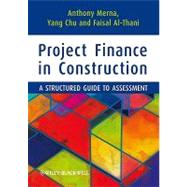
| List of illustrations | |
| List of tables | |
| About the Authors | |
| Preface | |
| Introduction | |
| The development of project finance | |
| Financial assessment | |
| What is financial assessment? | |
| Why perform a financial assessment? | |
| Who is involved in the risk assessment process? | |
| Where should a financial asse... MORE | |
| When should a financial assessment be performed? | |
| What data are to be used? | |
| How should assessment outputs be presented? | |
| Purpose of this guide | |
| Scope of the guide | |
| Project finance | |
| Introduction | |
| Definition of project finance | |
| The key characteristics of project finance | |
| Special project/purpose vehicle | |
| Contractual arrangement | |
| Non-/limited recourse | |
| Off-balance sheet transaction | |
| Robust income stream of the project as the basis for financing | |
| Legal and financial considerations in project finance | |
| Legal | |
| Financial | |
| Financial instruments and cash flow modelling | |
| Introduction | |
| Debt finance | |
| Senior debt | |
| Mezzanine finance | |
| Subordinate debt | |
| Bond finance | |
| Equity finance | |
| Sources of debt and equity | |
| Cash flow modelling and project financing | |
| Risk management | |
| Introduction | |
| Risk | |
| Risk management process | |
| Risk identification | |
| Risk analysis | |
| Risk response | |
| Typical risks in project financing | |
| The financial assessment process | |
| Introduction | |
| The financial assessment structure | |
| SPV assessment | |
| Lenders' assessment | |
| SPV and lender final assessment | |
| Case study | |
| Introduction | |
| Independent power project | |
| Supply and offtake contracts | |
| Supply contracts | |
| Offtake contracts | |
| Applications of supply and offtake contracts | |
| Assumptions for initial assessment | |
| Developing the base case model | |
| Introduction | |
| SPV's initial assessment | |
| Identify the estimated activities, time, costs and revenues of the project | |
| Development of the base case model | |
| Identify major project risks | |
| Assessment of base case model incorporating risks | |
| Initial economic assessment by lenders | |
| Introduction | |
| Financial package assessment | |
| Finance package (1) | |
| Finance package (2) | |
| Finance package (3) | |
| Conclusions | |
| Financial engineering | |
| Introduction | |
| Financial instruments used in financial engineering | |
| Forward rates | |
| Financial futures | |
| Swaps | |
| Options | |
| Caps, floors, collars, swaptions and compound options | |
| Asset-backed securities | |
| Refinancing | |
| Reappraising public-private partnerships | |
| Techniques applied in the reappraisal of PPP concession agreement | |
| Other financial engineering techniques | |
| Final assessment to determine project commercial viability | |
| Introduction | |
| Detailed risk assessment | |
| Financial engineering | |
| Tax holiday | |
| Financial collar | |
| Extending the concession | |
| Increasing debt | |
| Grace period | |
| Phasing construction and operation | |
| Upfront payments | |
| Existing concession revenues | |
| Summary | |
| Financial close | |
| Introduction | |
| Due diligence | |
| Technical | |
| Legal due diligence | |
| Trigger step in rights | |
| Model audit and sensitivity analysis | |
| Risk valuation | |
| Term sheet | |
| Inter-creditor agreement | |
| Hedge strategy | |
| Letters of credit | |
| Reserve account | |
| Escrow and ring-fenced facilities | |
| Economic indicators | |
| Taxation | |
| Insurance | |
| Financial close | |
| Credit committee approval process | |
| Due diligence report | |
| Technical closure | |
| Financial close | |
| Technical commencement | |
| Execute interest rate swaps | |
| Islamic finance and project finance | |
| Introduction | |
| Islamic finance | |
| Shariah | |
| Qiyas and Litihad | |
| Core principles of Islamic finance | |
| Sharing (profit/loss and risk) | |
| No unfair gain | |
| No speculation | |
| No uncertainty | |
| No investments that are not in the public interest | |
| No hoarding of money | |
| Deception | |
| Islamic financial institutions | |
| Shariah supervisory boards | |
| Project finance | |
| The Ijara principle | |
| Ijara Mawsufah Fi Al Dhimmah (forward lease) | |
| Istisna'a | |
| Sukuk | |
| Sukuk al Istisna'a | |
| A typical SAI deal | |
| Hedging | |
| Swaps | |
| Other Islamic finance techniques for projects | |
| Musharaka (equity financing) | |
| Bai salam (forward financing) | |
| Risks and liabilities | |
| Summary | |
| Conclusions and recommendations | |
| Review | |
| Conclusions | |
| Recommendations | |
| Appendix | |
| Glossary | |
| References | |
| Index | |
| Table of Contents provided by Publisher. All Rights Reserved. |
Yang Chu is a graduate of the School of Mechanical, Aerospace and Civil Engineering at the University of Manchester and a research consultant with Oriel Group Practice specialising in the areas of project finance and risk modelling. He is currently carrying out risk management research at Manchester Business School.
Faisal Al-Thani is Senior Development Manager, Middle East for Maersk Oil based in Doha and a board member of the Marsh International Risk Council.