FREE SHIPPING BOTH WAYS
ON EVERY ORDER!
LIST PRICE:
$101.33

OUR PRICE:
$35.12

You may extend rentals at any time.


Planning Health Promotion Programs : An Intervention Mapping Approach
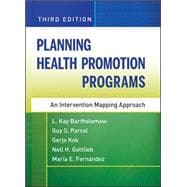
ISBN: 9780470528518 | 0470528516
Edition: 3rd
Format: Hardcover
Publisher: Jossey-Bass
Pub. Date: 1/18/2011

Why Rent from Knetbooks?

Because Knetbooks knows college students. Our rental program is designed to save you time and money. Whether you need a textbook for a semester, quarter or even a summer session, we have an option for you. Simply select a rental period, enter your information and your book will be on its way!

Top 5 reasons to order all your textbooks from Knetbooks:

  • We have the lowest prices on thousands of popular textbooks
  • Free shipping both ways on ALL orders
  • Most orders ship within 48 hours
  • Need your book longer than expected? Extending your rental is simple
  • Our customer support team is always here to help
SummaryTable of ContentsAuthor Biography
Planning Health Promotion ProgramsThis thoroughly revised and updated third edition of Planning Health Promotion Programs provides a powerful, practical resource for the planning and development of health education and health promotion programs.At the heart of the book is a streamlined presentation of Intervention Mapping, a useful tool for the planning and development of effective programs. The steps and tasks of Intervention Mapping offer a framework for making and documenting decisions for influencing change in behavior and environmental con... MORE
... MORE
Figures, Tables, and Exhibits
Preface
Acknowledgments
The Authors
Foundations
Overview of Intervention Mapping
Learning Objectives
Perspectives
The Need for a Framework for Intervention Development
Intervention Mapping Steps
Core Processes for Applying Theory and Evidence
Navigating the Book
Important Repeating Concepts in the Book
Summary
Discussion Questions and Learning Activities
Behavior-Oriented Theories Used in Health Promotion
Learning Objectives
Perspectives
Overview of Theories
Learning Theories
Theories of Information Processing
Health Belief Model (HBM)
Protection-Motivation Theory (PMT) and Extended Parallel Process. Model (EPPM)
Theories of Reasoned Action, Planned Behavior (TPB) and the Integrated Behavioral Model (IBM)
Additional Constructs
Goal-Setting Theory
Theories of Goal-Directed Behavior
Theories of Automatic Behavior, Impulsive Behavior, and Habits
Transtheoretical Model (TTM) of Behavior Change
Precaution-Adoption Process Model (PAPM) and Risk Communication
Attribution Theory and Relapse Prevention
Communication-Persuasion Matrix (CPM)
Elaboration Likelihood Model (ELM)
Theories of Self-Regulation
Social Cognitive Theory (SCT)
Theories of Stigma and Discrimination
Diffusion of Innovations Theory (DIT)
Summary
Discussion Questions and Learning Activities
Environment-Oriented Theories
Learning Objectives
Perspectives
Interpersonal-Level Theories
Organizational-Level Theories
Community-Level Theories
Societal and Governmental Theories
Summary
Discussion Questions and Learning Activities
Intervention Mapping Steps
Intervention Mapping Step 1: Needs Assessment
Learning Objectives
Perspectives
Collaborative Planning
Planning and Conducting the Needs Assessment
Conducting the Needs Assessment
Sources of Needs-Assessment Data
Community Capacity
Setting Goals and Linking to Evaluation
Implications for Evaluation
Summary
Discussion Questions and Learning Activities
Intervention Mapping Step 2: Preparing Matrices of Change. Objectives
Learning Objectives
Perspectives
Behavioral and Environmental Outcomes
Performance Objectives
Personal Determinants
Matrix of Change Objectives
Implications for Program Evaluation
Summary
Discussion Questions and Learning Activities
Intervention Mapping Step 3: Selecting Theory-Informed. Intervention Methods and Practical Applications
Learning Objectives
Perspectives
Ideas About the Program
Identifying Theoretical Methods
Method Selection
From Methods to Applications
Implications for Evaluation
Summary
Discussion Questions and Learning Activities
Intervention Mapping Step 4: Producing Program Components and Materials
Learning Objectives
Perspectives
Designing Culturally Relevant Program Materials
Creating Program Plans and Structure
Producing Program Materials
Initial Design Documents: Conveying the Project Intent
Reviewing Existing Program Materials
Developing Program Materials
Pretesting, Revising and Producing Program Components
Summary
Discussion Questions and Learning Activities
Intervention Mapping Step 5: Planning Program Adoption, Implementation, and Sustainability
Learning Objectives
Perspectives
Planning Group for Program Use
Program Use Outcomes and Performance Objectives for Adoption, Implementation, and Sustainability
Determinants of Program Use
Matrices for Promoting Program Use
Methods and Practical Applications for Program Use
Interventions to Influence Program Use
Implications for Program Evaluation
Summary
Discussion Questions and Learning Activities
Intervention Mapping Step 6: Planning for Evaluation
Learning Objectives
Perspectives
Reviewing the Program Logic Model
Impact on Health, Quality of Life, Behavior, and Environment
Impact on Change Objectives
Program Process
Selecting and Developing Measures
Design Issues
Summary
Discussion Questions and Learning Activities
Using Intervention Mapping to Adapt Evidence-Based Programs to New Settings and Populations
Learning Objectives
Choosing, Adopting, and Adapting Evidence-Based Programs
Perspectives
Applying Intervention Mapping to Adaptation
Lessons Learned from Adaptation Cases
Summary
Discussion Questions and Learning Activities
References
Index
Table of Contents provided by Publisher. All Rights Reserved.

L. Kay Bartholomew, EdD, MPH, is associate professor of health promotion and behavioral sciences and associate dean for academic affairs at the University of Texas School of Public Health.

Guy S. Parcel, PhD, is former dean and professor in health promotion and behavioral science at the University of Texas Health Science Center at Houston, School of Public Health.

Gerjo Kok, PhD, is former dean and professor of applied psychology at the faculty of psychology at Maastricht University, The Netherlands.

Nell H. Gottlieb, PhD, is professor of health education in the department of kinesiology and health education at the University of Texas at Austin.

MarÍa E. Fernández, PhD, is associate professor of health promotion and behavioral sciences and director of diversity programs at the University of Texas Health Science Center at Houston, School of Public Health.


Please wait while this item is added to your cart...