Free Shipping On Every Order



Amazon no longer offers textbook rentals. We do!
Physlet Physics : Interactive Illustrations, Explorations and Problems for Introductory Physics
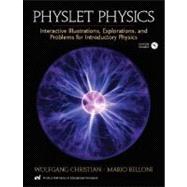
Physlet Physics : Interactive Illustrations, Explorations and Problems for Introductory Physics
- ISBN 13:
9780131019690
- ISBN 10:
0131019694
- Edition: CD
- Format: Paperback
- Copyright: 07/22/2003
- Publisher: Addison-Wesley
 Free Shipping On Every Order
Note: Supplemental materials are not guaranteed with Rental or Used book purchases.
Extend or Purchase Your Rental at Any Time
Need to keep your rental past your due date? At any time before your due date you can extend or purchase your rental through your account.
Summary
By now it is hard to imagine an instructor who has not heard the call to "teach with technology," as it has resounded through educational institutions and government agencies alike over the past several years. However, teaching with technology has often resulted in the use of technology for technology's sake and also often resulted in the development of tools that are not pedagogically sound. For example, consider PowerPoint lectures, which are a popular response to the "teach with technology" push. While PowerPoint lectures are more colorful, they are generally no more interactive than chalkboard lectures. The physics community has, to its credit, worked to use technology in a variety of highly interactive and effective ways including wireless classroom response systems that allow for in-class quizzing of students and MBLs (microcomputer-based laboratories) that free students from the drudgery of data collection so that they can spend more time understanding the underlying physical concepts. Into this we offer Physlet Physics, a collection of ready-to-run interactive computer simulations designed with a sound use of pedagogy in mind. The aim of Physlet Physics is to provide a resource for teaching that enhances student learning and interactive engagement. At the same time, Physlet Physics is a resource flexible enough to be adapted to a variety of pedagogical strategies and local environments.
Content
Physlet Physics contains a collection of exercises spanning the introductory physics sequence. These exercises use computer animations generated in Java applets to show physics content. We call these Java applets Physlets (Physics content simulated with Java applets). Every chapter of Physlet Physics contains three quite different Physlet-based exercises: Illustrations, Explorations, and Problems.
Illustrations are designed to demonstrate physical concepts. Students need to interact with the Physlet, but the answers to the questions posed in the Illustration are given or are easily determined from interacting with it. Many Illustrations provide examples of physics applications. Other Illustrations are designed to introduce a particular concept or analytical tool. Typical uses of Illustrations would include "reading" assignments prior to class and classroom demonstrations.
Explorations are tutorial in nature. They provide some hints or suggest problem-solving strategies to students in working problems or understanding concepts. Some Explorations ask students to make a prediction and then check their predictions, explaining any differences between predictions and observations. Other Explorations require students to change parameters and observe the effect, asking students to develop, for themselves, certain physics relationships (equations). Typical uses of Explorations would be in group problem-solving and homework or pre-laboratory assignments. Explorations are also often useful as Just-In-Time Teaching exercises. To aid in the assignment of the Explorations, Exploration Worksheets are included on the Physlet Physics CD. The Worksheets provide students with extra structure to aid in the completion of the Exploration and provide instructors with an easy way to assign Explorations.
Problems are interactive versions of the kind of exercises typically assigned for homework. They require the students to demonstrate their understanding without as much guidance as is given in the Explorations. They vary widely in difficulty, from exercises appropriate for high school physics students to exercises appropriate for calculus-based university physics students. Some Problems ask conceptual questions, while others require detailed calculations. Typical uses for the Problems would be for homework assignments, in-class concept questions, and group problem-solving sessions.
Conditions of Use
Instructors may not post the exercises from Physlet Physics on the Web without express written permission from the Publisher for the English language and from Wolfgang Christian and Mario Belloni for all other languages. As stated on the Physlets website, Physlets (that is, the applets themselves) are free for noncommercial use. Instructors are encouraged to author and post their own Physlet-based exercises. In doing so, the text and script of Physlets-based exercises must be placed in the public domain for noncommercial use. Please share your work!
Authors who have written Physlet exercises and posted them on the Internet are encouraged to send us a short e-mail with a link to their exercises. Links will be posted on the Physlets page: http://webphysics.davidson.edu/applets/Applets.html .
More details can be found on the Conditions of Use page on the CD.
Web Resources
In addition to the interactive curricular material in this book and CD, instructors may also wish to view the Physlet Physics Instructor's Guide by Anne J. Cox and Melissa H. Dancy. The Physlet Physics Instructor's Guide as well as the Exploration Worksheets by Thomas M. Colbert are available for download from Prentice Hall's Teaching Innovations in Physics, TiP, website.
Instructors can access the official Prentice Hall Web page for Physlet Physics by visiting the TiP website at http://www.prenhall.com/tiponline , then click on the Physlet Physics link.
Before You Start
Assigning Physlet Physics material without properly preparing the class can lead to frustration. Although Physlet problems often appear to be simple, they are usually more challenging than traditional problems because novice solution strategies are often ineffective. In addition, small technical problems are bound to occur without testing. We use Physlets extensively in our introductory courses at Davidson College, but we always start the semester with a short laboratory whose sole purpose is to solve a Physlet problem in the way a physicist solves a problem; that is, to consider the problem conceptually, to decide what method is required and what data to collect, and finally to solve the problem. As a follow-up, we then assign a simple Physlet-based exercise that must be completed in one of the College's public computer clusters. This minimal preparation allows us to identify potential problems before Physlet-based material is assigned on a regular basis.
In response to these possible difficulties, we have written Chapter 1Introduction to Physlets. This chapter provides students and instructors with a guided tutorial through the basic functionality of Physlets. After completing the exercises in Chapter 1, students and instructors alike should be in a position to complete the exercises in the rest of the book.
Before you begin, or assign material to students, you should also read the section on Browser Tests and System Requirements.
Table of Contents
Read moreSupplemental Materials
Read moreExcerpts
Read moreRelated Products