FREE SHIPPING BOTH WAYS
ON EVERY ORDER!
LIST PRICE:
$91.68

OUR PRICE:
$15.74

You may extend rentals at any time.


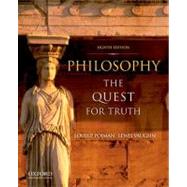
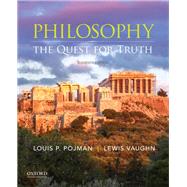
Philosophy : The Quest for Truth

ISBN: 9780199751792 | 019975179X
Edition: 8th
Format: Paperback
Publisher: Oxford University Press, USA
Pub. Date: 12/30/2010

Why Rent from Knetbooks?

Because Knetbooks knows college students. Our rental program is designed to save you time and money. Whether you need a textbook for a semester, quarter or even a summer session, we have an option for you. Simply select a rental period, enter your information and your book will be on its way!

Top 5 reasons to order all your textbooks from Knetbooks:

  • We have the lowest prices on thousands of popular textbooks
  • Free shipping both ways on ALL orders
  • Most orders ship within 48 hours
  • Need your book longer than expected? Extending your rental is simple
  • Our customer support team is always here to help
SummaryTable of ContentsAuthor Biography
Praised for its unique combination of accessibility and comprehensiveness, Philosophy: The Quest for Truth is one of the best-selling textbooks for the introduction to philosophy course. Now in its eighth edition, this acclaimed text provides an excellent selection of eighty-nine classical and contemporary readings on nineteen key problems in philosophy. Coeditors Louis P. Pojman and Lewis Vaughn have carefully organized the essays so that they present pro/con dialogues that allow students to compare and contrast the philosophers' positions. To... MORE

Each part opens with an Introduction and ends with Key Terms (new to this edition) and Suggestions for Further Reading.
*=New to this edition
Preface
* Time Line
I. WHAT IS PHILOSOPHY?
1. Plato: Socratic Wisdom
* 2. Plato: The Allegory of the Cave
3. John Locke: Of Enthusiasm and the Quest for Truth
4. Bertrand Russell: The Value of Philosophy
Excursus: A Little Bit of Logic
Deductive and Inductive R... MORE
Inference to the Best Explanation
* Identifying Arguments
Some Applications
Fallacies of Reasoning
Exercises in Critical Reasoning
Study and Discussion Questions
II. PHILOSOPHY OF RELIGION
II.A. Is Belief in God Rationally Justified? Arguments for the Existence of God
The Cosmological Argument
Pro
5. Thomas Aquinas: The Five Ways
6. William Lane Craig: The Kalam Cosmological Argument and the Anthropic Principle
Contra
7. Paul Edwards: A Critique of the Cosmological Argument
The Teleological Argument
Pro
8. William Paley: The Watch and the Watchmaker
Contra
9. David Hume: A Critique of the Teleological Argument
The Ontological Argument
Pro et Contra
10. St. Anselm and Gaunilo: The Ontological Argument
11. William Rowe: An Analysis of the Ontological Argument
II.B. Why Is There Evil?
12. Fyodor Dostoevsky: Why Is There Evil?
13. B.C. Johnson: Why Doesn't God Intervene to Prevent Evil?
14. John Hick: There Is a Reason Why God Allows Evil
II.C. Is Faith Compatible with Reason?
15. Blaise Pascal: Yes, Faith Is a Logical Bet
16. W.K. Clifford: The Ethics of Belief
17. William James: The Will to Believe
18. Antony Flew, R.M. Hare, and Basil Mitchell: A Debate on the Rationality of Religious Belief
19. Alvin Plantinga: Religious Belief Without Evidence
20. Søren Kierkegaard: Faith and Truth
21. Michael Martin: Holy Spirit Epistemology
22. Bertrand Russell: Can Religion Cure Our Troubles?
III. KNOWLEDGE
III.A. What Can We Know? Classical Theories of Knowledge
23. René Descartes: Cartesian Doubt and the Search for Foundational Knowledge
24. John Locke: The Empiricist Theory of Knowledge
25. George Berkeley: An Idealist Theory of Knowledge
26. David Hume: The Origin of Our Ideas
27. John Hospers: An Argument Against Skepticism
III.B. Truth, Rationality, and Cognitive Relativism
28. Bertrand Russell: The Correspondence Theory of Truth
29. William James: The Pragmatic Theory of Truth
30. Richard Rorty: Dismantling Truth: Solidarity versus Objectivity
31. Daniel Dennett: Postmodernism and Truth
32. Harvey Siegel: Relativism
* III.C. Induction
* 33. David Hume: Skeptical Doubts Concerning the Operations of the Understanding
* 34. Wesley C. Salmon: The Problem of Induction
IV. PHILOSOPHY OF MIND: THE MIND-BODY PROBLEM
IV.A. What Am I? A Mind or a Body?
35. René Descartes: Substance Dualism
36. Gilbert Ryle: Exorcising Descartes' "Ghost in the Machine"
37. J.P. Moreland: A Contemporary Defense of Dualism
38. Paul Churchland: On Functionalism and Materialism
39. Thomas Nagel: What Is It Like to Be a Bat?
40. Jerry A. Fodor: The Mind-Body Problem
41. David Chalmers: Property Dualism
42. John Searle: Minds, Brains, and Computers
* 43. Ned Block: Troubles with Functionalism
IV.B. Who Am I? Do We Have Personal Identity?
44. John Locke: Our Psychological Properties Define the Self
45. David Hume: We Have No Substantial Self with Which We Are Identical
* 46. Buddhist Scripture: Questions to King Milinda
IV.C. Is There Life after Death? Am I Immortal?
47. Plato: Arguments for the Immortality of the Soul
48. Paul Edwards: An Argument Against Survival: The Dependence of Consciousness on the Brain
49. John Hick: In Defense of Immortality
V. FREEDOM OF THE WILL AND DETERMINISM
Contra
50. Baron d'Holbach: We Are Completely Determined
Pro
51. William James: The Dilemma of Determinism
* 52. Peter van Inwagen: The Powers of Rational Beings: Freedom of the Will
53. Roderick M. Chisholm: Human Freedom and the Self
Pro et Contra
54. W.T. Stace: Compatibilism
55. Harry Frankfurt: Freedom of the Will and the Concept of a Person
56. David Hume: Liberty and Necessity
Contra
57. Richard Taylor: Fate
VI. ETHICS
VI.A. Are There Any Moral Absolutes or Is Morality Completely Relative?
58. Ruth Benedict: Morality Is Relative
59. James Rachels: Morality Is Not Relative
VI.B. Ethics and Egoism: Why Should We Be Moral?
60. Plato: Why Should I Be Moral?: Gyges' Ring and Socrates' Dilemma
61. Louis P. Pojman: Egoism and Altruism: A Critique of Ayn Rand
VI.C. Which Is the Correct Ethical Theory?
62. Aristotle: The Ethics of Virtue
* 63. Virginia Held: The Ethics of Care
64. Immanuel Kant: The Moral Law
65. John Stuart Mill: Utilitarianism
66. Jean-Paul Sartre: Existentialist Ethics
67. James Rachels: The Divine Command Theory
VII. POLITICAL PHILOSOPHY
68. Robert Paul Wolff: In Defense of Anarchism
69. Thomas Hobbes: The Absolutist Answer: The Justification of the State Is the Security It Affords
70. John Locke: The Democratic Answer: The Justification of the State Is Its Promotion of Security and Natural Human Rights
71. John Stuart Mill: A Classical Liberal Answer: Government Must Promote Freedom
72. John Rawls: The Contemporary Liberal Answer
VIII. WHAT IS THE MEANING OF LIFE?
73. Epicurus: Moderate Hedonism
74. Epictetus: Stoicism: Enchiridion
75. Albert Camus: Life Is Absurd
* 76. Julian Baggini: Living Life Forwards
77. Louis P. Pojman: Religion Gives Meaning to Life
78. Thomas Nagel: The Absurd
79. Bertrand Russell: Reflections on Suffering
IX. CONTEMPORARY MORAL PROBLEMS
IX.A. Is Abortion Morally Permissible?
Contra
80. Don Marquis: Why Abortion Is Immoral
Pro
81. Mary Anne Warren: On the Moral and Legal Status of Abortion
82. Judith Jarvis Thomson: A Defense of Abortion
Pro et Contra
83. Jane English: The Moderate Position: Beyond the Personhood Argument
IX.B. Is the Death Penalty Morally Permissible?
Pro
84. Burton Leiser: The Death Penalty Is Permissible
Contra
85. Hugo Adam Bedau: No, the Death Penalty Is Not Morally Permissible
IX.C. Do Animals Have Rights?
Pro
86. Peter Singer: The Case for Animal Liberation
Contra
87. Carl Cohen: The Case Against Animal Rights
* IX.D. Do We Have Obligations to the Poor and Hungry?
Pro
* 88. Peter Singer: Famine, Affluence and Morality
Contra
* 89. Garrett Hardin: Living on a Lifeboat
Appendix: How to Read and Write a Philosophy Paper
Glossary

The late Louis P. Pojman was Professor of Philosophy at the United States Military Academy at West Point. He is the author or editor of more than thirty books including Classics of Philosophy, Third Edition (OUP, 2010) and The Moral Life, Fourth Edition (OUP, 2010).

Lewis Vaughn is the author or coauthor of several books, including Contemporary Moral Arguments (OUP, 2010), The Power of Critical Thinking, Third Edition (OUP, 2009), Doing Philosophy, Fourth Edition (2009), Bioethics (OUP, 2008), and Writing Philosophy (OUP, 2005).

Related Products


  • Philosophy : The Quest for Truth
    Philosophy : The Quest for Truth
  • Philosophy : The Quest for Truth
    Philosophy : The Quest for Truth


Please wait while this item is added to your cart...