Free Shipping On Every Order



Amazon no longer offers textbook rentals. We do!
Objects First with Java : A Practical Introduction Using BlueJ
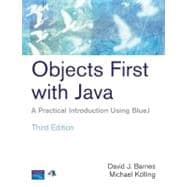
Objects First with Java : A Practical Introduction Using BlueJ
- ISBN 13:
9780131976290
- ISBN 10:
013197629X
- Edition: 3rd
- Format: Paperback w/CD
- Copyright: 01/01/2006
- Publisher: Prentice Hall
- Newer Edition
Rent
Sorry, this item is currently unavailable.
 Free Shipping On Every Order
Note: Supplemental materials are not guaranteed with Rental or Used book purchases.
Extend or Purchase Your Rental at Any Time
Need to keep your rental past your due date? At any time before your due date you can extend or purchase your rental through your account.
Summary
Objects First with Java: A Practical Introduction Using BlueJ Third Edition David J. Barnes Michael Kouml;lling The BlueJ revolution goes on! The third edition of Objects First with Java has been fully updated for Java 5.0, and features a new version of BlueJ providing even stronger support for learning Java syntax and semantics. Hallmark features bull; bull;An 'Objects First' approach encourages students to exploit the power of OOP from the beginning bull;A project-driven approach applies a problem-solving method to real applications. bull;A CD-ROM containing the JDK and versions of BlueJ for a variety of operating systems bull;A Companion Website at www.pearsoned.co.uk/barnes includes a style guide for all program examples, PowerPoint slides and other resources for both students and instructors. bull;Additional resources can be found on the BlueJ website: www.bluej.org/objects-first/ New to the third edition bull; bull;Fully compliant with Java 5.0 features including generics bull;A revised treatment of autobox and enumerators bull;Expanded coverage of graphics and GUI programming bull;A new version of the BlueJ environment, featuring: o Full support for Java 5.0 o An all-new interface 'look and feel' o A new 'Code Pad' feature, allowing immediate execution and evaluation of Java code. About the Authors David Barnes has 25 years experience in teaching programming. He and Michael Kouml;lling both teach introductory Java courses at the Universityof Kent, Canterbury. Michael Kouml;lling was a key member of the team that developed BlueJ at MonashUniversityin Australia. [Copy to appear on inside front cover of 3rd edition] From reviews of the original edition ";The book represents a valuable, new approach to introductory programming; it is still my best choice as textbook for the introductory programming course."; -Michael Caspersen, University of Aarhus, Denmark ";This is the most innovative approach to teaching an Introduction to Programming course I have seen so far."; -Clemens Martin, University of Ontario ";I would like to thank the authors for their good job on this book, and the wonderful BlueJ, the best programming environment for students learning Java."; -Ying Zhou, Rhode Island College The first true 'objects first' introductory text; the best introduction to objects and OO programming concepts I have ever seen."; -Michael Goldweber, XavierUniversity ";The more I read Barnes and Kouml;lling's book, the more impressed I am with it. It is a pedagogical masterpiece."; -Ian Bridgewood, CopenhagenUniversityCollegeof Engineering
Table of Contents
Read moreSupplemental Materials
Read moreRelated Products