FREE SHIPPING BOTH WAYS
ON EVERY ORDER!
LIST PRICE:
$170.67

OUR PRICE:
$36.23

You may extend rentals at any time.


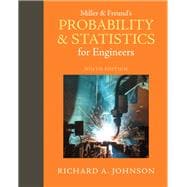
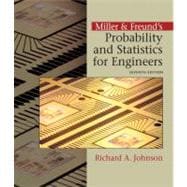
Miller and Freund's Probability and Statistics for Engineers
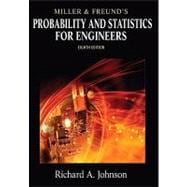
ISBN: 9780321640772 | 0321640772
Edition: 8th
Format: Hardcover
Publisher: Pearson
Pub. Date: 1/3/2010

Why Rent from Knetbooks?

Because Knetbooks knows college students. Our rental program is designed to save you time and money. Whether you need a textbook for a semester, quarter or even a summer session, we have an option for you. Simply select a rental period, enter your information and your book will be on its way!

Top 5 reasons to order all your textbooks from Knetbooks:

  • We have the lowest prices on thousands of popular textbooks
  • Free shipping both ways on ALL orders
  • Most orders ship within 48 hours
  • Need your book longer than expected? Extending your rental is simple
  • Our customer support team is always here to help
SummaryTable of ContentsAuthor Biography
This text is rich in exercises and examples, and explores both elementary probability and basic statistics, with an emphasis on engineering and science applications. Much of the data have been collected from the author's own consulting experience and from discussions with scientists and engineers about the use of statistics in their fields. In later chapters, the book emphasizes designed experiments, especially two-level factorial design.

Normal 0 false false false KEY BENEFIT: This text is rich in exercises and ex... MORE

Preface


1. Introduction

1.1 Why Study Statistics?

1.2 Modern Statistics

1.3 Statistics and Engineering

1.4 The Role of the Scientist and Engineer in Quality Improvement

... MORE

1.6 Two Basic Concepts–Population and Sample


2. Organization and Description of Data

2.1 Pareto Diagrams and Dot Diagrams

2.2 Frequency Distributions

2.3 Graphs of Frequency Distributions

2.4 Stem-and-Leaf Displays

2.5 Descriptive Measures

2.6 Quartiles and Percentiles

2.7 The Calculation of x and s

2.8 A Case Study: Problems with Aggregating Data


3. Probability

3.1 Sample Spaces and Events

3.2 Counting

3.3 Probability

3.4 The Axioms of Probability

3.5 Some Elementary Theorems

3.6 Conditional Probability

3.7 Bayes’ Theorem


4. Probability Distributions

4.1 Random Variables

4.2 The Binomial Distribution

4.3 The Hypergeometric Distribution

4.4 The Mean and the Variance of a Probability Distribution

4.5 Chebyshev’s Theorem

4.6 The Poisson Approximation to the Binomial Distribution

4.7 Poisson Processes

4.8 The Geometric and Negative Binomial Distribution

4.9 The Multinomial Distribution

4.10 Simulation


5. Probability Densities

5.1 Continuous Random Variables

5.2 The Normal Distribution

5.3 The Normal Approximation to the Binomial Distribution

5.4 Other Probability Densities

5.5 The Uniform Distribution

5.6 The Log-Normal Distribution

5.7 The Gamma Distribution

5.8 The Beta Distribution

5.9 The Weibull Distribution

5.10 Joint Distributions–Discrete and Continuous

5.11 Moment Generating Functions

5.12 Checking If the Data Are Normal

5.13 Transforming Observations to Near Normality

5.14 Simulation


6. Sampling Distributions

6.1 Populations and Samples

6.2 The Sampling Distribution of the Mean (σ known)

6.3 The Sampling Distribution of the Mean (σ unknown)

6.4 The Sampling Distribution of the Variance

6.5 Representations of the Normal Theory Distributions

6.6 The Moment Generating Function Method to Obtain Distributions

6.7 Transformation Methods to Obtain Distributions


7. Inferences Concerning a Mean

7.1 Point Estimation

7.2 Interval Estimation

7.3 Maximum Likelihood Estimation

7.4 Tests of Hypotheses

7.5 Null Hypotheses and Tests of Hypotheses

7.6 Hypotheses Concerning One Mean

7.7 The Relation between Tests and Confidence Intervals

7.8 Power, Sample Size, and Operating Characteristic Curves


8. Comparing Two Treatments

8.1 Experimental Designs for Comparing Two Treatments

8.2 Comparisons–Two Independent Large Samples

8.3 Comparisons–Two Independent Small Samples

8.4 Matched Pairs Comparisons

8.5 Design Issues–Randomization and Pairing


9. Inferences Concerning Variances

9.1 The Estimation of Variances

9.2 Hypotheses Concerning One Variance

9.3 Hypotheses Concerning Two Variances


10. Inferences Concerning Proportions

10.1 Estimation of Proportions

10.2 Hypotheses Concerning One Proportion

10.3 Hypotheses Concerning Several Proportions

10.4 Analysis of r x c Tables

10.5 Goodness of Fit


11. Regression Analysis

11.1 The Method of Least Squares

11.2 Inferences Based on the Least Squares Estimators

11.3 Curvilinear Regression

11.4 Multiple Regression

11.5 Checking the Adequacy of the Model

11.6 Correlation

11.7 Multiple Linear Regression (Matrix Notation)


12. Analysis of Variance

12.1 Some General Principles

12.2 Completely Randomized Designs

12.3 Randomized-Block Designs

12.4 Multiple Comparisons

12.5 Analysis of Covariance


13. Factorial Experimentation

13.1 Two-Factor Experiments

13.2 Multifactor Experiments

13.3 2 n Factorial Experiments

13.4 The Graphic Presentation of 22 and 23 Experiments

13.5 Response Surface Analysis

13.6 Confounding in a 2 n Factorial Experiment

13.7 Fractional Replication


14. Nonparametric Tests

14.1 Introduction

14.2 The Sign Test

14.3 Rank-Sum Tests

14.4 Correlation Based on Ranks

14.5 Tests of Randomness

14.6 The Kolmogorov-Smirnov and Anderson-Darling Tests


15. The Statistical Content of Quality-Improvement Programs

15.1 Quality-Improvement Programs

15.2 Starting a Quality-Improvement Program

15.3 Experimental Designs for Quality

15.4 Quality Control

15.5 Control Charts for Measurements

15.6 Control Charts for Attributes

15.7 Tolerance Limits


16. Application to Reliability and Life Testing

16.1 Reliability

16.2 Failure-Time Distribution

16.3 The Exponential Model in Life Testing

16.4 The Weibull Model in Life Testing


Appendix A Bibliography

Appendix B Statistical Tables

Appendix C Using the R Software Program

Appendix D Answers to Odd-Numbered Exercises


Richard Johnson is the co-author of seven statistics texts and monographs, including Probability and Statistics for Engineers and Applied Multivariate Statistical Analysis. He was thefounding editor of Statistics and Probability Letters and served as editor for 25 years.Besides many years of experience in teaching all levels of statistics courses at the University of Wisconsin, he has published more than 120 technical papers concentrating in the areas of reliability and life testing, multivariate analysis, large sample theory, and applications to engineering. Johnson has presented talks on his research in 23 foreign counties. He is an elected member of the International Statistical Institute, a Fellow of the American Statistical Association, a Fellow of theInstitute of Mathematical Statistics, and a Fellow of the Royal Statistical Society.

Related Products


  • Miller and Freund's Probability and Statistics for Engineers
    Miller and Freund's Probabilit...
  • Miller and Freund's Probability and Statistics for Engineers
    Miller and Freund's Probabilit...
  • Miller and Freund's Probability and Statistics for Engineers
    Miller and Freund's Probabilit...
  • Outlines & Highlights for Probability and Statistics for Engineers
    Outlines & Highlights for Prob...
  • Outlines and Highlights for Miller and Freunds Probability and Statistics for Engineers by Richard a Johnson, Isbn : 9780321640772
    Outlines and Highlights for Mi...
  • Outlines and Highlights for Miller and Freunds Probability and Statistics for Engineers by Richard Johnson, Isbn : 9780131437456
    Outlines and Highlights for Mi...


Please wait while this item is added to your cart...