Because Knetbooks knows college students. Our rental program is designed to save you time and money. Whether you need a textbook for a semester, quarter or even a summer session, we have an option for you. Simply select a rental period, enter your information and your book will be on its way!
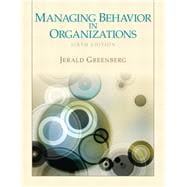
Managing Behavior in Organizations provides a brief tour of the scientific and practical highlights of organizational behavior (OB).
The Field of Organizational Behavior; Organizational Justice, Ethics, and Corporate Social Responsibility; Psychological Processes in Organizations: Personality, Perception, and Learning; Coping with Organizational Life: Emotions and Stress; Work-Related Attitudes: Prejudice, Job Satisfaction, and Organizational Commitment; What Motivates People to Work?; Interpersonal Behavior in the Workplace; ... MORE
MARKET: For readers who have no special background or training in the social sciences to use as a stand-alone guide to the essentials of OB.
In just 14 chapters, Jerald Greenberg offers up-to-date coverage of the major organizational behavior topics!
This new edition of Managing Behavior in Organizations helps students understand organizational behavior, its current theories and their value to modern organizational practice.
Look for these features in the new edition:
-"Making the Case for..." are brief opening cases in each chapter that illustrate the importance of the particular topic in an organization.
-Two new chapters including Chapter 3-"Personality, Feelings, and Stress" and Chapter 6-"Interpersonal Behavior in the Workplace"
-"Winning Practices"is a box included in each chapter that describes how organizational behavior principles were applied in a way that helped an organization improve.
-End of chapter elements including self-assessment exercises, group exercises, and "You Be the Consultant" mini cases.

| Preface | p. xiii |
| Introduction | p. 1 |
| The Field of Organizational Behavior | p. 1 |
| What Is Organizational Behavior and Why Does it Matter? | p. 3 |
| What Are the Field's Fundamental Assumptions? | p. 9 |
| OB Then and Now: A Capsule History of the Field | p. 23 |
| Organizational Justice, Ethics, and Corporate Social Responsibility | p. 33 |
| Organizational Justice: Fairness Matters | ... MOREp. 35 |
| Ethical Behavior in Organizations | p. 44 |
| Beyond Ethics: Corporate Social Responsibility | p. 57 |
| Individual Behavior | p. 65 |
| Psychological Processes in Organizations: Personality, Perception, and Learning | p. 65 |
| Personality: The Unique Differences Between Us | p. 68 |
| Social Perception: Understanding and Judging Others | p. 79 |
| Learning: Adapting to the World of Work | p. 87 |
| Applications of Learning in Organizations | p. 91 |
| Coping with Organizational Life: Emotions and Stress | p. 100 |
| Understanding Emotions and Mood | p. 102 |
| The Role of Emotions and Mood in Organizations | p. 106 |
| Managing Emotions in Organizations | p. 109 |
| The Basic Nature of Stress | p. 114 |
| Major Causes of Stress in the Workplace | p. 120 |
| Major Effects of Organizational Stress | p. 124 |
| Reducing Stress: What Can Be Done? | p. 126 |
| Work-Related Attitudes: Prejudice, Job Satisfaction, and Organizational Commitment | p. 133 |
| Prejudice: Negative Attitudes Toward Others | p. 135 |
| Strategies for Overcoming Workplace Prejudice: Managing a Diverse Workforce | p. 140 |
| Theories of Job Satisfaction: Attitudes Toward Jobs | p. 144 |
| Consequences of Job Dissatisfaction-and Ways to Avoid Them | p. 147 |
| Organizational Commitment: Attitudes Toward Companies | p. 153 |
| What Motivates People to Work? | p. 160 |
| The Basic Nature of Motivation | p. 162 |
| Motivating by Meeting Basic Human Needs | p. 162 |
| Motivating by Being Equitable | p. 166 |
| Expectancy Theory: Believing You Can Get What You Want | p. 171 |
| Goal Setting: Taking Aim at Performance Targets | p. 176 |
| Designing Jobs That Motivate | p. 182 |
| Group Behavior | p. 191 |
| Interpersonal Behavior in the Workplace | p. 191 |
| The Dynamics of Interpersonal Relationships | p. 193 |
| Prosocial Behavior: Helping Others | p. 198 |
| Cooperation: Providing Mutual Assistance | p. 201 |
| Competition: The Opposite of Cooperation | p. 203 |
| Conflict: The Inevitable Result of Incompatible Interests | p. 204 |
| Deviant Organizational Behavior | p. 211 |
| Organizational Communication | p. 221 |
| The Communication Process | p. 223 |
| Communicating With and Without Words: Verbal and Nonverbal Communication | p. 230 |
| Improving Your Communication Skills | p. 235 |
| Group Processes and Work Teams | p. 250 |
| What Is a Group? | p. 252 |
| The Basic Building Blocks of Group Dynamics | p. 253 |
| Individual Performance in Groups | p. 256 |
| Teams: Empowered Work Groups | p. 261 |
| Effective Team Performance | p. 268 |
| How to Develop Successful Teams | p. 271 |
| Making Individual and Group Decisions in Organizations | p. 280 |
| The Fundamental Nature of Decision Making | p. 282 |
| Varieties of Organizational Decisions | p. 285 |
| How Are Individual Decisions Made? | p. 288 |
| The Imperfect Nature of Human Decisions | p. 291 |
| Group Decisions: Do Too Many Cooks Spoil the Broth? | p. 297 |
| Structural Approaches for Improving Group Decisions | p. 301 |
| Computer-Based Approaches to Promoting Effective Decisions | p. 304 |
| The Quest for Leadership | p. 309 |
| What Is Leadership? Some Fundamental Issues | p. 311 |
| The Trait Approach: Are Some People "Born Leaders"? | p. 313 |
| The Behavior Approach: What Do Leaders Do? | p. 319 |
| Contingency Theories of Leader Effectiveness | p. 322 |
| Emerging Trends and Challenges in Leadership Practice | p. 329 |
| Leadership Development: Bringing Out the Leader Within You | p. 333 |
| Organizational Processes | p. 339 |
| Culture, Creativity, and Innovation | p. 339 |
| Organizational Culture: Its Basic Nature | p. 341 |
| The Formation and Maintenance of Organizational Culture | p. 344 |
| Organizational Culture: Its Effects and Capacity to Change | p. 347 |
| Creativity in Individuals and Teams | p. 352 |
| Promoting Creativity in Organizations | p. 355 |
| The Process of Innovation | p. 360 |
| Designing Effective Organizations | p. 369 |
| Structural Dimensions of Organizations | p. 371 |
| Departmentalization: Ways of Structuring Organizations | p. 376 |
| Traditional Organizational Designs | p. 381 |
| Emerging Organizational Designs | p. 386 |
| Interorganizational Designs: Going Beyond the Single Organization | p. 391 |
| Managing Organizational Change: Strategic Planning and Organizational Development | p. 398 |
| Today's First Rule of Business: Change or Disappear! | p. 400 |
| External Forces for Organizational Change | p. 401 |
| Planning Strategic Change | p. 405 |
| Readiness for Change: Accepting and Resisting Organizational Change | p. 410 |
| Organizational Development Interventions: Implementing Planned Change | p. 417 |
| Key Questions About Organizational Development | p. 422 |
| Notes | p. 427 |
| Company Index | p. 461 |
| Name Index | p. 465 |
| Subject Index | p. 467 |
| Table of Contents provided by Ingram. All Rights Reserved. |