FREE SHIPPING BOTH WAYS
ON EVERY ORDER!
LIST PRICE:
$210.13

OUR PRICE:
$166.42

You may extend rentals at any time.


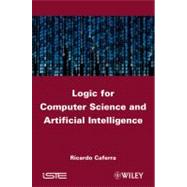
Logic for Computer Science and Artificial Intelligence
ISBN: 9781848213012 | 1848213018
Edition: 1st
Format: Hardcover
Publisher: Wiley-ISTE
Pub. Date: 8/30/2011

Why Rent from Knetbooks?

Because Knetbooks knows college students. Our rental program is designed to save you time and money. Whether you need a textbook for a semester, quarter or even a summer session, we have an option for you. Simply select a rental period, enter your information and your book will be on its way!

Top 5 reasons to order all your textbooks from Knetbooks:

  • We have the lowest prices on thousands of popular textbooks
  • Free shipping both ways on ALL orders
  • Most orders ship within 48 hours
  • Need your book longer than expected? Extending your rental is simple
  • Our customer support team is always here to help
SummaryTable of ContentsAuthor Biography
This book is the result of several years of teaching experience at Grenoble INP (Ensimag). It is essentially self-instruction oriented, but of course can be used in traditional courses. Logic (propositional, first-order, and non-classical) plays a key role in Computer Science and Artificial Intelligence. A huge amount of information exists in different supports (such as books, articles, and web pages), but to avoid becoming lost in these references, the beginner needs a unified, synthetic approach. Such an approach is followed throughout the bo... MORE
Prefacep. xi
Introductionp. 1
Logic, foundations of computer science, and applications of logic to computer sciencep. 1
On the utility of logic for computer engineersp. 3
A Few Thoughts Before the Formalizationp. 7
What is logic?p. 7
Logic and paradoxesp. 8
Paradoxes and set theoryp. 9
The answerp. 10
... MOREp. 13
The halting problemp. 13
On formalisms and well-known notionsp. 15
Some "well-known" notions that could turn out to be difficult to analyzep. 19
Back to the definition of logicp. 23
Some definitions of logic for allp. 24
A few more technical definitionsp. 24
Theory and meta-theory (language and meta-language)p. 30
A few thoughts about logic and computer sciencep. 30
Some historic landmarksp. 32
Propositional Logicp. 39
Syntax and semanticsp. 40
Language and meta-languagep. 43
Transformation rules for cnf and dnfp. 49
The method of semantic tableauxp. 54
A slightly different formalism: signed tableauxp. 58
Formal systemsp. 64
A capital notion: the notion of proofp. 64
What do we learn from the way we do mathematics?p. 72
A formal system for PL (PC)p. 78
Some properties of formal systemsp. 84
Another formal system for PL (PC)p. 86
Another formal systemp. 86
The method of Davis and Putnamp. 92
The Davis-Putnam method and the SAT problemp. 95
Semantic trees in PLp. 96
The resolution method in PLp. 101
Problems, strategies, and statementsp. 109
Strategiesp. 110
Horn clausesp. 113
Algebraic point of view of propositional logicp. 114
First-order Termsp. 121
Matching and unificationp. 121
A motivation for searching for a matching algorithmp. 121
A classification of treesp. 123
First-order terms, substitutions, unificationp. 125
First-Order Logic (FOL) or Predicate Logic (PL1, PC1)p. 131
Syntaxp. 133
Semanticsp. 137
The notions of truth and satisfactionp. 139
A variant: multi-sorted structuresp. 150
Expressive power, sort reductionp. 150
Theories and their modelsp. 152
How can we reason in FOL?p. 153
Semantic tableaux in FOLp. 154
Unification in the method of semantic tableauxp. 166
Toward a semi-decision procedure for FOLp. 169
Prenex normal formp. 169
Skolemizationp. 174
Skolem normal formp. 176
Semantic trees in FOLp. 186
Skolemization and clausal formp. 188
The resolution method in FOLp. 190
Variables must be renamedp. 201
A decidable class: the monadic classp. 202
Some decidable classesp. 205
Limits: Gödel's (first) incompleteness theoremp. 206
Foundations of Logic Programmingp. 213
Specifications and programmingp. 213
Toward a logic programming languagep. 219
Logic programming: examplesp. 222
Acting on the execution control: cut"/"p. 229
Translation of imperative structuresp. 231
Negation as failure (NAF)p. 232
Some remarks about the strategy used by LP and negation as failurep. 238
Can we simply deduce instead of using NAF?p. 239
Computability and Horn clausesp. 241
Artificial Intelligencep. 245
Intelligent systems: AIp. 245
What approaches to study AI?p. 249
Toward an operational definition of intelligencep. 249
The imitation game proposed by Turingp. 250
Can we identify human intelligence with mechanical intelligence?p. 251
Chinese room argumentp. 252
Some historyp. 254
Prehistoryp. 254
Historyp. 255
Some undisputed themes in AIp. 256
Inferencep. 259
Deductive inferencep. 260
An important concept: clause subsumptionp. 266
An important problemp. 268
Abductionp. 273
Discovery of explanatory theoriesp. 274
Required conditionsp. 275
Inductive inferencep. 278
Deductive inferencep. 279
Inductive inferencep. 280
Hempel's paradox (1945)p. 280
Generalization: the generation of inductive hypothesesp. 284
Generalization from examples and counter examplesp. 288
Problem Specification in Logical Languagesp. 291
Equalityp. 291
When is it used?p. 292
Some questions about equalityp. 292
Why is equality needed?p. 293
Whatis equality?p. 293
How to reason with equality?p. 295
Specification without equalityp. 296
Axiomatization of equalityp. 297
Adding the definition of = and using the resolution methodp. 297
By adding specialized rules to the method of semantic tableauxp. 299
By adding specialized rules to resolutionp. 300
Paramodulation and demodulationp. 300
Constraintsp. 309
Second Order Logic (SOL): a few notionsp. 319
Syntax and semanticsp. 324
Vocabularyp. 324
Syntaxp. 325
Semanticsp. 325
Non-classical Logicsp. 327
Many-valued logicsp. 327
How to reason with p-valued logics?p. 334
Semantic tableaux for p-valued logicsp. 334
Inaccurate concepts: fuzzy logicp. 337
Inference in FLp. 348
Syntaxp. 349
Semanticsp. 349
Herbrand's method in FLp. 350
Resolution andFLp. 351
Modal logicsp. 353
Toward a semanticsp. 355
Syntax (language of modal logic)p. 357
Semanticsp. 358
How to reason with modallogics?p. 360
Formal systems approachp. 360
Translation approachp. 361
Some elements of temporal logicp. 371
Temporal operators and semanticsp. 374
A famous argumentp. 375
A temporal logicp. 377
How to reason with temporal logics?p. 378
The method of semantic tableauxp. 379
An example of a PL for linear and discrete time; PTL (or PLTL)p. 381
Syntaxp. 331
Semanticsp. 382
Method of semantic tableaux for PLTL (direct method)p. 333
Knowledge and Logic: Some Notionsp. 385
What is knowledge?p. 335
Knowledge and modal logicp. 389
Toward a formalizationp. 389
Syntaxp. 339
What expressive power? An examplep. 389
Semanticsp. 339
New modal operatorsp. 391
Syntax (extension)p. 391
Semantics (extension)p. 391
Application examplesp. 392
Modeling the muddy children puzzlep. 392
Corresponding Kripke worldsp. 392
Properties of the (formalization chosen for the) knowledgep. 394
Solutions to the Exercisesp. 395
Bibliographyp. 515
Indexp. 517
Table of Contents provided by Ingram. All Rights Reserved.
Ricardo Caferra has been involved in teaching and research in Computational Logic and Artificial intelligence for many years. He has published several works in both domains, particularly on some non-standard features of automated deduction.


Please wait while this item is added to your cart...

