FREE SHIPPING BOTH WAYS
ON EVERY ORDER!
LIST PRICE:
$98.50

Sorry, this item is currently unavailable.

The Limits of Consent; A socio-ethical approach to human subject research in medicine
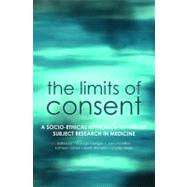
ISBN: 9780199231461 | 019923146X
Edition: 1st
Format: Hardcover
Publisher: Oxford University Press, USA
Pub. Date: 3/25/2009

Why Rent from Knetbooks?

Because Knetbooks knows college students. Our rental program is designed to save you time and money. Whether you need a textbook for a semester, quarter or even a summer session, we have an option for you. Simply select a rental period, enter your information and your book will be on its way!

Top 5 reasons to order all your textbooks from Knetbooks:

  • We have the lowest prices on thousands of popular textbooks
  • Free shipping both ways on ALL orders
  • Most orders ship within 48 hours
  • Need your book longer than expected? Extending your rental is simple
  • Our customer support team is always here to help
SummaryTable of ContentsAuthor Biography
Since its inception as an international requirement to protect patients and healthy volunteers taking part in medical research, informed consent has become the primary consideration in research ethics. Despite the ubiquity of consent, however, scholars have begun to question its adequacy for contemporary biomedical research.

Informed consent developed as an international principle to protect the welfare of patients and volunteers taking part in medical research. This book examines the inadequacies of consent for co... MORE
Contributorsp. xi
Introductionp. 1
Informed consent in medical research - a procedure stretched beyond breaking point?p. 11
Trust and exploitation in clinical researchp. 25
Consent and private liability in clinical researchp. 39
The decision to decline to enrol in a clinical trial: a blind spot in the literature on decision-making for research participationp. 57
Beyond a rebar... MOREp. 79
The normative status of the requirement to gain an informed consent in clinical trials: comprehension, obligations, and empirical evidencep. 99
Is there an obligation to participate in medical research?p. 115
Consenting older adults: research as a virtuous relationshipp. 133
Towards supported decision-making in biomedical research with cognitively vulnerable adultsp. 151
Is consent sufficient? A case study of qualitative research with men with intellectual disabilitiesp. 171
Consent to genetic testing: a family affair?p. 185
Cultural authority of informed consent: indigenous participation in biobanking and salmon genomics focus groupsp. 199
Consent and beyond: some conclusionsp. 213
Indexp. 229
Table of Contents provided by Ingram. All Rights Reserved.

Oonagh Corrigan's areas of research include informed consent, clinical trials, genetics and medical education. In 2007 she held a Leverhulme Trust visiting abroad fellowship at the University of British Columbia, and has previously held lectureship positions in Sociology at the Universities of Cambridge and Plymouth. She is editor of the journal Medical Studies. Dr Kathy Liddell is a Lecturer in Law at the University of Cambridge and a Fellow of Downing College. She teaches intellectual property, medical law and ethics, and torts, which complements her research on the regulatory frameworks that govern and provide incentives for medical research. She studied law and science at the University of Melbourne, bioethics at Monash University and completed her doctorate of law at the University of Oxford. She is Deputy Director of the Law Faculty's Centre for Intellectual Property and Information Law.
John McMillan is responsible for designing and teaching the ethics curriculum at the Hull Yok Medical School. Prior to this appointment he held posts at the Universities of Cambridge, Oxford and Otago where he taught ethics to philosophy and medical students. He is a program director for the Institute of Applied Ethics at the University of Hull. Martin Richards is Leverhulme Emeritus Fellow at the University of Cambridge. Until his retirement in 2005 he was Director of the Centre for Family Research at Cambridge University, which he founded in 1968. His current research concerns genetic and reproductive technologies and family life. He is Vice Chair of the UK Biobank Ethics and Governance Council and a member of the Law and Ethics Committee of the Human Fertilisation and Embryology Authority. He was a member of the Human Genetics Commission (1998-2005) and has served on working parties of the Nuffield Council on Bioethics. Charles Weijer is a leading authority on research ethics. He is a philosopher and physician and holds the Canada Research Chair in Bioethics at the University of Western Ontario. His research, immediately recognizable for its relevance to important social issues and philosophical rigor, has broadly influenced scholarly discourse and the practice of clinical research. Especially influential is his work on the ethics of benefits and harms in research, research in developing countries, and research involving communities. He served as a consultant to the Joint United Nations Programme on HIV/AIDS, the US Institute of Medicine, President Clinton's National Bioethics Advisory Commission, the World Health Organization, and the World Medical Association. Dr Weijer was elected a Fellow of the Hastings Center (2002), Fellow of the Royal College of Physicians and Surgeons of Canada (2002), Fellow of the American College of Physicians (2007), and Fellow of the Canadian Academy of Health Sciences (2007).


Please wait while this item is added to your cart...

