FREE SHIPPING BOTH WAYS
ON EVERY ORDER!
LIST PRICE:
$88.00

OUR PRICE:
$24.81

You may extend rentals at any time.


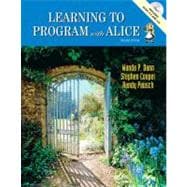
Learning to Program with Alice (w/ CD ROM)
ISBN: 9780132122474 | 0132122472
Edition: 3rd
Format: Paperback
Publisher: Prentice Hall
Pub. Date: 2/25/2011

Why Rent from Knetbooks?

Because Knetbooks knows college students. Our rental program is designed to save you time and money. Whether you need a textbook for a semester, quarter or even a summer session, we have an option for you. Simply select a rental period, enter your information and your book will be on its way!

Top 5 reasons to order all your textbooks from Knetbooks:

  • We have the lowest prices on thousands of popular textbooks
  • Free shipping both ways on ALL orders
  • Most orders ship within 48 hours
  • Need your book longer than expected? Extending your rental is simple
  • Our customer support team is always here to help
SummaryTable of ContentsAuthor Biography
Learning to Program with Alice, 3e is appropriate for all one-semester pre-CS1 and computer literacy courses, and for integration into the first weeks of many introductory CS1 courses.Alice was designed to make programming concepts easier to teach and learn. in the Third Edition of Learning to Program with Alice, Alice's creators offer a complete full-color introduction To The interactive Alice 2.2 programming environment. the authors make extensive use of program visualization to establish an easy, intuitive relationship between program constr... MORE

Foreword xi

Preface xiii

Acknowledgments xxi

About the Authors xxiii


Part I: Introduction to Alice 1


1 Getting Started with Alice 3

... MORE

1-2 Alice Concepts 8

  Tips & Techniques 1: Special Effects: Text and 2D Graphic Images 15

  Summary 18

  Exercises 19

2 Program Design and Implementation 22

2-1 Scenarios and Storyboards 22

2-2 A First Program 29

  Tips & Techniques 2: Orientation and Movement Instructions 43

  Summary 57

  Exercises 59

3 Programming: Putting Together the Pieces 62

3-1 Built-in Functions and Expressions 63

3-2 Simple Control Structures 68

  Tips & Techniques 3: Camera and Animation Controls 76

  Summary 81

  Exercises 83


Part II: Object-Oriented and Event-Driven Programming

Concepts 87


4 Classes, Objects, Methods and Parameters 89

4-1 World-Level Methods 91

4-2 Parameters 100

4-3 Object-Level Methods and Inheritance 110

  Tips & Techniques 4: Visible and Invisible Objects 121

  Summary 127

  Exercises and Projects 129

5 Interaction: Events and Event Handling 140

5-1 Interactive Programming 140

5-2 Parameters and Event Handling Methods 147

  Tips & Techniques 5: Creating Your Own People Models 156

  Summary 158

  Exercises and Projects 159


Part III: Using Functions and Control Statements 171


6 Functions and If/Else 173

6-1 Functions 173

6-2 Execution Control with If/Else and Boolean Functions 180

  Tips & Techniques 6: Random Numbers and Random Motion 196

  Summary 199

  Exercises and Projects 201

7 Repetition: Definite and Conditional Loops 213

7-1 Loops 213

7-2 While—a Conditional Loop 219

  Tips & Techniques 7: Events and Repetition 225

  Summary 228

  Exercises and Projects 229

8 Repetition: Recursion 239

8-1 Introduction to Recursion 239

8-2 Another Flavor of Recursion 244

  Tips & Techniques 8: Engineering Look and Feel 254

  Summary 257

  Exercises and Projects 258


Part IV: Advanced Topics 265


9 Lists and List Processing 267

9-1 Lists 267

9-2 List Search 273

  Tips & Techniques 9: Groups 277

  Summary 279

  Exercises and Projects 280

10 Variables and Revisiting Inheritance 289

10-1 Variables 289

10-2 An Array Visualization Using an Index Variable 300

  Tips & Techniques 10: Debugging with Watch and Text Output 308

  Summary 312

  Exercises and Projects 313

11 What’s Next? 322

11-1 Transition to Java 322

11-2 Alice 3 327

  Tips & Techniques 11: Poses 328


Appendix A: Using Alice 331

Part 1: Running Virtual Worlds in Alice 331

Part 2: Using Popup Menus to Create an Initial Scene 345

Appendix B: Managing the Alice Interface 350


Index 363

Wanda Dann is the Director of the Alice Project and Associate Teaching Professor of Computer Science at Carnegie Mellon University. Her research has encompassed program visualization and object-oriented and event-driven programming. She has published papers on the use of program visualization in computer science education for SIGCSE, the Computer Science Education Journal, and related publications. She has been co-PI for three NSF-funded projects. She is an active member of the ITiCSE Visualization Working Group, studying the effectiveness of visualization in computer science education. She has taken on a major leadership role in the international computer science education community, serving as SIGCSE 2004 Program co-Chair and SIGCSE 2005 Symposium co-Chair.

Stephen Cooper is an Associate Professor of Computer Science and the Director for the Center for Visualization at Saint Joseph's University.¿He taught previously at Rivier College, serving as Computer Science program director. He has also worked at IBM as a systems programmer. Dr. Cooper's research interests lie in the semantics of programming languages as well as in program visualization. He is the author or co-author of a dozen articles, and has been the principal investigator for several National Science Foundation and private grants.

¿

Randy Pausch was a Professor of Computer Science, Human-Computer Interaction and Design at Carnegie Mellon, and co-founder of the Entertainment Technology Center. He also served as the Director of Carnegie Mellon's Alice research group, where he oversaw the development of Alice. He was a National Science Foundation Presidential Young Investigator and a Lilly Foundation Teaching Fellow. In 1995, he spent a Sabbatical with the Walt Disney Imagineering Virtual Reality Studio and consulted with Imagineering on interactive theme park attractions, particularly for the "DisneyQuest" virtual-reality based theme park. Dr. Pausch authored or co-authored five books and over 60 reviewed journal and conference proceedings articles, and his primary interests were human-computer interaction, entertainment technology and undergraduate education.

Related Products


  • Learning to Program with Alice Beta Version
    Learning to Program with Alice...
  • Learning to Program with Alice
    Learning to Program with Alice
  • Learning To Program with Alice
    Learning To Program with Alice


Please wait while this item is added to your cart...