FREE SHIPPING BOTH WAYS
ON EVERY ORDER!
LIST PRICE:
$92.67

Sorry, this item is currently unavailable.

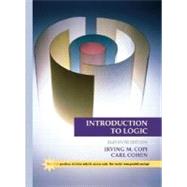
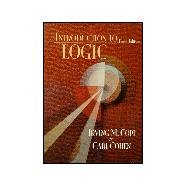
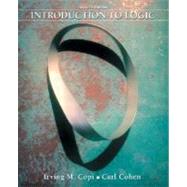
Introduction to Logic

ISBN: 9780130337351 | 0130337358
Edition: 11th
Format: Hardcover
Publisher: Prentice Hall
Pub. Date: 1/1/2002

Why Rent from Knetbooks?

Because Knetbooks knows college students. Our rental program is designed to save you time and money. Whether you need a textbook for a semester, quarter or even a summer session, we have an option for you. Simply select a rental period, enter your information and your book will be on its way!

Top 5 reasons to order all your textbooks from Knetbooks:

  • We have the lowest prices on thousands of popular textbooks
  • Free shipping both ways on ALL orders
  • Most orders ship within 48 hours
  • Need your book longer than expected? Extending your rental is simple
  • Our customer support team is always here to help
SummaryTable of Contents
For an undergraduate-level course in Introduction to Logic.This is the most complete and authoritative treatment of introductory logic both deductive and inductive, classical and modern prepares students to understand, recognize, and apply classical syllogistic logic and the more powerful techniques of modern symbolic logic. It explains all concepts and techniques clearly, accurately, and thoroughly, bringing them to life using a wealth of real-life examples of lively arguments and explanations.Free interactive online tutorial!Each text includes a free access code for eLOGIC a dynamic, interactive online tutorial program. New to this edition, this tutorial program combines a concise version of the text with animated examples, practice exercises, all text exercises, and a dynamic "logic toolkit" which enables students to solve logic problems.
I. LOGIC AND LANGUAGE.

1. Basic Logical Concepts.
What Logic Is. Propositions and Sentences. Arguments, Premisses, and Conclusions. Analyzing Arguments. Recognizing Arguments. Arguments and Explanations. Deduction and Validity. Induction and Probability. Validity and Truth. Complex Argumentative Passages. Reasoning.

2. The Uses of Language.
Three Basic Functions of Langua... MORE

3. Definition.
Disputes, Verbal Disputes, and Definitions. Kinds of Definition and the Resolution of Disputes. Extension and Intension. Extensional Definitions. Intensional Definitions. Rules for Definition by Genus and Difference.

4. Fallacies.
What Is a Fallacy? Fallacies of Relevance. Fallacies of Presumption. Fallacies of Ambiguity.

II. DEDUCTION.

5. Categorical Propositions.
The Theory of Deduction. Categorical Propositions and Classes. Quality, Quantity, and Distribution. The Traditional Square of Opposition. Further Immediate Inferences. Existential Import and the Interpretation of Categorical Propositions. Symbolism and Diagrams for Categorical Propositions.

6. Categorical Syllogisms.
Standard-Form Categorical Syllogisms. The Formal Nature of Syllogistic Argument. Venn Diagram Technique for Testing Syllogisms. Syllogistic Rules and Syllogistic Fallacies. Exposition of the 15 Valid Forms of the Categorical Syllogism. Deduction of the 15 Valid Forms of the Categorical Syllogism.

7. Arguments in Ordinary Language.
Syllogistic Arguments in Ordinary Language. Reducing the Number of Terms in a Syllogistic Argument. Translating Categorical Propositions into Standard Form. Uniform Translation. Enthymemes. Sorites. Disjunctive and Hypothetical Syllogisms. The Dilemma.

8. Symbolic Logic.
The Symbolic Language of Modern Logic. The Symbols for Conjunction, Negation, and Disjunction. Conditional Statements and Material Implication. Argument Forms and Arguments. Statement Forms and Material Equivalence. Logical Equivalence. The Paradoxes of Material Implication. The Three “Laws of Thought.”

9. The Method of Deduction.
Formal Proof of Validity. The Rule of Replacement. Proof of Invalidity. Inconsistency.

10. Quantification Theory.
Singular Propositions. Quantification. Traditional Subject-Predicate Propositions. Proving Validity. Proving Invalidity. Asyllogistic Inference.

III. INDUCTION.

11. Analogy and Probable Inference.
Argument by Analogy. Appraising Analogical Arguments. Refutation by Logical Analogy.

12. Causal Connections: Mill's Methods of Experimental Inquiry.
Cause and Effect. Mill's Methods. Critique of Mill's Methods.

13. Science and Hypothesis.
The Values of Science. Explanations: Scientific and Unscientific. Evaluating Scientific Explanations. Seven Stages of Scientific Investigation. Scientists in Action: The Pattern of Scientific Investigation. Crucial Experiments and Ad Hoc Hypotheses. Classification as Hypothesis.

14. Probability.
Alternative Conceptions of Probability. The Probability Calculus. Probability of Joint Occurrences. Probability of Alternative Occurrences. Expected Value.

Solutions to Selected Exercises.
Special Symbols.
Glossary/Index.

Related Products


  • INTRO TO LOGIC & ELOGIC EXERCISES CD PKG, 12/e
    INTRO TO LOGIC & ELOGIC EXERCI...
  • Introduction to Logic
    Introduction to Logic
  • Introduction to Logic
    Introduction to Logic
  • Introduction to Logic
    Introduction to Logic
  • Introduction to Logic
    Introduction to Logic
  • Introduction to Logic
    Introduction to Logic
  • MyLogicLab Pegasus Student Access Code Card for Introduction to Logic (standalone)
    MyLogicLab Pegasus Student Acc...
  • Outlines and Highlights for Introduction to Logic - Text Only by Irving M Copi, Isbn : 9780136141396
    Outlines and Highlights for In...


Please wait while this item is added to your cart...