FREE SHIPPING BOTH WAYS
ON EVERY ORDER!
LIST PRICE:
$190.00

OUR PRICE:
$38.00

You may extend rentals at any time.


Introduction to Finite Elements in Engineering
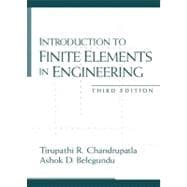
ISBN: 9780130615916 | 0130615919
Edition: 3rd
Format: Hardcover
Publisher: Prentice Hall
Pub. Date: 1/1/2002

Why Rent from Knetbooks?

Because Knetbooks knows college students. Our rental program is designed to save you time and money. Whether you need a textbook for a semester, quarter or even a summer session, we have an option for you. Simply select a rental period, enter your information and your book will be on its way!

Top 5 reasons to order all your textbooks from Knetbooks:

  • We have the lowest prices on thousands of popular textbooks
  • Free shipping both ways on ALL orders
  • Most orders ship within 48 hours
  • Need your book longer than expected? Extending your rental is simple
  • Our customer support team is always here to help
SummaryTable of Contents
For senior undergraduate and first-year graduate students and also as a learning resource to practicing engineers. This book provides an integrated approach to finite element methodologies. The development of finite element theory is combined with examples and exercises involving engineering applications. The steps used in the development of the theory are implemented in complete, self-contained computer programs. While the strategy and philosophy of the previous editions has been retained, the Third Edition has been updated and improved to inc... MORE
Prefacexv
Fundamental Concepts
1(21)
Introduction
1(1)
... MORE
Historical Background
1(1)
Outline of Presentation
2(1)
Stresses and Equilibrium
2(2)
Boundary Conditions
4(1)
Strain-Displacement Relations
4(2)
Stress-Strain Relations
6(2)
Special Cases
7(1)
Temperature Effects
8(1)
Potential Energy and Equilibrium; The Rayleigh-Ritz Method
9(4)
Potential Energy II
9(2)
Rayleigh-Ritz Method
11(2)
Galerkin's Method
13(3)
Saint Venant's Principle
16(1)
Von Mises Stress
17(1)
Computer Programs
17(1)
Conclusion
18(4)
Historical References
18(1)
Problems
18(4)
Matrix Algebra and Gaussian Elimination
22(23)
Matrix Algebra
22(7)
Row and Column Vectors
23(1)
Addition and Subtraction
23(1)
Multiplication by a Scalar
23(1)
Matrix Multiplication
23(1)
Transposition
24(1)
Differentiation and Integration
24(1)
Square Matrix
25(1)
Diagonal Matrix
25(1)
Identity Matrix
25(1)
Symmetric Matrix
25(1)
Upper Triangular Matrix
26(1)
Determinant of a Matrix
26(1)
Matrix Inversion
26(1)
Eigenvalues and Eigenvectors
27(1)
Positive Definite Matrix
28(1)
Cholesky Decomposition
29(1)
Gaussian Elimination
29(10)
General Algorithm for Gaussian Elimination
30(3)
Symmetric Matrix
33(1)
Symmetric Banded Matrices
33(2)
Solution with Multiple Right Sides
35(1)
Gaussian Elimination with Column Reduction
36(2)
Skyline Solution
38(1)
Frontal Solution
39(1)
Conjugate Gradient Method for Equation Solving
39(6)
Conjugate Gradient Algorithm
40(1)
Problems
41(2)
Program Listings
43(2)
One-Dimensional Problems
45(58)
Introduction
45(1)
Finite Element Modeling
46(2)
Element Division
46(1)
Numbering Scheme
47(1)
Coordinates and Shape Functions
48(4)
The Potential-Energy Approach
52(4)
Element Stiffness Matrix
53(1)
Force Terms
54(2)
The Galerkin Approach
56(2)
Element Stiffness
56(1)
Force Terms
57(1)
Assembly of the Global Stiffness Matrix and Load Vector
58(3)
Properties of K
61(1)
The Finite Element Equations; Treatment of Boundary Conditions
62(16)
Types of Boundary Conditions
62(1)
Elimination Approach
63(6)
Penalty Approach
69(5)
Multipoint Constraints
74(4)
Quadratic Shape Functions
78(6)
Temperature Effects
84(19)
Input Data File
88(1)
Problems
88(10)
Program Listing
98(5)
Trusses
103(27)
Introduction
103(1)
Plane Trusses
104(10)
Local and Global Coordinate Systems
104(1)
Formulas for Calculating l and m
105(1)
Element Stiffness Matrix
106(1)
Stress Calculations
107(4)
Temperature Effects
111(3)
Three-Dimensional Trusses
114(2)
Assembly of Global Stiffness Matrix for the Banded and Skyline Solutions
116(14)
Assembly for Banded Solution
116(3)
Input Data File
119(1)
Problems
120(8)
Program Listing
128(2)
Two-Dimensional Problems Using Constant Strain Triangles
130(48)
Introduction
130(1)
Finite Element Modeling
131(2)
Constant-Strain Triangle (CST)
133(19)
Isoparametric Representation
135(4)
Potential-Energy Approach
139(1)
Element Stiffness
140(1)
Force Terms
141(5)
Galerkin Approach
146(2)
Stress Calculations
148(2)
Temperature Effects
150(2)
Problem Modeling and Boundary Conditions
152(2)
Some General Comments on Dividing into Elements
154(1)
Orthotropic Materials
154(24)
Temperature Effects
157(3)
Input Data File
160(2)
Problems
162(12)
Program Listing
174(4)
Axisymmetric Solids Subjected to Axisymmetric Loading
178(30)
Introduction
178(1)
Axisymmetric Formulation
179(2)
Finite Element Modeling: Triangular Element
181(10)
Potential-Energy Approach
183(1)
Body Force Term
184(1)
Rotating Flywheel
185(1)
Surface Traction
185(2)
Galerkin Approach
187(3)
Stress Calculations
190(1)
Temperature Effects
191(1)
Problem Modeling and Boundary Conditions
191(17)
Cylinder Subjected to Internal Pressure
191(1)
Infinite Cylinder
192(1)
Press Fit on a Rigid Shaft
192(1)
Press Fit on an Elastic Shaft
193(1)
Belleville Spring
194(1)
Thermal Stress Problem
195(2)
Input Data File
197(1)
Problems
198(7)
Program Listing
205(3)
Two-Dimensional Isoparametric Elements and Numerical Integration
208(29)
Introduction
208(1)
The Four-Node Quadrilateral
208(6)
Shape Functions
208(3)
Element Stiffness Matrix
211(2)
Element Force Vectors
213(1)
Numerical Integration
214(6)
Two-Dimensional Integrals
217(1)
Stiffness Integration
217(1)
Stress Calculations
218(2)
Higher Order Elements
220(5)
Nine-Node Quadrilateral
220(2)
Eight-Node Quadrilateral
222(1)
Six-Node Triangle
223(2)
Four-Node Quadrilateral for Axisymmetric Problems
225(1)
Conjugate Gradient Implementation of the Quadrilateral Element
226(11)
Concluding Note
227(1)
Input Data File
228(2)
Problems
230(3)
Program Listings
233(4)
Beams and Frames
237(38)
Introduction
237(3)
Potential-Energy Approach
238(1)
Galerkin Approach
239(1)
Finite Element Formulation
240(3)
Load Vector
243(1)
Boundary Considerations
244(1)
Shear Force and Bending Moment
245(2)
Beams on Elastic Supports
247(1)
Plane Frames
248(5)
Three-Dimensional Frames
253(4)
Some Comments
257(18)
Input Data File
258(3)
Problems
261(6)
Program Listings
267(8)
Three-Dimensional Problems in Stress Analysis
275(31)
Introduction
275(1)
Finite Element Formulation
276(4)
Element Stiffness
279(1)
Force Terms
280(1)
Stress Calculations
280(1)
Mesh Preparation
281(4)
Hexahedral Elements and Higher Order Elements
285(2)
Problem Modeling
287(2)
Frontal Method for Finite Element Matrices
289(17)
Connectivity and Prefront Routine
290(1)
Element Assembly and Consideration of Specified dof
290(1)
Elimination of Completed dof
291(1)
Backsubstitution
291(1)
Consideration of Multipoint Constraints
291(1)
Input Data File
292(1)
Problems
293(4)
Program Listings
297(9)
Scalar Field Problems
306(61)
Introduction
306(2)
Steady State Heat Transfer
308(23)
One-Dimensional Heat Conduction
309(7)
One-Dimensional Heat Transfer in Thin Fins
316(4)
Two-Dimensional Steady-State Heat Conduction
320(9)
Two-Dimensional Fins
329(1)
Preprocessing for Program Heat2D
330(1)
Torsion
331(5)
Triangular Element
332(1)
Galerkin Approach
333(3)
Potential Flow, Seepage, Electric and Magnetic Fields, and Fluid Flow in Ducts
336(12)
Potential Flow
336(2)
Seepage
338(1)
Electrical and Magnetic Field Problems
339(2)
Fluid Flow in Ducts
341(2)
Acoustics
343(1)
Boundary Conditions
344(1)
One-Dimensional Acoustics
344(1)
1-D Axial Vibrations
345(3)
Two-Dimensional Acoustics
348(1)
Conclusion
348(19)
Input Data File
349(1)
Problems
350(11)
Program Listings
361(6)
Dynamic Considerations
367(44)
Introduction
367(1)
Formulation
367(3)
Solid Body with Distributed Mass
368(2)
Element Mass Matrices
370(5)
Evaluation of Eigenvalues and Eigenvectors
375(16)
Properties of Eigenvectors
376(1)
Eigenvalue-Eigenvector Evaluation
376(6)
Generalized Jacobi Method
382(4)
Tridiagonalization and Implicit Shift Approach
386(1)
Bringing Generalized Problem to Standard Form
386(1)
Tridiagonalization
387(3)
Implicit Symmetric QR Step with Wilkinson Shift for Diagonalization
390(1)
Interfacing with Previous Finite Element Programs and a Program for Determining Critical Speeds of Shafts
391(1)
Guyan Reduction
392(2)
Rigid Body Modes
394(2)
Conclusion
396(15)
Input Data File
397(2)
Problems
399(5)
Program Listings
404(7)
Preprocessing and Postprocessing
411(29)
Introduction
411(1)
Mesh Generation
411(8)
Region and Block Representation
411(1)
Block Corner Nodes, Sides, and Subdivisions
412(7)
Postprocessing
419(5)
Deformed Configuration and Mode Shape
419(1)
Contour Plotting
420(1)
Nodal Values from Known Constant Element Values for a Triangle
421(2)
Least Squares Fit for a Four-Noded Quadrilateral
423(1)
Conclusion
424(16)
Input Data File
425(1)
Problems
425(2)
Program Listings
427(13)
Appendix Proof of dA = det J dξ dη440(3)
Bibliography443(4)
Answers to Selected Problems447(2)
Index449

Related Products


  • Introduction to Finite Elements in Engineering
    Introduction to Finite Element...
  • Introduction to Finite Elements in Engineering
    Introduction to Finite Element...


Please wait while this item is added to your cart...