Free Shipping On Every Order



Amazon no longer offers textbook rentals. We do!
Interpersonal Communication
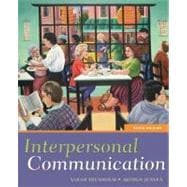
Interpersonal Communication
- ISBN 13:
9780195312904
- ISBN 10:
0195312902
- Edition: 6th
- Format: Paperback
- Copyright: 04/27/2007
- Publisher: Oxford University Press
- Newer Edition
Rent
Sorry, this item is currently unavailable.
 Free Shipping On Every Order
Note: Supplemental materials are not guaranteed with Rental or Used book purchases.
Extend or Purchase Your Rental at Any Time
Need to keep your rental past your due date? At any time before your due date you can extend or purchase your rental through your account.
Summary
Now in its sixth edition, Interpersonal Communication continues to help students learn the skills needed to communicate effectively in an increasingly complex environment, while interweaving the most current research and important theories in interpersonal communication. This edition includes greater coverage of computer-mediated communication all throughout the text, and introduces two new boxed features of high appeal: ·"Research in Review" boxes provide abstracts of recent, key studies in the field ·"Screening Room" boxes look at contemporary films and the interpersonal communication concepts they help to illustrate In addition to the updating throughout, key revisions in the text include · Chapter 3, Nonverbal Competence , updates research and reorganizes discussion of nonverbal codes into three categories-visual, auditory, and invisible. · Chapter 6, Interpretive Competence , includes exciting new research showing connections between the brain and mind, as well as the physical and the social. It also features a new discussion of emotion and motivation, a reorganized treatment of social cognitive schema, and expanded material on listening with a section on emotional intelligence. · Chapter 9, Goal Competence , has been rewritten and simplified to make explanations of general theories of influence more accessible, and includes more material on how individuals use daily conversation to influence one another. · Companion Website - www.oup.com/us/trenholm - includes discussion questions, test items, additional activities, and handouts previously found in the text