FREE SHIPPING BOTH WAYS
ON EVERY ORDER!
LIST PRICE:
$164.00

OUR PRICE:
$9.74

You may extend rentals at any time.


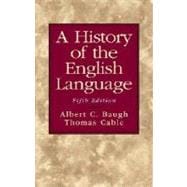
A History of the English Language

ISBN: 9780130151667 | 0130151661
Edition: 5th
Format: Hardcover
Publisher: Longman
Pub. Date: 11/9/2001

Why Rent from Knetbooks?

Because Knetbooks knows college students. Our rental program is designed to save you time and money. Whether you need a textbook for a semester, quarter or even a summer session, we have an option for you. Simply select a rental period, enter your information and your book will be on its way!

Top 5 reasons to order all your textbooks from Knetbooks:

  • We have the lowest prices on thousands of popular textbooks
  • Free shipping both ways on ALL orders
  • Most orders ship within 48 hours
  • Need your book longer than expected? Extending your rental is simple
  • Our customer support team is always here to help
SummaryTable of Contents
For courses in the History of the English Language (English Composition). Comprehensive and balanced, this classic exploration of the history of the English language combines internal linguistic history and external cultural historyfrom the Middle Ages to the present. Students are encouraged to develop both an understanding of present-day English and an enlightened attitude toward questions affecting the language today.

Comprehensive and balanced, this classic exploration of the history of the English language comb... MORE
Prefacexiii
English Present and Future
1(17)
The History of the English Language a Cultural Subject
... MORE
Influences at Work on Language
Growth and Decay
The Importance of a Language
The Importance of English
The Future of the English Language
English as a World Language
Assets and Liabilities
Cosmopolitan Vocabulary
Inflectional Simplicity
Natural Gender
Liabilities
The Indo-European Family of Languages
18(25)
Language Constantly Changing
Dialectal Differentiation
The Discovery of Sanskrit
Grimm's Law
The Indo-European Family
Indian
Iranian
Armenian
Hellenic
Albanian
Italic
Balto-Slavic
Germanic
Celtic
Twentieth-century Discoveries
The Home of the Indo-Europeans
Old English
43(31)
The Languages in England before English
The Romans in Britain
The Roman Conquest
Romanization of the Island
The Latin Language in Britain
The Germanic Conquest
Anglo-Saxon Civilization
The Names ``England'' and ``English''
The Origin and Position of English
The Periods in the History of English
The Dialects of Old English
Some Characteristics of Old English
The Noun
Grammatical Gender
The Adjective
The Definite Article
The Personal Pronoun
The Verb
The Language Illustrated
The Resourcefulness of the Old English Vocabulary
Self-explaining Compounds
Prefixes and Suffixes
Old English Syntax
Old English Literature
Foreign Influences on Old English
74(34)
The Contact of English with Other Languages
The Celtic Influence
Celtic Place-Names and Other Loanwords
Three Latin Influences on Old English
Chronological Criteria
Continental Borrowing (Latin Influence of the Zero Period)
Latin through Celtic Transmission (Latin Influence of the First Period)
Latin Influence of the Second Period: The Christianizing of Britain
Effects of Christianity on English Civilization
The Earlier Influence of Christianity on the Vocabulary
The Benedictine Reform
Influence of the Benedictine Reform on English
The Application of Native Words to New Concepts
The Extent of the Influence
The Scandinavian Influence: The Viking Age
The Scandinavian Invasions of England
The Settlement of the Danes in England
The Amalgamation of the Two Peoples
The Relation of the Two Languages
The Tests of Borrowed Words
Scandinavian Place-Names
The Earliest Borrowing
Scandinavian Loanwords and Their Character
The Relation of Borrowed and Native Words
Form Words
Scandinavian Influence outside the Standard Speech
Effect on Grammar and Syntax
Period and Extent of the Influence
The Norman Conquest and the Subjection of English, 1066--1200
108(19)
The Norman Conquest
The Origin of Normandy
The Year 1066
The Norman Settlement
The Use of French by the Upper Class
Circumstances Promoting the Continued Use of French
The Attitude toward English
French Literature at the English Court
Fusion of the Two Peoples
The Diffusion of French and English
Knowledge of English among the Upper Class
Knowledge of French among the Middle Class
The Reestablishment of English, 1200--1500
127(31)
Changing Conditions after 1200
The Loss of Normandy
Separation of the French and English Nobility
French Reinforcements
The Reaction against Foreigners and the Growth of National Feeling
French Cultural Ascendancy in Europe
English and French in the Thirteenth Century
Attempts to Arrest the Decline of French
Provincial Character of French in England
The Hundred Years' War
The Rise of the Middle Class
General Adoption of English in the Fourteenth Century
English in the Law Courts
English in the Schools
Increasing Ignorance of French in the Fifteenth Century
French as a Language of Culture and Fashion
The Use of English in Writing
Middle English Literature
Middle English
158(42)
Middle English a Period of Great Change
Decay of Inflectional Endings
The Noun
The Adjective
The Pronoun
The Verb
Losses among the Strong Verbs
Strong Verbs That Became Weak
Survival of Strong Participles
Surviving Strong Verbs
Loss of Grammatical Gender
Middle English Syntax
French Influence on the Vocabulary
Governmental and Administrative Words
Ecclesiastical Words
Law
Army and Navy
Fashion, Meals, and Social Life
Art, Learning, Medicine
Breadth of the French Influence
Anglo-Norman and Central French
Popular and Literary Borrowings
The Period of Greatest Influence
Assimilation
Loss of Native Words
Differentiation in Meaning
Curtailment of OE Processes of Derivation
Prefixes
Suffixes
Self-explaining Compounds
The Language Still English
Latin Borrowings in Middle English
Aureate Terms
Synonyms at Three Levels
Words from the Low Countries
Dialectal Diversity of Middle English
The Middle English Dialects
The Rise of Standard English
The Importance of London English
The Spread of the London Standard
Complete Uniformity Still Unattained
The Renaissance, 1500--1650
200(53)
Changing Conditions in the Modern Period
Effect upon Grammar and Vocabulary
The Problems of the Vernaculars
The Struggle for Recognition
The Problem of Orthography
The Problem of Enrichment
The Opposition to Inkhorn Terms
The Defense of Borrowing
Compromise
Permanent Additions
Adaptation
Reintroductions and New Meanings
Rejected Words
Reinforcement through French
Words from the Romance Languages
The Method of Introducing the New Words
Enrichment from Native Sources
Methods of Interpreting the New Words
Dictionaries of Hard Words
Nature and Extent of the Movement
The Movement Illustrated in Shakespeare
Shakespeare's Pronunciation
The Importance of Sound-changes
From Old to Middle English
From Middle English to Modern
The Great Vowel Shift
Weakening of Unaccented Vowels
Grammatical Features
The Noun
The Adjective
The Pronoun
The Verb
Usage and Idiom
General Characteristics of the Period
The Appeal to Authority, 1650--1800
253(43)
The Impact of the Seventeenth Century
The Temper of the Eighteenth Century
Its Reflection in the Attitude toward the Language
``Ascertainment''
The Problem of ``Refining'' the Language
The Desire to ``Fix'' the Language
The Example of Italy and France
An English Academy
Swift's Proposal, 1712
Objection to an Academy
Substitutes for an Academy
Johnson's Dictionary
The Eighteenth-century Grammarians and Rhetoricians
The Aims of the Grammarians
The Beginnings of Prescriptive Grammar
Methods of Approach
The Doctrine of Usage
Results
Weakness of the Early Grammarians
Attempts to Reform the Vocabulary
Objection to Foreign Borrowings
The Expansion of the British Empire
Some Effects of Expansion on the Language
Development of Progressive Verb Forms
The Progressive Passive
The Nineteenth Century and After
296(55)
Influences Affecting the Language
The Growth of Science
Automobile, Film, Broadcasting, Computer
The World Wars
Language as a Mirror of Progress
Sources of the New Words: Borrowings
Self-explaining Compounds
Compounds Formed from Greek and Latin Elements
Prefixes and Suffixes
Coinages
Common Words from Proper Names
Old Words with New Meanings
The Influence of Journalism
Changes of Meaning
Slang
Cultural Levels and Functional Varieties
The Standard Speech
English Dialects
English World-Wide
Pidgins and Creoles
Spelling Reform
Purist Efforts
Gender Issues and Linguistic Change
The Oxford English Dictionary
Grammatical Tendencies
Verb-adverb Combinations
A Liberal Creed
The English Language in America
351(58)
The Settlement of America
The Thirteen Colonies
The Middle West
The Far West
Uniformity of American English
Archaic Features in American English
Early Changes in the Vocabulary
National Consciousness
Noah Webster and an American Language
Webster's Influence on American Spelling
Webster's Influence on American Pronunciation
Pronunciation
The American Dialects
The Controversy over Americanisms
The Purist Attitude
Present Differentiation of Vocabulary
American Words in General English
Scientific Interest in American English
American English and World English
Appendix A Specimens of the Middle English Dialects409(13)
Appendix B English Spelling422(7)
Index429

Related Products


  • A Companion to Braugh & Cable's A History of the English Language
    A Companion to Braugh & Cable'...
  • A History of the English Language
    A History of the English Langu...
  • A History of the English Language
    A History of the English Langu...
  • A History of the English Language Plus NEW MyCompLab -- Access Card Package
    A History of the English Langu...
  • Companion to Baugh and Cable's
    Companion to Baugh and Cable's...
  • HISTORY OF THE ENGLISH LANGUAGE
    HISTORY OF THE ENGLISH LANGUAGE


Please wait while this item is added to your cart...