FREE SHIPPING BOTH WAYS
ON EVERY ORDER!
LIST PRICE:
$22.95

Sorry, this item is currently unavailable.

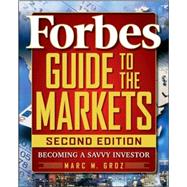
Forbes Guide to the Markets: Becoming a Savvy Investor, 2nd Edition

ISBN: 9780470463383 | 0470463384
Edition: 2nd
Format: Paperback
Publisher: Wiley
Pub. Date: 9/1/2009

Why Rent from Knetbooks?

Because Knetbooks knows college students. Our rental program is designed to save you time and money. Whether you need a textbook for a semester, quarter or even a summer session, we have an option for you. Simply select a rental period, enter your information and your book will be on its way!

Top 5 reasons to order all your textbooks from Knetbooks:

  • We have the lowest prices on thousands of popular textbooks
  • Free shipping both ways on ALL orders
  • Most orders ship within 48 hours
  • Need your book longer than expected? Extending your rental is simple
  • Our customer support team is always here to help
SummaryTable of ContentsAuthor Biography
ForbesGuide To The MarketsSecond EditionBecoming a Savvy InvestorMARC M. GROZForbesGuide To The MarketsSecond EditionWhat a difference ten years can make. When the first edition of Forbesr Guide to the Markets was published a decade ago, the financial landscape was very different. "Dot coms" were flying high and the global economy was booming. Today, while the climate is very different, the basics and fundamentals remain the same, and the Second Edition of Forbesr Guide to the Markets reflects the most up-to-date look at how best to navigate to... MORE
Acknowledgments
Note to the Reader
About the Author
Introduction: Becoming a Savvy Investor
Establishing a Frame of Reference
From "Dumb" Barter to Intelligent Agents
Point-Counterpoint
Stocks
Mutual Funds
Bonds
ETFs
Options
... MORE
Summary
Confronting Information Overload
Investor Constraints
Investor Choices
Investor Safety
Stocks and Equity Markets
Varieties of Stocks
Just What Is a Security, Anyway?
Issues and Underwriters: Why Does a Corporation Sell Stockto the Public?
Why Investors Buy Stock
Summing Up Total Return: Dividends and Capital Gains
A Letter to Our Shareholders: Annual and Quarterly Reports (and Filings)
Making Sense of Types, Classes, and Other Stock Categories:A Map of the World of Stock
Stock Markets
The Big Board
The Incredible Growth of Trading and Capital
National Association of Securities Dealers Automated QuotationSystem (Nasdaq)
Technology, Dark Pools, and the Evolution of a Unified Market
Three Views of the Numbers
Fundamental Analysis
Technical Analysis
Quantitative Analysis
Where to Find Information on Stocks and Financial Markets
A Selection of Information Sources on the Financial Markets
How to Buy and Sell Stock
Full-Service Brokers
Discount Brokers
Financial Intermediaries
Direct Purchase
If It Sounds Too Good to Be True . . . Protecting Yourself from Stock Scams
A Note on Financial Planners
Mutual Funds and Investment Companies
A History and Overview of the Mutual Fund Business
Open-End versus Closed-End Funds
Index Funds
Load versus No-Load Funds
Advantages of Mutual Funds
Simplicity
Diversification
Access to New Issues
Economies of Scale
Professional Management
Indexing
Disadvantages
Impact of One-Time Charges and Recurring Fees on Fund Performance
Hidden Cost of Brokerage
Some Hidden Risks of Fund Ownership
Sources of Information on Mutual Funds
Investment Company Institute Classification of Types of Funds
Lipper Analytical Services
Morningstar
Alternative Investments
Hedge Funds
Funds of Funds
Other Alternatives
Bonds and Other Fixed-Income Securities
Seven Characteristics of Bonds
The Lifespan of Bonds
Interest versus Discount
Relationship of Price to Yield
Four Important Yield Measures
Credit Quality, Ratings, and Insurance
Call and Related Features
Fixed versus Floating Rates and Foreign Currencies
Chapter Fifteen: How the Other $30 Trillion Is Invested
Treasuries
Corporates
Mortgage-Backed Securities
Municipals
Summary
Options, Futures, and Other Derivatives: Engines of Financial Innovation
Chapter Sixteen: Options
Exchange-Traded Options
Combination Strategies
Determining the Value of an Option
Chapter Seventeen: Futures
A Seller's Need to Hedge . .
Some Buyers Need to Hedge, Too
Speculation or Insurance? Maybe a Little of Both
Actuals versus Cash-Settled Contracts
Margin and Collateral
Chapter Eighteen: Other Derivatives
Summing Up Risk and Return
Chapter Nineteen: How Well Are My Investments Doing?
The Basics of Return
Annualized Returns: Arithmetic (Simple) or Geometric (Compound)?
Time-Weighted Returns vs. Money-Weighted Returns
Complicating Factors
Chapter Twenty: Coming to Grips with the Many Dimensions of Risk
A Definition of Investment Risk
The Relativity of Risk
What Is Market Risk?
"It Will Fluctuate"
Other Kinds of Investment Risk: From the Quantifiable to the Subjective
Balancing Risk and Return
Chapter Twenty-One: A Crescendo of Change
Again, We Ask, What Is a Market?
Glossary
Index
Table of Contents provided by Publisher. All Rights Reserved.

Marc M. Groz is a leading authority on financial markets, with a deep understanding>of hedge funds, risk management, and the interplay of liquidity, transparency, and valuation in market dynamics. Currently, he serves as managing member and chief investment officer of Topos LLC, a Stamford, Connecticut?based alternative asset manager, investor, and risk advisor.

Forbes is the leading business magazine in the United States, with an audience of more than 5 million readers. Since 1917, Forbes' mission has been to provide access to information and insights that ensure its readers' success.


Please wait while this item is added to your cart...