FREE SHIPPING BOTH WAYS
ON EVERY ORDER!
LIST PRICE:
$29.95

Sorry, this item is currently unavailable.

Experimental Design for the Life Sciences
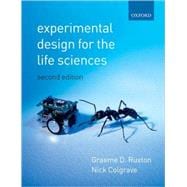
ISBN: 9780199285112 | 019928511X
Edition: 2nd
Format: Paperback
Publisher: Oxford University Press, USA
Pub. Date: 6/20/2006

Why Rent from Knetbooks?

Because Knetbooks knows college students. Our rental program is designed to save you time and money. Whether you need a textbook for a semester, quarter or even a summer session, we have an option for you. Simply select a rental period, enter your information and your book will be on its way!

Top 5 reasons to order all your textbooks from Knetbooks:

  • We have the lowest prices on thousands of popular textbooks
  • Free shipping both ways on ALL orders
  • Most orders ship within 48 hours
  • Need your book longer than expected? Extending your rental is simple
  • Our customer support team is always here to help
SummaryTable of ContentsAuthor Biography
Nick Colegrave is lecturer in invertebrate biology in the School of Biological Sciences, University of Edinburgh, UK.

At the core of good research lies the careful design of experiments. Yet all too often a successful design comes only after a painful trial-and-error process, wasting valuable time and valuable resources. Experimental Design for the Life Sciences teaches the reader how to effectively design experiments, to ensure that today's students are equipped with the skills they need to be the researchers of t... MORE
Why you need to care about design
Why experiments need to be designed
1(2)
The costs of poor design
... MORE(2)
Time and money
3(1)
Ethical issues
4(1)
The relationship between experimental design and statistics
5(1)
Why good experimental design is particularly important to life scientists
5(4)
Random variation
6(1)
Confounding factors
6(1)
Summary
7(2)
Starting with a well-defined hypothesis
Why your experiment should be focused: questions, hypotheses and predictions
9(5)
An example of moving from a question to hypotheses, and then to an experimental design
11(1)
An example of multiple hypotheses
11(3)
Producing the strongest evidence with which to challenge a hypothesis
14(3)
Indirect measures
15(1)
Considering all possible outcomes of an experiment
16(1)
Satisfying sceptics: the Devil's advocate
17(1)
The importance of a pilot study and preliminary data
18(4)
Making sure that you are asking a sensible question
18(2)
Making sure that your techniques work
20(2)
Experimental manipulation versus natural variation
22(8)
An example of a hypothesis that could be tackled by either manipulation or correlation
22(1)
Arguments for doing a correlational study
23(2)
Arguments for doing a manipulative study
25(3)
Situations where manipulation is impossible
28(2)
Deciding whether to work in the field or the laboratory
30(2)
In vivo versus in vitro studies
32(1)
There is no perfect study
33(3)
Summary
34(2)
Between-individual variation, replication and sampling
Between-individual variation
36(1)
Replication
37(6)
Pseudoreplication
43(11)
Explaining what pseudoreplication is
43(2)
Common sources of pseudoreplication
45(4)
Dealing with pseudoreplication
49(2)
Accepting that sometimes pseudoreplication is unavoidable
51(1)
Pseudoreplication, third variables and confounding variables
52(1)
Cohort effects, confounding variables and cross-sectional studies
53(1)
Randomization
54(6)
Why you often want a random sample
55(1)
Haphazard sampling
56(1)
Self-selection
57(1)
Some pitfalls associated with randomization procedures
58(1)
Randomizing the order in which you treat replicates
58(1)
Random samples and representative samples
59(1)
Selecting the appropriate number of replicates
60(9)
Educated guesswork
61(1)
Formal power analysis
61(1)
Factors affecting the power of an experiment
62(1)
Relationship between power and type I and type II errors
63(5)
Summary
68(1)
Different experimental designs
Controls
69(7)
Different types of control
70(2)
Blind procedures
72(1)
Making sure that the control is as reliable as possible
73(1)
The ethics of controlling
74(1)
Situations where a control is not required
75(1)
Completely randomized and factorial experiments
76(7)
Experiments with several factors
77(1)
Confusing levels and factors
78(3)
Pros and cons of complete randomization
81(2)
Blocking
83(6)
Blocking on individual characters, space and time
85(1)
The pros and cons of blocking
86(1)
Paired designs
87(1)
How to select blocks
87(1)
Covariates
88(1)
Within-subject designs
89(6)
The advantages of a within-subject design
90(1)
The disadvantages of a within-subject design
91(1)
Isn't repeatedly measuring the same individual pseudoreplication?
92(1)
With multiple treatments, within-subject experiments can take a long time
93(1)
Which sequences should you use?
94(1)
Split-plot designs (sometimes called split-unit designs)
95(2)
Thinking about the statistics
97(5)
Summary
100(2)
Taking measurements
Calibration
102(1)
Inaccuracy and imprecision
103(2)
Intra-observer variability
105(4)
Describing the problem
105(1)
Tackling the problem
106(1)
Repeatability
106(2)
Remember, you can be consistent but still consistently wrong
108(1)
Inter-observer variability
109(1)
Describing the problem
109(1)
Tackling the problem
109(1)
Defining categories
110(1)
Observer effects
110(2)
Recording data
112(2)
Don't try to record too much information at once
112(1)
Beware of shorthand codes
112(1)
Keep more than one copy of your data
113(1)
Write out your experimental protocol formally and in detail, and keep a detailed field journal or lab book
113(1)
Don't over-work
113(1)
Computers and automated data collection
114(1)
Floor and ceiling effects
114(2)
Observer bias
116(1)
Taking measurements of humans and animals in the laboratory
116(3)
Summary
117(2)
Final thoughts
How to select the levels for a treatment
119(2)
Subsampling: more woods or more trees?
121(2)
Using unbalanced groups for ethical reasons
123(2)
Other sampling schemes
125(4)
Sequential sampling
126(1)
Stratified sampling
126(1)
Systematic sampling
127(2)
Latin square designs
129(1)
More on interactions
130(4)
Covariates can interact too
130(2)
The importance of interactions (and the interaction fallacy)
132(2)
Dealing with human subjects
134(8)
Deception
136(1)
Collecting data without permission
137(1)
Confidentiality
137(1)
Discretion
138(1)
Ethical guidelines
138(1)
Volunteers
139(1)
Honesty of subjects
139(1)
There is no perfect study: a reprise
140(1)
Summary
140(2)
Sample answers to self-test questions142(11)
Flow chart on experimental design153(5)
Bibliography158(3)
Index161

Graeme Ruxton obtained a first degree in Physics before getting a PhD in Statistics and Modelling Science. After his PhD he worked for several years with the Scottish Agricultural Statistical Service in Edinburgh. He then got a lectureship in Ecology at the University of Glasgow, where he has been ever since.
Nick Colegrave trained as an evolutionary biologist, obtaining his first degree at the University of Sussex, and his PhD on the evolution of competition strategies at the University of Sheffield. Since then he has held a number of postdoctoral research positions at a range of universities including, McGill, St Andrews, Glasgow and Edinburgh, working on various aspects of evolutionary biology, with a range of organisms. At various points he has also held the post of zoology demonstrator at the University of Edinburgh, teaching experimental design to zoology students and advising on statistics. He is now lecturer in Invertebrate Zoology at Edinburgh.

Related Products


  • Experimental Design for the Life Sciences
    Experimental Design for the Li...


Please wait while this item is added to your cart...