FREE SHIPPING BOTH WAYS
ON EVERY ORDER!
LIST PRICE:
$129.33

Sorry, this item is currently unavailable.

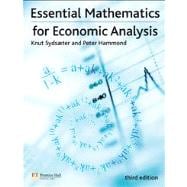
Essential Mathematics for Economic Analysis
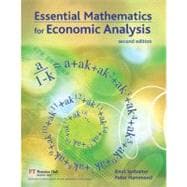
ISBN: 9780273681809 | 027368180X
Edition: 3rd
Format: Paperback
Publisher: Prentice Hall
Pub. Date: 1/1/2008

Why Rent from Knetbooks?

Because Knetbooks knows college students. Our rental program is designed to save you time and money. Whether you need a textbook for a semester, quarter or even a summer session, we have an option for you. Simply select a rental period, enter your information and your book will be on its way!

Top 5 reasons to order all your textbooks from Knetbooks:

  • We have the lowest prices on thousands of popular textbooks
  • Free shipping both ways on ALL orders
  • Most orders ship within 48 hours
  • Need your book longer than expected? Extending your rental is simple
  • Our customer support team is always here to help
SummaryTable of ContentsAuthor Biography
The book is by far the best choice one can make for a course on mathematics for economists. It is exemplary in finding the right balance between mathematics and economic examples.”Dr Roelof J Stroeker, Erasmus University, Rotterdam.The writing style is superb...it manages to allow intuitive understanding whilst not sacrificing mathematical precision and rigour.”Dr Steven Cook, University of Wales SwanseaEssential Mathematics for Economic Analysis provides an invaluable introduction to mathematical analysis and linear algebra for economists. Its... MORE
Prefaceix
Introductory Topics I: Algebra
1(36)
The Real Numbers
1(3)
... MOREInteger Powers
4(6)
Rules of Algebra
10(6)
Fractions
16(5)
Fractional Powers
21(5)
Inequalities
26(6)
Intervals and Absolute Values
32(5)
Review Problems for Chapter 1
35(2)
Introductory Topics II: Equations
37(18)
How to Solve Simple Equations
37(3)
Equations with Parameters
40(3)
Quadratic Equations
43(6)
Linear Equations in Two Unknowns
49(3)
Nonlinear Equations
52(3)
Review Problems for Chapter 2
54(1)
Introductory Topics III: Miscellaneous
55(28)
Summation Notation
55(4)
Rules for Sums. Newton's Binomial Formula
59(5)
Double Sums
64(2)
A Few Aspects of Logic
66(6)
Mathematical Proofs
72(2)
Essentials of Set Theory
74(5)
Mathematical Induction
79(4)
Review Problems for Chapter 3
81(2)
Functions of One Variable
83(52)
Introduction
83(1)
Basic Definitions
84(6)
Graphs of Functions
90(4)
Linear Functions
94(7)
Linear Models
101(3)
Quadratic Functions
104(8)
Polynomials
112(7)
Power Functions
119(2)
Exponential Functions
121(6)
Logarithmic Functions
127(8)
Review Problems for Chapter 4
132(3)
Properties of Functions
135(28)
Shifting Graphs
135(5)
New Functions from Old
140(4)
Inverse Functions
144(7)
Graphs of Equations
151(3)
Distance in the Plane, Circles
154(4)
General Functions
158(5)
Review Problems for Chapter 5
161(2)
Differentiation
163(52)
Slopes of Curves
163(2)
The Derivative. Tangents
165(6)
Increasing and Decreasing Functions
171(2)
Rates of Change
173(4)
A Dash of Limits
177(5)
Simple Rules for Differentiation
182(4)
Sums, Products, and Quotients
186(7)
Chain Rule
193(5)
Higher-Order Derivatives
198(5)
Exponential Functions
203(4)
Logarithmic Functions
207(8)
Review Problems for Chapter 6
213(2)
Derivatives in Use
215(54)
Implicit Differentiation
215(5)
Economic Examples
220(3)
Differentiating the Inverse
223(3)
Linear Approximations
226(5)
Polynomial Approximations
231(4)
Taylor's Formula
235(3)
Why Economists Use Elasticities
238(5)
Continuity
243(4)
More on Limits
247(8)
Intermediate Value Theorem. Newton's Method
255(4)
Infinite Sequences
259(3)
L'Hopital's Rule
262(7)
Review Problems for Chapter 7
266(3)
Single-Variable Optimization
269(36)
Introduction
269(3)
Simple Tests for Extreme Points
272(4)
Economic Examples
276(5)
The Extreme-Value Theorem
281(6)
Further Economic Examples
287(5)
Local Extreme Points
292(6)
Inflection Points
298(7)
Review Problems for Chapter 8
303(2)
Integration
305(44)
Indefinite Integrals
305(6)
Area and Definite Integrals
311(6)
Properties of Definite Integrals
317(4)
Economic Applications
321(7)
Integration by Parts
328(3)
Integration by Substitution
331(3)
Infinite Intervals of Integration
334(7)
A Glimpse at Differential Equations
341(8)
Review Problems for Chapter 9
346(3)
Interest Rates and Present Values
349(28)
Interest Periods and Effective Rates
349(4)
Continuous Compounding
353(2)
Present Value
355(3)
Geometric Series
358(4)
Total Present Value
362(6)
Mortgage Repayments
368(5)
Internal Rate of Return
373(4)
Review Problems for Chapter 10
374(3)
Functions of Many Variables
377(36)
Functions of Two Variables
377(4)
Partial Derivatives with Two Variables
381(6)
Geometric Representation
387(7)
Surfaces and Distance
394(3)
Functions of More Variables
397(5)
Partial Derivatives with More Variables
402(4)
Economic Applications
406(2)
Partial Elasticities
408(5)
Review Problems for Chapter 11
410(3)
Tools for Comparative Statics
413(50)
A Simple Chain Rule
413(5)
Chain Rules for Many Variables
418(4)
Implicit Differentiation along a Level Curve
422(4)
More General Cases
426(4)
Elasticity of Substitution
430(3)
Homogeneous Functions of Two Variables
433(4)
General Homogeneous and Homothetic Functions
437(6)
Linear Approximations
443(4)
Differentials
447(4)
Systems of Equations
451(4)
Differentiating Systems of Equations
455(8)
Review Problems for Chapter 12
461(2)
Multivariable Optimization
463(40)
Two Variables: Necessary Conditions
463(5)
Two Variables: Sufficient Conditions
468(4)
Local Extreme Points
472(6)
Linear Models with Quadratic Objectives
478(8)
The Extreme-Value Theorem
486(6)
Three or More Variables
492(4)
Comparative Statics and the Envelope Theorem
496(7)
Review Problems for Chapter 13
500(3)
Constrained Optimization
503(46)
The Lagrange Multiplier Method
503(6)
Interpreting the Lagrange Multiplier
509(3)
Why the Lagrange Multiplier Method Works
512(5)
Sufficient Conditions
517(3)
More Variables and More Constraints
520(7)
Comparative Statics
527(5)
Nonlinear Programming: A Simple Case
532(6)
More on Nonlinear Programming
538(11)
Review Problems for Chapter 14
546(3)
Matrix and Vector Algebra
549(42)
Systems of Linear Equations
549(4)
Matrices and Matrix Operations
553(4)
Matrix Multiplication
557(4)
Rules for Matrix Multiplication
561(7)
The Transpose
568(2)
Gaussian Elimination
570(6)
Vectors
576(4)
Geometric Interpretation of Vectors
580(5)
Lines and Planes
585(6)
Review Problems for Chapter 15
589(2)
Determinants and Inverse Matrices
591(38)
Determinants of Order 2
591(4)
Determinants of Order 3
595(4)
Determinants of Order n
599(3)
Basic Rules for Determinants
602(5)
Expansion by Cofactors
607(3)
The Inverse of a Matrix
610(6)
A General Formula for the Inverse
616(3)
Cramer's Rule
619(4)
The Leontief Model
623(6)
Review Problems for Chapter 16
626(3)
Linear Programming
629(22)
Preliminaries
629(6)
Introduction to Duality Theory
635(4)
The Duality Theorem
639(3)
A General Economic Interpretation
642(2)
Complementary Slackness
644(7)
Review Problems for Chapter 17
650(1)
Appendix: Geometry651(2)
The Greek Alphabet653(2)
Answers to Selected Problems655(54)
Index709
Peter Hammond is a Professor of Economics at Stanford University. Knut Sydsaeter is a Professor of Mathematics in the Economics Department at the University of Oslo.

Related Products


  • Essential Mathematics for Economic Analysis
    Essential Mathematics for Econ...
  • Essential Mathematics for Economic Analysis
    Essential Mathematics for Econ...
  • Essential Mathematics for Economic Analysis
    Essential Mathematics for Econ...
  • Outlines and Highlights for Essential Mathematics for Economic Analysis by Knut Sydsaeter
    Outlines and Highlights for Es...


Please wait while this item is added to your cart...