FREE SHIPPING BOTH WAYS
ON EVERY ORDER!
LIST PRICE:
$36.95

OUR PRICE:
$16.46

You may extend rentals at any time.


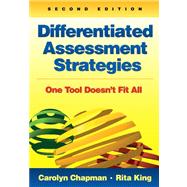
Differentiated Assessment Strategies : One Tool Doesn't Fit All
ISBN: 9781412996648 | 1412996643
Edition: 2nd
Format: Paperback
Publisher: Corwin Pr
Pub. Date: 11/15/2011

Why Rent from Knetbooks?

Because Knetbooks knows college students. Our rental program is designed to save you time and money. Whether you need a textbook for a semester, quarter or even a summer session, we have an option for you. Simply select a rental period, enter your information and your book will be on its way!

Top 5 reasons to order all your textbooks from Knetbooks:

  • We have the lowest prices on thousands of popular textbooks
  • Free shipping both ways on ALL orders
  • Most orders ship within 48 hours
  • Need your book longer than expected? Extending your rental is simple
  • Our customer support team is always here to help
SummaryTable of Contents
This updated edition includes a generous selection of user-friendly strategies that help teachers assess struggling learners, students with special needs, children who are performing at grade level, and advanced learners. Included are practical tools that improve student performance and help them take responsibility for their own learning.

In this second edition of the bestseller, the authors provide research-based and practical formative assessment tools, strategies, and activities that simplify the process of ide... MORE
Prefacep. ix
Acknowledgmentsp. xiii
About the Authorsp. xv
One Tool Doesn't Fit All: Introductionp. 1
What Is Differentiated Assessment?p. 1
Analyzing Your View of Differentiated Assessmentp. 5
Building the Toolbox to "Zap the Gaps"p. 6
Assessment in the Age of Accountabilityp. 6
What Is the Teacher's Role in Differentiated A... MOREp. 11
Opening the Toolboxp. 13
p. 15
Processing Information and Memoryp. 15
Why Students Forget and Why They Rememberp. 16
Assist the Brain in Memory Processingp. 18
Develop Intelligent Behaviors for Assessmentp. 20
Authentic Assessmentp. 23
Performance Feedbackp. 24
Summaryp. 24
Creating a Climate for Formative Assessmentp. 25
The Affective Domain and Assessmentp. 25
Emotionsp. 26
Emotional Intelligencep. 26
Self-Efficacyp. 28
Motivation for Assessmentp. 29
The Physical Environmentp. 32
Setting Climate Goalsp. 35
Summaryp. 38
Knowing the Learnerp. 39
Information Gatheringp. 39
Gardner's Multiple Intelligence Theoryp. 42
Exploring Goleman and Sternbergp. 47
Through Animals' Eyesp. 48
True Colors Through Objectsp. 48
Assessing Students' Perceptual Stylesp. 50
Engaging Learner Viewsp. 54
Performance Level Titles for the Assessed Learnerp. 56
Summaryp. 57
Exploring Self-Assessmentp. 59
What Is Self-Assessment?p. 59
What Is Self-Talk?p. 59
What Is the Role of Self-Talk in Self-Assessment?p. 59
Productive Metacognitive Conditionsp. 60
Self-Talk for Task Assessmentp. 61
Teaching Self-Assessmentp. 63
Self-Checking Techniques for Assessmentp. 64
Assess On-Task Behaviorsp. 67
Summaryp. 67
Formative Assessment Before the Learningp. 69
Personalize Instructional Planningp. 71
Engaging Students Before the Learningp. 72
Summaryp. 82
Formative Assessment During the Learningp. 83
Formative Assessment Tools to Use During the Learningp. 83
Summaryp. 92
Formative Assessment After the Learningp. 93
Student Engagement After the Learningp. 93
Assessment Tools: After the Learningp. 94
Bloom's Taxonomy for Comprehension Assessmentp. 95
Summaryp. 122
Differentiating Summative Assessmentsp. 123
How Can Standardized Assessments Be Differentiated?p. 123
Create a Positive Testing Environmentp. 125
Give Effective Directionsp. 125
Teach Test-Taking Skillsp. 126
Gradingp. 127
Summaryp. 129
Assessment for Differentiated Instruction and Flexible Groupingp. 131
Using Technology for Assessmentp. 131
Assessment Cubingp. 133
Choice Boardsp. 134
Assessment Agendasp. 136
Stations, Centers, and Learning Zones for Assessmentp. 138
Assessment for Flexible Groupingp. 140
Evaluating Group Workp. 146
Group Discussion: Assessmentp. 149
Troubleshooting Tools for Group Assessmentp. 152
Summaryp. 153
Differentiated Instructional Planning Modelsp. 155
Adjustable Assignment Modelp. 155
Curriculum Compacting Modelp. 163
Academic Contract Modelp. 166
Project-Based Modelp. 168
Problem-Based Modelp. 171
Summaryp. 172
Planning for Differentiated Assessmentp. 173
Step Up to Formative Assessment Planningp. 173
Content, Process, Product, and Learning Disposition Assessmentp. 177
The Role of Formative Assessment in Curriculum Planningp. 179
Essential Questions for Planningp. 182
Teaching Assessment Strategiesp. 183
Effective Differentiated Assessment Practicesp. 184
Generate Change for Differentiated Formative Assessmentp. 187
Summaryp. 187
Bibliographyp. 193
Indexp. 195
Table of Contents provided by Ingram. All Rights Reserved.


Please wait while this item is added to your cart...

