FREE SHIPPING BOTH WAYS
ON EVERY ORDER!
LIST PRICE:
$35.00

Sorry, this item is currently unavailable.

Developmentally Appropriate Practice in Early Childhood Programs
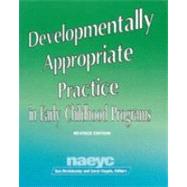
ISBN: 9780935989793 | 093598979X
Edition: Revised
Format: Paperback
Publisher: NAEYC
Pub. Date: 1/1/1997

Why Rent from Knetbooks?

Because Knetbooks knows college students. Our rental program is designed to save you time and money. Whether you need a textbook for a semester, quarter or even a summer session, we have an option for you. Simply select a rental period, enter your information and your book will be on its way!

Top 5 reasons to order all your textbooks from Knetbooks:

  • We have the lowest prices on thousands of popular textbooks
  • Free shipping both ways on ALL orders
  • Most orders ship within 48 hours
  • Need your book longer than expected? Extending your rental is simple
  • Our customer support team is always here to help
Table of Contents
Prefacev(4)
Acknowledgmentsix
Part 1 NAEYC Position Statement: Developmentally Appropriate Practice in Early Childhood Programs Serving Children from Birth through Age 8 (Adopted July 1996)3(30)
The current context ... MORE
3(3)
Rationale for the position statement
6(1)
NAEYC's commitment to children
7(1)
Statement of the position
8(1)
Principles of child development and learning that inform developmentally appropriate practice
9(7)
Guidelines for decisions about developmentally appropriate practice
16(7)
Creating a caring community of learners
16(1)
Teaching to enhance development and learning
17(3)
Constructing appropriate curriculum
20(1)
Assessing children's learning and development
21(1)
Establishing reciprocal relationships with families
22(1)
Moving from either/or to both/and thinking in early childhood practice
23(1)
Policies essential for achieving developmentally appropriate early childhood programs
24(1)
References
25(8)
Part 2 Developmentally Appropriate Practice: The Early Childhood Teacher As Decisionmaker/Sue Bredekamp33(22)
Overview and NAEYC's definition of developmentally appropriate practice
36(1)
Using knowledge about child development and learning to inform practice
36(3)
Using knowledge of individual children to inform practice
39(2)
Using knowledge of the social and cultural context to inform practice
41(2)
Using multiple sources of knowledge in professional decisionmaking
43(1)
Resolving contradictions
44(7)
Resolving contradictions in practice: A strategy for making decisions and negotiating conflicts
47(1)
Considering children's individual needs in decisions about developmentally appropriate practice
48(1)
Considering families' concerns and the wider social context in decisions about developmentally appropriate practice
48(3)
Conclusion
51(1)
References
51(4)
Part 3 Developmentally Appropriate Practice for Infants and Toddlers55(42)
Development in the First Three Years of Life
55(15)
Young infants (birth to 9 months)
56(4)
Mobile infants (8 to 18 months)
60(5)
Toddlers (16 to 36) months
65(5)
Developmental milestones of children from birth to age 3
70(2)
Examples of appropriate and inappropriate practices for infants
72(9)
Examples of appropriate and inappropriate practices for toddlers
81(10)
References and resources
91(6)
Part 4 Developmentally Appropriate Practice for 3- through 5-Year-Olds97(44)
Development and learning in children age 3 through 5
98(25)
Integrated development and learning during early childhood
98(1)
A sketch of physical development in 3-, 4-, and 5-year-olds
99(5)
Physical growth
99(1)
Maturation
100(1)
Sensation and perception
100(1)
Gross-motor development
101(1)
Gross-motor development--Widely held expectations
102(1)
Considerations for early childhood educators
103(1)
Fine-motor development
103(2)
Fine-motor development--Widely held expectations
105
Considerations for early childhood educators
104
A sketch of language and communication development in 3-, 4-, and 5-year-olds
104
Language and communication development--Widely held expectations
108(1)
Considerations for early childhood educators
109(1)
A sketch of cognitive development in 3-, 4-, and 5-year-olds
110(5)
Characteristics of thought
112(1)
Information processing
113(1)
Social cognition
114(1)
Considerations for early childhood educators
115(1)
A sketch of social and emotional development of 3- through 5-year-olds
115(3)
Considerations for early childhood educators
116(1)
Social and emotional development--Widely held expectations
117(1)
Responding to individual and cultural variation
118(3)
Negotiating transitions: Changes and challenges
121(2)
Examples of appropriate and inappropriate practices for 3- through 5-year-olds
123(13)
References
136(5)
Part 5 Developmentally Appropriate Practice for 6- through 8-Year-Olds in the Primary Grades141(41)
Development and learning in primary-age children
144(17)
A sketch of physical development in 6- through 8-year-olds
146(1)
Growth and maturation, sensation and perception
146(1)
Gross- and fine-motor development
147(1)
A sketch of cognitive development in 6- through 8-year-olds
147(8)
Characteristics of thought
148(3)
Information processing
151(1)
Language and communication development
152(1)
Moral development
152(3)
A sketch of social and emotional development in 6- through 8-year-olds
155(3)
Considerations for early childhood educators
156(2)
Responding to individual and cultural variation
158(3)
Examples of appropriate and inappropriate practices for 6- through 8-year-olds
161(19)
References
180(2)
Index182

Related Products


  • Develop Mentally Appropriate Practice
    Develop Mentally Appropriate P...
  • Developmentally Appropriate Practice in Early Childhood Programs Serving Children from Birth through Age 8
    Developmentally Appropriate Pr...
  • Developmentally Appropriate Practice in Early Childhood Programs Serving Children from Birth Through Age 8
    Developmentally Appropriate Pr...


Please wait while this item is added to your cart...