FREE SHIPPING BOTH WAYS
ON EVERY ORDER!
LIST PRICE:
$39.99

OUR PRICE:
$31.67

You may extend rentals at any time.


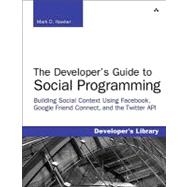
The Developer's Guide to Social Programming: Building Social Context Using Facebook, Google Fri...

ISBN: 9780321680778 | 0321680774
Edition: 1st
Format: Paperback
Publisher: Addison-Wesley Professional
Pub. Date: 1/1/2011

Why Rent from Knetbooks?

Because Knetbooks knows college students. Our rental program is designed to save you time and money. Whether you need a textbook for a semester, quarter or even a summer session, we have an option for you. Simply select a rental period, enter your information and your book will be on its way!

Top 5 reasons to order all your textbooks from Knetbooks:

  • We have the lowest prices on thousands of popular textbooks
  • Free shipping both ways on ALL orders
  • Most orders ship within 48 hours
  • Need your book longer than expected? Extending your rental is simple
  • Our customer support team is always here to help
SummaryTable of ContentsAuthor Biography
"With the advent of the social web, companies must know how to leverage new technologies to stay competitive. The author, Mark Hawker, shows readers in simple steps what social programming really means. He walks you through examples of integrating with many of today's most successful social platformsgetting you up and running with social programming in no time at all." Joseph Annuzzi, Jr., Web Architect, PeerDynamic.com "An essential reference for the social web, present and futurehellip;a must-have for making your website known on the social g... MORE

I: Twitter

1 Working with the Twitter API 1

Twitter API Essentials 1

Twitter API Methods 3

Twitter API Parameters 6

Twitter API Return Formats 10

Accessing the Twitter API 11

cURL 12

Twitter-async 14

Twitter API Rate Limiting 17

... MORE

Summary 19

2 Diving Into the Twitter API Methods 21

Twitter API Methods 21

User Objects 23

Status Objects 26

Direct Message Objects 28

Saved Search Objects 29

ID Objects 30

Relationship Objects 31

Response Objects 32

Hash Objects 33

Twitter Search API 34

Introducing the Atom Syndication Format 34

Twitter Search API Methods 38

Summary 43

3 Authentication with Twitter OAuth 45

Introducing Twitter OAuth 45

OAuth Benefits 46

OAuth Definitions 46

Implementing Twitter OAuth 48

Twitter OAuth Workflow 48

Test Tube: A Sample Twitter Application 50

Summary 59

4 Extending the Twitter API: Retweets, Lists,

and Location 61

Extending Twitter’s Core Functionality 61

Retweet API 62

Lists API 64

Geolocation API 68

Twitter Community Evolution 71

Platform Translations 71

Spam Reporting 72

Future Directions 74

Summary 76

II: Facebook Platform

5 An Overview of Facebook Platform Website

Integration 77

Facebook Platform for Developers 77

Facebook Platform 78

Registering a Facebook Application 79

Referencing a Facebook Platform Application 81

Facebook API, FQL, and XFBML 84

Facebook API and FQL 84

XFBML 97

Summary 98

6 Registration, Authentication, and Translations with Facebook 99

User Authorization and Authentication 99

Logging In and Detecting Facebook Status 101

Logging Out, Disconnecting, and Reclaiming

Accounts 107

Connecting and Inviting Friends 109

Translations for Facebook 111

Preparing Your Application and Registering Text 111

Administering and Accessing Translations 113

Summary 114

7 Using Facebook for Sharing, Commenting, and Stream Publishing 115

Content-Sharing and Live Conversation 115

Facebook Share 116

Facebook Widgets 118

Social Commenting and Stream Publishing 120

Comments Box 120

Open Stream API 123

Summary 135

8 Application Discovery, Tabbed Navigation, and the Facebook JavaScript Library 137

Application Dashboards and Counters 138

News and Activity Streams 139

Games and Applications Counters 143

Navigating and Showcasing Your Application

Using Tabs 145

Configuring and Installing an Application Tab 146

Extending an Application Tab 149

Dynamic Content and the Facebook

JavaScript (FBJS) Library 157

Facebook Animation Library 157

Facebook Dialogs 160

Handling Events with an Event Listener 162

Summary 164

III: Google Friend Connect

9 An Overview of Google Friend Connect 165

Components of Google Friend Connect 165

Google Friend Connect Gadgets 166

Google Friend Connect JavaScript API 167

Server-Side Integration 167

Google Friend Connect Plug-ins 168

Using the Google Friend Connect JavaScript API 169

Installing and Configuring the JavaScript Library 169

Working with Google Friend Connect Data 171

An Overview of the OpenSocial API 173

OpenSocial API Methods 173

The DataRequest Object 174

Fetching People and Profiles 176

Fetching and Updating Activities 177

Fetching and Updating Persistence 178

Color Picker: A Google Friend Connect Application 181

Summary 191

10 Server-Side Authentication and OpenSocial Integration 193

Server-Side OpenSocial Protocols and Authentication Methods 193

Google Friend Connect Authentication Methods 194

OpenSocial Client Libraries 196

Using the PHP OpenSocial Client Library with Google Friend Connect 197

Google Friend Connect Authentication Workflow 197

Setting Up a Server-Side Application 198

OpenSocial Data Extraction Principles 201

Summary 207

11 Developing OpenSocial Gadgets with Google Friend Connect 209

An Overview of Google Gadgets 209

Anatomy of an OpenSocial Google Gadget 210

OpenSocial v0.9 Specification 214

Advanced OpenSocial Gadget Development 217

Creating a Google Gadget 222

Color Picker, Revisited 222

Testing, Tracking, and Directory Submission 230

Summary 233

IV: Putting It All Together

12 Building a Microblog Tool Using CodeIgniter 235

An Overview of CodeIgniter 235

The Model-View-Controller Architectural Design 236

Installing, Configuring, and Exploring CodeIgniter 237

CodeIgniter Libraries 240

CodeIgniter Helpers 245

Building the Basic Sprog Application 246

Stage 1: Creating the Registration, Login, and Home Pages 247

Stage 2: Extending the Sprog Application with Updates, Comments, and Likes 257

Summary 266

13 Integrating Twitter, Facebook, and Google Friend Connect 267

Implementing Twitter Functionality 267

Setting Up Twitter and Twitter-async Support 268

Stage 3: Extending the Sprog Application with Twitter Functionality 270

Updating a User’s Twitter Account 276

Implementing Facebook Functionality 279

Registering a Facebook Application and Adding Facebook Support 279

Stage 4: Extending the Sprog Application with Facebook Functionality 281

Implementing Google Friend Connect Functionality 292

Registering and Adding Google Friend Connect Support 292

Stage 5: Extending the Sprog Application with Google Friend Connect Functionality 294

Summary 301

Index 303


Mark Hawker is a social applications developer and consultant focused on developing for social platforms such as Facebook and Twitter. He is a graduate from the University of Leeds, United Kingdom, with a First-class Honors degree in Informatics.A researcher in the field of health informatics, Mark focuses his time on how to innovatively apply social networking technologies in a wide variety of consumer health scenarios.


Please wait while this item is added to your cart...