FREE SHIPPING BOTH WAYS
ON EVERY ORDER!
LIST PRICE:
$249.33

Sorry, this item is currently unavailable.

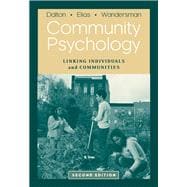
Community Psychology : Linking Individuals and Communities

ISBN: 9780534634544 | 0534634540
Edition: 2nd
Format: Hardcover
Publisher: Cengage Learning
Pub. Date: 6/28/2006

Why Rent from Knetbooks?

Because Knetbooks knows college students. Our rental program is designed to save you time and money. Whether you need a textbook for a semester, quarter or even a summer session, we have an option for you. Simply select a rental period, enter your information and your book will be on its way!

Top 5 reasons to order all your textbooks from Knetbooks:

  • We have the lowest prices on thousands of popular textbooks
  • Free shipping both ways on ALL orders
  • Most orders ship within 48 hours
  • Need your book longer than expected? Extending your rental is simple
  • Our customer support team is always here to help
SummaryTable of Contents
Learn through application with COMMUNITY PSYCHOLOGY! Through concrete examples and numerous study tools, this psychology text helps you understand the concepts and then provides opportunities for you to apply them. Brief outlines of chapter content, anticipatory questions, key points, brief exercises, summaries, and self tests are just a few of the tools that will help you succeed in this course. Programs and citizen initiatives for enriching the quality of individual and community life such as Alcoholics Anonymous and the San Francisco Depress... MORE
Forewordsxxiii
Prefacexxvii
To Instructorsxxxi
About the Authorsxxxvii
PART I Introducing Community Psychology
... MORE2(32)
A Message to Readers
3(1)
Suggestions to Students: How to Use This Textbook
4(1)
Opening Exercise
5(2)
Community Psychology: A Shift in Perspective
7(3)
Homelessness as Musical Chairs
7(1)
Elaine: Multiple Contexts of Clinical Depression
7(3)
Persons, Contexts, and Change
10(5)
Persons and Contexts
10(2)
First-Order and Second-Order Change
12(3)
What Is Community Psychology? A Definition
15(2)
Ecological Levels of Analysis in Community Psychology
17(5)
Individuals
18(1)
Microsystems
19(1)
Organizations
19(1)
Localities
20(1)
Macrosystems
21(1)
Seven Core Values in Community Psychology
22(8)
Individual and Family Wellness
23(1)
Sense of Community
24(1)
Respect for Human Diversity
25(1)
Social Justice
26(1)
Citizen Participation
27(1)
Collaboration and Community Strengths
28(1)
Empirical Grounding
29(1)
Conclusion: Values in Context
30(1)
Chapter Summary
30(2)
Brief Exercises
32(1)
Recommended Readings
33(1)
Recommended Websites
33(1)
InfoTrac® College Edition Keywords
33(1)
How Has Community Psychology Developed?
34(34)
Opening Exercise
35(1)
Individualistic Science and Practice in Psychology
36(2)
Psychology in Cultural Perspective
37(1)
Individualistic Practice
38(1)
Community Psychology Emerges in the United States
38(11)
A Preventive Perspective on Problems in Living
39(1)
Reforms in the Mental Health System
40(3)
Group Dynamics and Action Research
43(2)
Movements for Social Change and Liberation
45(3)
The Undercurrent of Optimism
48(1)
The Swampscott Conference
48(1)
Community Psychology: Developing An Identity
49(6)
Changes in Community Mental Health
49(1)
The Limitations of Government-Mandated Social Change
50(1)
Blaming the Victim: Thinking about Social Issues
51(1)
Bottom-Up and Top-Down: Contrasting Approaches to Social Change
52(1)
Conceptual Frameworks for Community Psychology
53(2)
The Austin Conference
55(1)
Broadening the Focus of the Field
55(3)
An International Community Psychology
55(1)
Empowerment and Related Perspectives
56(1)
Collaborative, Participatory Research
57(1)
Conservative Shifts in Social Contexts
58(6)
Defining Social Issues in Progressive and Conservative Eras
59(1)
Fair Play and Fair Shares: Contrasting Definitions of Equality
60(1)
Opposing Viewpoints and Divergent Reasoning
61(1)
Community Psychology Responses to Conservative Contexts
62(2)
The Global Context of Community Psychology
64(1)
Conclusion
65(1)
Chapter Summary
65(1)
Brief Exercises
66(1)
Recommended Readings
67(1)
Recommended Videodisc
67(1)
InfoTrac® College Edition Keywords
67(1)
PART II Community Research
The Aims of Community Research
68(28)
Introduction
69(2)
Questions for Conducting Community Research
70(1)
What Values Stances Shall We Take?
71(5)
Three Philosophies of Science for Community Psychology Research
72(1)
Taking Sides: Research on Controversial Social Issues
73(3)
How Shall We Promote Community Participation and Collaboration in Research Decisions?
76(7)
Partnership ``Before the Beginning''
78(1)
Research Decisions
79(2)
Research Products and Impact
81(1)
Limitations of Participatory Approaches
82(1)
How Shall We Understand the Cultural and Social Contexts of This Research?
83(6)
Four Methodological Issues Involving Culture
83(3)
Conducting Culturally Anchored Research
86(2)
An Example: The Akwesasne Study
88(1)
At What Ecological Levels of Analysis Shall We Conduct This Research?
89(3)
Examples of the Importance of Considering Levels of Analysis
89(1)
How Can Ecological Levels Be Studied?
90(2)
Conclusion
92(1)
Chapter Summary
92(1)
Brief Exercises
93(1)
Recommended Readings
94(1)
InfoTrac® College Edition Keywords
95(1)
Methods of Community Psychology Research
96(36)
Introduction
97(1)
Qualitative Methods
98(13)
Common Features of Qualitative Methods
99(4)
Participant Observation
103(2)
Qualitative Interviewing
105(1)
Focus Groups
106(1)
Case Studies
107(2)
Two Concluding Issues
109(2)
Quantitative Methods
111(12)
Common Features of Quantitative Methods
111(1)
Quantitative Description
112(3)
Experimental Social Innovation and Dissemination
115(1)
Randomized Field Experiments
116(2)
Nonequivalent Comparison Group Designs
118(2)
Interrupted Time-Series Designs
120(3)
Integrating Qualitative and Quantitative Methods
123(2)
Conclusions
125(2)
Chapter Summary
127(1)
Brief Exercises
128(1)
Recommended Readings
128(1)
InfoTrac® College Edition Keywords
128(1)
Interchapter Exercise: Analyzing a Community Research Report
129(3)
PART III Understanding Communities
Understanding Individuals within Environments
132(36)
Opening Exercise and Introduction
133(2)
Conceptual Models of Ecological Context
135(16)
Ecological Psychology and Behavior Settings
135(4)
Activity Settings
139(1)
Four Ecological Principles
139(4)
Social Climate Dimensions
143(2)
Social Regularities
145(2)
Environmental Psychology
147(2)
Comparing the Perspectives: An Example
149(2)
Research and Action in Neighborhoods
151(5)
Research: Neighborhoods, Families, and Individuals
151(4)
Promoting Neighborhood Quality of Life
155(1)
Creating and Altering Settings
156(3)
The Community Lodge: Creating an Alternative Setting
156(2)
Step: Altering Social Regularities in School
158(1)
Conclusion: Enduring Questions
159(1)
Chapter Summary
160(2)
Brief Exercises
162(1)
Recommended Readings
163(1)
Recommended Websites
163(1)
InfoTrac® College Edition Keywords
164(1)
Interchapter Exercise: Ecological Assessment of a Setting
165(3)
Understanding Community
168(34)
Opening Exercise: Communities in Your Life
169(2)
What Is a Community?
171(3)
Types of Communities
172(1)
Levels of Communities
172(1)
Who Defines Communities?
173(1)
Sense of Community
174(4)
Four Elements of Sense of Community
174(3)
An Overview of Research on Sense of Community
177(1)
Questions and Issues for Defining Sense of Community
178(6)
Elements of Sense of Community
178(1)
Levels of Sense of Community
179(1)
Narratives and Sense of Community
180(1)
Negative Psychological Sense of Community
180(1)
Multiple Communities in a Person's Life
181(1)
Conflict and Change within a Community
182(1)
External Relationships
183(1)
Concepts Related to Sense of Community
184(3)
Competent Communities
184(2)
Other Related Concepts
186(1)
Social Capital
187(4)
Putnam's Social Capital Concepts
188(1)
Research on Social Capital
189(1)
Strengths and Limitations of Putnam's Perspective
190(1)
Building Communities: Three Examples
191(8)
Spirituality, Religion, and Communities
191(4)
Community Service Learning
195(1)
Online Communities
196(3)
Conclusion
199(1)
Chapter Summary
199(1)
Brief Exercises
200(1)
Recommended Readings
201(1)
Recommended Websites
201(1)
InfoTrac® College Edition Keywords
201(1)
Understanding Human Diversity
202(38)
Opening Exercise
203(2)
Key Dimensions of Human Diversity for Community Psychology
205(5)
Culture
205(1)
Race
206(1)
Ethnicity
207(1)
Gender
208(1)
Sexual Orientation
208(1)
Social Class, Socioeconomic Status
208(1)
Ability/Disability
208(1)
Age
209(1)
Localities
209(1)
Spirituality and Religion
210(1)
Other Dimensions, Intersectionality
210(1)
Individualism--Collectivism: A Spectrum of Cultures
210(4)
Examples of Individualism-Collectivism Contrasts
212(1)
Limitations of Individualism-Collectivism Concepts
213(1)
Concepts of Liberation and Oppression
214(10)
Oppression: Initial Definitions
215(2)
Oppression: Multiple Ecological Levels
217(4)
The Liberation Perspective: A Call to Action
221(1)
When Culture and Liberation Conflict
222(2)
Contributions and Limitations of the Liberation Perspective
224(1)
Identities and Acculturation
224(8)
Identity Development Models
225(1)
Acculturation Models
226(3)
Bicultural Competence
229(1)
The Need for a Contextual Perspective
230(2)
Implications for Community Psychologists
232(2)
Individual Cultural Competence
232(1)
Designing Culturally Sensitive Community Programs
233(1)
Conclusion
234(1)
Chapter Summary
235(2)
Brief Exercises
237(1)
Recommended Readings
238(1)
Recommended Websites
238(1)
InfoTrac® College Edition Keywords
239(1)
Understanding Coping in Context
240(44)
Opening Exercise
241(1)
Coping: An Ecological-Contextual Framework
242(22)
Risk and Protective Processes
245(1)
Distal Factors
246(2)
Proximal Stressors
248(4)
Stress Reactions
252(1)
Resources Activated for Coping
253(1)
Coping Processes
254(2)
Coping Outcomes
256(2)
Hurricane Katrina: A Disaster in Context
258(2)
Interventions to Promote Coping
260(4)
Social Support
264(4)
Generalized and Specific Support
264(1)
The Relationship Context of Support
265(1)
Social Support Networks
266(2)
Mutual Help Groups
268(5)
Distinctive Features of Mutual Help Groups
269(1)
Online Mutual Help
270(1)
What Really Happens in a Mutual Help Group?
271(1)
Mutual Help Outcomes
272(1)
Spirituality and Coping
273(2)
Empirical Research on Spirituality and Coping
274(1)
Conclusion
275(1)
Chapter Summary
275(1)
Brief Exercises
276(1)
Recommended Readings
277(1)
Recommended Websites
277(2)
InfoTrac® College Edition Keywords
279(1)
Interchapter Exercise: Mapping Your Social Support Network
280(4)
PART IV Preventing Problem Behavior and Promoting Social Competence
Prevention and Promotion: Key Concepts
284(30)
Opening Exercise: A Prevention Parable
285(1)
Introduction: Prevention as a Field of Study
286(3)
What Is Prevention?
288(1)
A Focus on Competence: Bower's Model
289(5)
Key Integrated Social Systems (KISS)
289(3)
Ailing-in-Difficulty (AID) Institutions
292(1)
Illness Correctional Endeavors (ICE)
292(1)
Linkage to Social Ecology and Developmental Psychology
293(1)
Concepts for Understanding Prevention and Promotion
294(7)
Caplan: Primary, Secondary, and Tertiary Prevention
294(2)
The IOM Report: Universal, Selective, and Indicated Measures
296(1)
Point/Counterpoint: Prevention of Disorder and Promotion of Wellness and Competence
297(1)
Connecting Stress and Coping Concepts with Prevention and Promotion
298(3)
The Prevention Equations: Integrative Guides for Research and Action
301(5)
Two Prevention Equations
301(2)
Defining the Terms in the Prevention Equations
303(2)
Integrating Person and Environment
305(1)
Applying the Concepts in the Real World: Some Caveats
306(1)
Chapter Summary
307(1)
Brief Exercises
308(2)
Recommended Readings
310(1)
Recommended Websites
310(1)
InfoTrac® College Edition Keywords
310(1)
Interchapter Exercise: Touring the Prevention/Promotion Literature
311(3)
Prevention and Promotion: Current and Future Applications
314(46)
Prevention and Promotion are All Around You
315(1)
An Ecological Tour of Prevention/Promotion
316(1)
Microsystem-Level Prevention/Promotion: Home, School, and Workplace
317(8)
Family-Based Programs
317(2)
Microsystem Programs in Schools
319(5)
Microsystem Programs in Workplaces
324(1)
Beyond Microsystems: Prevention/Promotion in Organizations, Communities, and Macrosystems
325(9)
Altering Settings
325(2)
Communitywide and Macrosystem Interventions
327(2)
International Examples
329(3)
The Importance of Context
332(2)
Prevention/Promotion: A Family Example
334(5)
How Do We Determine the Effectiveness of Prevention/Promotion Efforts?
339(6)
Meta-Analyses of Research on Program Outcomes
339(1)
Best Practices in Promoting Social-Emotional Learning
340(1)
Lessons Learned from Large-Scale Prevention/Promotion Evaluations
341(4)
Emerging Areas for Prevention/Promotion
345(8)
School-Based Prevention of Bullying and Suicide
345(4)
Preventing Youth Delinquency
349(1)
Preventing Negative Impacts of Terrorism
350(2)
HIV/AIDS Prevention
352(1)
Implementation and Sustainability of Programs
353(1)
Chapter Summary
353(2)
Brief Exercises
355(1)
Recommended Readings
356(1)
Recommended Websites
356(3)
InfoTrac® College Edition Keywords
359(1)
Prevention and Promotion: Implementing Programs
360(38)
Opening Exercise: Lessons Learned from Success
361(2)
What Really Happens When Prevention/Promotion Is Carried Out in Communities?
363(1)
Have Well-Implemented Prevention/Promotion Innovations Been Sustained over Time?
364(4)
The CASEL Model Site Sustainability Study
364(2)
An Action Research Perspective on Program Development
366(1)
The School Intervention Implementation Study
367(1)
Why Are Prevention/Promotion Innovations Not Widely Adopted?
368(7)
Seven Characteristics of Prevention/Promotion Innovations in Host Settings
370(5)
Implementing Prevention/Promotion Initiatives Widely and Effectively
375(6)
Ten Considerations for Praxis and Implementation
375(2)
Applying the Ten Considerations: An Exercise
377(1)
Historical Stages in the Process of Adapting Innovations to Settings
378(3)
A Conductor's Guide to Enduring Implementation
381(4)
Implementing a Prevention/Promotion Innovation: A Case Example
385(8)
Evolution of the Elementary School Level Program
386(1)
Adaptation to Middle School
387(1)
Setting Up an Infrastructure to Support Widespread Implementation
388(2)
Extension to Disadvantaged Urban Settings
390(3)
Case Example: Concluding Perspectives
393(1)
Final Thoughts, Future Thoughts
393(1)
Chapter Summary
394(1)
Brief Exercises
395(1)
Recommended Readings
396(1)
Recommended Websites
397(1)
InfoTrac® College Edition Keywords
397(1)
PART V Promoting Community and Social Change
Citizen Participation and Empowerment
398(34)
Introduction
399(3)
What are Citizen Participation and Empowerment?
402(4)
Citizen Participation
402(1)
Empowerment
403(3)
Multiple Forms of Power
406(6)
Power Over, To, and From
406(1)
Integrative Power
407(1)
Reward, Coercive, Legitimate, Expert, and Referent Power
408(1)
Three Instruments of Social Power
409(2)
Summary Thoughts on Power
411(1)
How Do Citizen Participation, Empowerment, and Sense of Community Intertwine?
412(6)
A Developmental Perspective
412(2)
Personal Qualities for Citizen Participation and Empowerment
414(3)
Sense of Community and Citizen Participation in Neighborhood Organizations
417(1)
How Can Community Organizations Empower Their Members?
418(10)
Empowering versus Empowered Community Organizations
419(1)
Block Booster: Capacity Building in Neighborhood Organizations
420(1)
Midwest ARC: Conflict and Coempowerment in a Community Organization
421(1)
Qualities of Empowering Community Organizations
422(4)
Dilemmas in Creating Empowering Organizations
426(2)
Chapter Summary
428(1)
Brief Exercises
429(1)
Recommended Readings
430(1)
Recommended Websites
430(1)
InfoTrac® College Edition Keywords
431(1)
Community and Social Change
432(34)
Opening Exercise and Introduction
433(1)
Case Examples of Community and Social Change
434(10)
PICO: Community Organizing for Social Power
434(2)
The Harvard Union of Clerical and Technical Workers
436(1)
Spanning Community: Networks
437(2)
CINCH: A Community Health Coalition
439(2)
The Lexington/Richland Coalition
441(1)
Preventing Homelessness: Policy Research and Advocacy
442(2)
Seven Approaches to Community and Social Change
444(12)
Consciousness Raising
444(2)
Social Action
446(1)
Community Development
447(1)
Community Coalitions
448(3)
Organizational Consultation
451(1)
Alternative Settings
451(1)
Policy Research and Advocacy
452(4)
Issues for Community and Social Change
456(7)
Community Betterment and Community Empowerment
456(1)
Elements of Effective Community Change Initiatives
457(4)
Issues in Promoting Social Change
461(1)
Conclusion
462(1)
Chapter Summary
463(1)
Brief Exercises
463(1)
Recommended Readings
464(1)
Recommended Websites
465(1)
InfoTrac® College Edition Keywords
465(1)
Program Evaluation and Program Development
466(38)
Acting on Evaluation in Everyday Life
467(4)
What Can Eating in Restaurants Teach Us about Evaluation?
467(1)
What Can Football Teach Us about Evaluation?
468(1)
What Can Project Dare Teach Us about Evaluation?
469(1)
It Seemed Like a Good Idea, But Is It Really Working?
470(1)
The Logic of Program Evaluation
471(2)
A Four-Step Model of Program Evaluation
473(9)
Step 1: Identify Goals and Desired Outcomes
474(1)
Step 2: Process Evaluation
474(3)
Step 3: Outcome Evaluation
477(1)
Step 4: Impact Evaluation
478(1)
Summary Illustration of the Four-Step Evaluation Model
478(4)
Mentoring: A Program Evaluation Perspective
482(4)
Mentoring: Applying the Four-Step Evaluation Method
484(2)
Linking Program Evaluation to Program Development
486(5)
Empowerment Evaluation
486(4)
Case Examples of Empowerment Evaluation
490(1)
Getting to Outcomes
491(10)
The Ten GTO Accountability Questions
492(4)
An Example of GTO in Action: The Winners Program
496(5)
Conclusion
501(1)
Chapter Summary
502(1)
Brief Exercise
502(1)
Recommended Readings
503(1)
Recommended Websites
503(1)
InfoTrac® College Edition Keywords
503(1)
Looking Ahead
504(17)
Emerging Trends in Community Psychology
505(5)
Growing Awareness of the Global Diversity of Human Communities
505(1)
Broadening Concern with Social Justice
506(1)
Collaborative, Participatory Research and Action
507(1)
Community Science
508(2)
Community Psychology: A Conversation within a Big Tent
510(1)
Time and Community and Social Change
510(3)
Qualities for a Community Psychologist
512(1)
Signs for Hope, Examples of Change
513(5)
Social-Emotional Literacy/Character Education
514(1)
Empowerment Evaluation in Schools
514(2)
Meyerhoff Scholars
516(1)
The Power of a Place
517(1)
A Final Exercise: Visioning a Future Community and Society
518(1)
Chapter Summary
519(1)
Brief Exercise
520(1)
References521(50)
Credits571(1)
Name Index572(13)
Subject Index585

Related Products


  • Community Psychology
    Community Psychology
  • Community Psychology : Linking Individuals and Communities
    Community Psychology : Linking...
  • Community Psychology : Linking Individuals and Communities
    Community Psychology : Linking...


Please wait while this item is added to your cart...