FREE SHIPPING BOTH WAYS
ON EVERY ORDER!
LIST PRICE:
$18.00

OUR PRICE:
$10.00

You may extend rentals at any time.


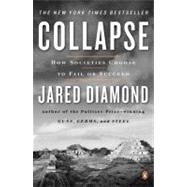
Collapse : How Societies Choose to Fail or Succeed
ISBN: 9780143036555 | 0143036556
Edition: Reprint
Format: Paperback
Publisher: Penguin (Non-Classics)
Pub. Date: 12/27/2005

Why Rent from Knetbooks?

Because Knetbooks knows college students. Our rental program is designed to save you time and money. Whether you need a textbook for a semester, quarter or even a summer session, we have an option for you. Simply select a rental period, enter your information and your book will be on its way!

Top 5 reasons to order all your textbooks from Knetbooks:

  • We have the lowest prices on thousands of popular textbooks
  • Free shipping both ways on ALL orders
  • Most orders ship within 48 hours
  • Need your book longer than expected? Extending your rental is simple
  • Our customer support team is always here to help
SummaryTable of ContentsAuthor Biography
In his runaway bestseller "Guns, Germs, and Steel," Jared Diamond brilliantly examined the circumstances that allowed Western civilizations to dominate much of the world. Now he probes the other side of the equation: What caused some of the great civilizations of the past to fall into ruin, and what can we learn from their fates? Using a vast historical and geographical perspective ranging from Easter Island and the Maya to Viking Greenland and modern Montana, Diamond traces a fundamental pattern of environmental catastropheone whose warning si... MORE
List of Mapsxiii
Prologue: A Tale of Two Farms1(24)
Two farms
Collapses, past and present
... MORE
Vanished Edens?
A five-point framework
Businesses and the environment
The comparative method
Plan of the book
Part One: MODERN MONTANA25(52)
Chapter 1: Under Montana's Big Sky
27(50)
Stan Falkow's story
Montana and me
Why begin with Montana?
Montana's economic history
Mining
Forests
Soil
Water
Native and non-native species
Differing visions
Attitudes towards regulation
Rick Laible's story
Chip Pigman's story
Tim Huls's story
John Cook's story
Montana, model of the world
Part Two: PAST SOCIETIES77(232)
Chapter 2: Twilight at Easter
79(41)
The quarry's mysteries
Easter's geography and history
People and food
Chiefs, clans, and commoners
Platforms and statues
Carving, transporting, erecting
The vanished forest
Consequences for society
Europeans and explanations
Why was Easter fragile?
Easter as metaphor
Chapter 3: The Last People Alive: Pitcairn and Henderson Islands
120(16)
Pitcairn before the Bounty
Three dissimilar islands
Trade
The movie's ending
Chapter 4: The Ancient Ones: The Anasazi and Their Neighbors
136(21)
Desert farmers
Tree rings
Agricultural strategies
Chaco's problems and packrats
Regional integration
Chaco's decline and end
Chaco's message
Chapter 5: The Maya Collapses
157(21)
Mysteries of lost cities
The Maya environment
Maya agriculture
Maya history
Copán
Complexities of collapses
Wars and droughts
Collapse in the southern lowlands
The Maya message
Chapter 6: The Viking Prelude and Fugues
178(33)
Experiments in the Atlantic
The Viking explosion
Autocatalysis
Viking agriculture
Iron
Viking chiefs
Viking religion
Orkneys, Shetlands, Faeroes
Iceland's environment
Iceland's history
Iceland in context
Vinland
Chapter 7: Norse Greenland's Flowering
211(37)
Europe's outpost
Greenland's climate today
Climate in the past
Native plants and animals
Norse settlement
Farming
Hunting and fishing
An integrated economy
Society
Trade with Europe
Self-image
Chapter 8: Norse Greenland's End
248(29)
Introduction to the end
Deforestation
Soil and turf damage
The Inuit's predecessors
Inuit subsistence
Inuit/Norse relations
The end
Ultimate causes of the end
Chapter 9: Opposite Paths to Success
277(32)
Bottom up, top down
New Guinea highlands
Tikopia
Tokugawa problems
Tokugawa solutions
Why Japan succeeded
Other successes
Part Three: MODERN SOCIETIES309(108)
Chapter 10: Malthus in Africa: Rwanda's Genocide
311(18)
A dilemma
Events in Rwanda
More than ethnic hatred
Buildup in Kanama
Explosion in Kanama
Why it happened
Chapter 11: One Island, Two Peoples, Two Histories: The Dominican Republic and Haiti
329(29)
Differences
Histories
Causes of divergence
Dominican environmental impacts
Balaguer
The Dominican environment today
The future
Chapter 12: China, Lurching Giant
358(20)
China's significance
Background
Air, water, soil
Habitat, species, megaprojects
Consequences
Connections
The future
Chapter 13: "Mining" Australia
378(39)
Australia's significance
Soils
Water
Distance
Early history
Imported values
Trade and immigration
Land degradation
Other environmental problems
Signs of hope and change
Part Four: PRACTICAL LESSONS417(109)
Chapter 14: Why Do Some Societies Make Disastrous Decisions?
419(22)
Road map for success
Failure to anticipate
Failure to perceive
Rational bad behavior
Disastrous values
Other irrational failures
Unsuccessful solutions
Signs of hope
Chapter 15: Big Businesses and the Environment: Different Conditions, Different Outcomes
441(45)
Resource extraction
Two oil fields
Oil company motives
Hardrock mining operations
Mining company motives
Differences among mining companies
The logging industry
Forest Stewardship Council
The seafood industry
Businesses and the public
Chapter 16: The World as a Polder: What Does It All Mean to Us Today?
486(40)
Introduction
7(519)
The most serious problems
If we don't solve them
Life in Los Angeles
One-liner objections
The past and the present
Reasons for hope
Acknowledgments526(3)
Further Readings529(32)
Index561(15)
Illustration Credits576
Jared Diamond is a professor of geography at the University of California, Los Angeles. The recipient of numerous awards, he has published more than two hundred articles in such prestigious magazines as Discover and Nature.


Please wait while this item is added to your cart...

