 Free Shipping On Every Order



Amazon no longer offers textbook rentals. We do!
The Checklist Manifesto How to Get Things Right
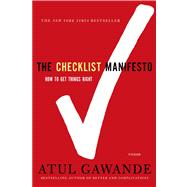
The Checklist Manifesto How to Get Things Right
- ISBN 13:
9780312430009
- ISBN 10:
0312430000
- Edition: 1st
- Format: Paperback
- Copyright: 01/04/2011
- Publisher: Picador
.svg) Rent
From $10.00
Rent
From $10.00
List Price $17.99 Save
| TERM | PRICE | DUE |
|---|---|---|
 Free Shipping Both Ways
Highlight/Take Notes Like You Own It
Purchase/Extend Before Due Date
 Free Shipping On Every Order
List Price $17.99 Save $3.15
In Stock Usually Ships in 24 Hours.
 We Buy This Book Back!
.svg "Free Shipping On Every Order") Free Shipping On Every Order
Free Shipping On Every Order
List Price $17.99 Save $0.63
Usually Ships in 2-3 Business Days
We Buy This Book Back!
Free Shipping On Every Order
Note: Supplemental materials are not guaranteed with Rental or Used book purchases.
Extend or Purchase Your Rental at Any Time
Need to keep your rental past your due date? At any time before your due date you can extend or purchase your rental through your account.
Summary
In his latest bestseller, Atul Gawande shows what the simple idea of the checklist reveals about the complexity of our lives and how we can deal with it.
The modern world has given us stupendous know-how. Yet avoidable failures continue to plague us in health care, government, the law, the financial industry—in almost every realm of organized activity. And the reason is simple: the volume and complexity of knowledge today has exceeded our ability as individuals to properly deliver it to people—consistently, correctly, safely. We train longer, specialize more, use ever-advancing technologies, and still we fail. Atul Gawande makes a compelling argument that we can do better, using the simplest of methods: the checklist.
In riveting stories, he reveals what checklists can do, what they can’t, and how they could bring about striking improvements in a variety of fields, from medicine and disaster recovery to professions and businesses of all kinds. And the insights are making a difference.
Already, a simple surgical checklist from the World Health Organization designed by following the ideas described here has been adopted in more than twenty countries as a standard for care and has been heralded as “the biggest clinical invention in thirty years” (The Independent).
“Gawande deftly weaves in examples of checklist successes in diverse fields like aviation and skyscraper construction. . . . Fascinating reading.”-New York Times Book Review
“This is a brilliant book about an idea so simple it sounds dumb until you hear the case for it. Atul Gawande presents an argument so strong that I challenge anyone to go away from this book unconvinced.”-The Seattle Times
“Fascinating . . . presents a convincing case that adopting more checklists will surely help.”-Bloomberg News
“Gawande argues convincingly and eloquently.”-San Francisco Chronicle


