FREE SHIPPING BOTH WAYS
ON EVERY ORDER!
LIST PRICE:
$194.67

OUR PRICE:
$24.74

You may extend rentals at any time.


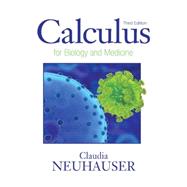
Calculus For Biology and Medicine

ISBN: 9780321644688 | 0321644689
Edition: 3rd
Format: Hardcover
Publisher: Pearson
Pub. Date: 1/3/2010

Why Rent from Knetbooks?

Because Knetbooks knows college students. Our rental program is designed to save you time and money. Whether you need a textbook for a semester, quarter or even a summer session, we have an option for you. Simply select a rental period, enter your information and your book will be on its way!

Top 5 reasons to order all your textbooks from Knetbooks:

  • We have the lowest prices on thousands of popular textbooks
  • Free shipping both ways on ALL orders
  • Most orders ship within 48 hours
  • Need your book longer than expected? Extending your rental is simple
  • Our customer support team is always here to help
SummaryTable of ContentsAuthor Biography
For a two-semester or three-semester course in Calculus for Life Sciences.Calculus for Biology and Medicine, Third Edition, addresses the needs of students in the biological sciences by showing them how to use calculus to analyze natural phenomenawithout compromising the rigorous presentation of the mathematics. While the table of contents aligns well with a traditional calculus text, all the concepts are presented through biological and medical applications. The text provides students with the knowledge and skills necessary to analyze and inte... MORE

1. Preview and Review

1.1 Preliminaries

1.2 Elementary Functions

1.3 Graphing


2. Discrete Time Models, Sequences, and Difference Equations

2.1 Exponential Growth and Decay

... MORE

2.3 More Population Models


3. Limits and Continuity

3.1 Limits

3.2 Continuity

3.3 Limits at Infinity

3.4 The Sandwich Theorem and Some Trigonometric Limits

3.5 Properties of Continuous Functions

3.6 A Formal Definition of Limits (Optional)


4. Differentiation

4.1 Formal Definition of the Derivative

4.2 The Power Rule, the Basic Rules of Differentiation, and the Derivatives of Polynomials

4.3 The Product and Quotient Rules, and the Derivatives of Rational and Power Functions

4.4 The Chain Rule and Higher Derivatives

4.5 Derivatives of Trigonometric Functions

4.6 Derivatives of Exponential Functions

4.7 Derivatives of Inverse Functions, Logarithmic Functions, and the Inverse Tangent Function

4.8 Linear Approximation and Error Propagation


5. Applications of Differentiation

5.1 Extrema and the Mean-Value Theorem

5.2 Monotonicity and Concavity

5.3 Extrema, Inflection Points, and Graphing

5.4 Optimization

5.5 L’Hôpital’s Rule

5.6 Difference Equations: Stability (Optional)

5.7 Numerical Methods: The Newton-Raphson Method (Optional)

5.8 Antiderivatives


6. Integration

6.1 The Definite Integral

6.2 The Fundamental Theorem of Calculus

6.3 Applications of Integration


7. Integration Techniques and Computational Methods

7.1 The Substitution Rule

7.2 Integration by Parts and Practicing Integration

7.3 Rational Functions and Partial Fractions

7.4 Improper Integrals

7.5 Numerical Integration

7.6 The Taylor Approximation

7.7 Tables of Integrals (Optional)


8. Differential Equations

8.1 Solving Differential Equations

8.2 Equilibria and Their Stability

8.3 Systems of Autonomous Equations (Optional)


9. Linear Algebra and Analytic Geometry

9.1 Linear Systems

9.2 Matrices

9.3 Linear Maps, Eigenvectors, and Eigenvalues

9.4 Analytic Geometry


10. Multivariable Calculus

10.1 Functions of Two or More Independent Variables

10.2 Limits and Continuity

10.3 Partial Derivatives

10.4 Tangent Planes, Differentiability, and Linearization

10.5 More about Derivatives (Optional)

10.6 Applications (Optional)

10.7 Systems of Difference Equations (Optional)


11. Systems of Differential Equations

11.1 Linear Systems: Theory

11.2 Linear Systems: Applications

11.3 Nonlinear Autonomous Systems: Theory

11.4 Nonlinear Systems: Applications


12. Probability and Statistics

12.1 Counting

12.2 What is Probability?

12.3 Conditional Probability and Independence

12.4 Discrete Random Variables and Discrete Distributions

12.5 Continuous Distributions

12.6 Limit Theorems

12.7 Statistical Tools
Claudia Neuhauser is Vice Chancellor for Academic Affairs and Director of the Center for Learning Innovation at the University of Minnesota Rochester (UMR). She is a Distinguished McKnight University Professor, Howard Hughes Medical Institute Professor, and Morse-Alumni Distinguished Teaching Professor. She received her diploma in Mathematics from the Universität Heidelberg (Germany), and a PhD in Mathematics from Cornell University. Before joining UMR in July 2008, she was Professor and Head in the Department of Ecology, Evolution and Behavior at the University of Minnesota—Twin Cities, and a faculty member in mathematics departments at the University of Southern California, University of Wisconsin—Madison, University of Minnesota, and University of California—Davis. Dr. Neuhauser’s research is at the interface of ecology and evolution. She investigates effects of spatial structure on community dynamics, in particular, the effect of competition on the spatial structure of competitors and the effect of symbionts on the spatial distribution of their hosts. In addition, her research in population genetics has resulted in the development of statistical tools for random samples of genes. In her role as Director of the Center for Learning Innovation at the University of Minnesota Rochester, Dr. Neuhauser is responsible for the development of the Bachelor of Science in Health Sciences. The Center promotes a learner-centered, concept-based learning environment in which ongoing assessment guides and monitors student learning and is the basis for data-driven research on learning. Dr. Neuhauser’s interest in furthering the quantitative training of biology undergraduate students has resulted in a textbook on Calculus for Biology and Medicine and a web page Numb3r5 Count! (http://bioquest.org/numberscount/). In her spare time, she enjoys riding her bike, working out in the gym, and reading history and philosophy.

Related Products


  • Calculus for Biology and Medicine
    Calculus for Biology and Medic...
  • Calculus for Biology and Medicine
    Calculus for Biology and Medic...
  • Outlines & Highlights for Calculus for Biology and Medicine
    Outlines & Highlights for Calc...


Please wait while this item is added to your cart...