FREE SHIPPING BOTH WAYS
ON EVERY ORDER!
LIST PRICE:
$62.67

Sorry, this item is currently unavailable.

Brief Guide to Writing from Readings, A
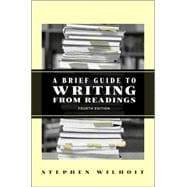
ISBN: 9780321435088 | 0321435087
Edition: 4th
Format: Paperback
Publisher: Longman
Pub. Date: 1/1/2007

Why Rent from Knetbooks?

Because Knetbooks knows college students. Our rental program is designed to save you time and money. Whether you need a textbook for a semester, quarter or even a summer session, we have an option for you. Simply select a rental period, enter your information and your book will be on its way!

Top 5 reasons to order all your textbooks from Knetbooks:

  • We have the lowest prices on thousands of popular textbooks
  • Free shipping both ways on ALL orders
  • Most orders ship within 48 hours
  • Need your book longer than expected? Extending your rental is simple
  • Our customer support team is always here to help
SummaryTable of Contents
This brief guide teaches students how to write the most common papers assigned in college courses: source-based essays that summarize, analyze, critique, and synthesize. Comprehensive enough to serve as a primary text yet compact enough to serve as a supplement, this clear and concise writing guide teaches students how to critically read, clearly summarize, carefully respond to, precisely critique, creatively synthesize, and accurately quote or paraphrase texts. A Brief Guide is a valuable teaching and reference tool that students of many disci... MORE
... MORE
Prefacexiii
Chapter 1 CRITICAL READING1(28)
Definition and Purpose
1(2)
Asking Questions about What You Read
3(8)
Questions to Ask Before You Begin a Close Reading of a Text
4(3)
Questions to Ask While You Read and Reread Material
7(4)
Marking Texts
11(4)
Highlighting Texts
11(1)
Annotating Texts
12(3)
Sample Annotated Reading: "Hard Choices" by Patrick Moore
15(4)
Note Taking
19(1)
Additional Reading: "Getting Serious about Eradicating Binge Drinking" by Henry Wechsler
20(5)
Summary Chart—Critical Reading: Asking Questions
25(2)
Summary Chart—Critical Reading: Marking Texts
27(1)
Summary Chart—Critical Reading: Note Taking
28(1)
Chapter 2 JOURNALS29(10)
Definition
29(1)
Purpose
30(2)
Types of Entries
32(3)
Summaries
32(1)
Analyses
32(1)
Responses
32(1)
Reflections
33(1)
Questions
33(1)
Critiques
33(1)
Syntheses
33(1)
Applications
33(1)
Refutations
34(1)
Outlines
34(1)
Drafts
34(1)
Personal Experience
34(1)
Self-Reflection
35(1)
Creative Writing
35(1)
Drawings
35(1)
Language and Format
35(2)
Language
36(1)
Format
36(1)
Final Considerations
37(2)
Chapter 3 QUOTATION39(18)
Definition and Purpose
39(1)
Guidelines on When to Quote Material
40(2)
Quote Passages When the Author Has Written Something in a Distinctive or Especially Insightful or Interesting Way
40(1)
Quote Material That Lends Support to a Position You Are Trying to Make in Your Paper
40(1)
Quote Authorities Who Disagree with a Position You Are Advocating or Who Offer Alternative Explanations or Contradictory Data
41(1)
Guidelines on When Not to Quote Material
42(1)
Do Not Quote Passages Merely to Fill Space
42(1)
Do Not Quote Passages as a Substitute for Thinking
42(1)
Do Not Quote Passages Because You Do Not Understand the Author's Ideas Well Enough to Paraphrase Them
43(1)
Integrating Quotations into Your Writing
43(1)
Two Basic Types of Quotations
43(1)
Reading: "Missing Link"
44(7)
The Block Quotation
46(3)
The Integrated Quotation
49(2)
Altering Quoted Material and Avoiding Misquotations
51(3)
Summary Chart: Guidelines on Quotations
54(1)
Summary Chart: Integrating Quotations into Your Writing
55(2)
Chapter 4 PARAPHRASE57(12)
Definition and Purpose
57(1)
Qualities of a Good Paraphrase
58(2)
Thorough
58(1)
Accurate
58(1)
Fair
59(1)
Objective
59(1)
How to Paraphrase Material
60(5)
Changing Words
60(2)
Changing Sentence Structure
62(1)
Combining Sentences
63(1)
"Unpacking" Sentences
64(1)
Documentation
65(1)
Summary Chart: How to Write a Paraphrase
66(1)
Summary Chart: Qualities of a Good Paraphrase
67(2)
Chapter 5 SUMMARY69(14)
Definition and Purpose
69(1)
Types of Summaries
70(1)
Qualities of a Good Summary
71(3)
Comprehensive
71(1)
Brief
72(1)
Accurate
72(1)
Neutral
73(1)
Independent
73(1)
How to Summarize a Text
74(1)
Read, Reread, and Annotate the Source Text
74(1)
Summarize Each Section of the Source Text
74(1)
Write Your First Draft
74(1)
Check the Draft against the Source Text
75(1)
Rewrite the Summary
75(1)
Documentation
75(1)
Sample Summaries
76(1)
Reading: "AIDS and Population 'Control'" by Gerard Piel
76(2)
Sample Informative Summary
78(1)
Sample Explanatory Summary
79(2)
Summary Chart: How to Write a Summary
81(2)
Chapter 6 RESPONSE ESSAYS83(14)
Definition and Purpose
83(1)
Qualities of a Good Response Essay
84(2)
Honest
84(1)
Informed
84(1)
Clear
85(1)
Well Supported
85(1)
Writing the Response Essay
86(5)
Carefully Read the Material
86(1)
Explore Your Responses to the Reading as You Annotate the Text
86(1)
Compose Your Rough Draft
87(1)
Introduce Your Topic, Source Text, and Thesis
88(1)
Write Your Conclusion
89(1)
Revise Your Rough Draft
89(2)
Sample Response Essay: A Response to "AIDS and Population 'Control'"
91(1)
Sample Essay 1
91(1)
Sample Essay 2
92(3)
Summary Chart: How to Write a Response Essay
95(2)
Chapter 7 CRITIQUE97(32)
Definition and Purpose
97(1)
The Film Review as Critique
98(3)
Writing a Critique
101(12)
Step 1 Carefully Read and Annotate the Source Text
101(1)
Step 2 Analyze and Evaluate the Reading
102(7)
Step 3 Write Your Thesis and Decide Which Aspects of the Reading Will Be the Focus of Your Essay
109(1)
Step 4 Write Your Rough Draft
110(2)
Step 5 Rewrite Your Critique
112(1)
Reading: "Clear Message to Teens: 'It's OK to Have Sex'" by Joan Beck
113(2)
Sample Critique: "Beck's Essay Not Convincing"
115(2)
Additional Reading: "Condom Availability Promotes Health, Saves Lives" by Margaret Pruitt Clark
117(4)
Additional Reading: "Apply Peer Pressure, Not Latex, against Casual Sex" by Edwin J. Delattre
121(6)
Summary Chart: Writing a Critique
127(2)
Chapter 8 RHETORICAL ANALYSIS129(20)
Definition and Purpose
129(1)
The Rhetorical Situation
130(2)
Elements of the Rhetorical Situation
131(1)
Rhetorical Strategies
132(5)
Content
133(3)
Structure
136(1)
Style
136(1)
Analyzing a Text's Rhetorical Strategies—An Example
137(3)
Lincoln's Second Inaugural Address
137(1)
A Rhetorical Analysis of Lincoln's Speech
138(2)
Writing a Rhetorical Analysis Essay
140(4)
Step 1 Carefully Read the Assignment
140(1)
Step 2 Establish the Source Text's Rhetorical Situation
140(1)
Step 3 Determine the Author's Goal
140(1)
Step 4 Identify and Evaluate the Source Text's Rhetorical Strategies
141(1)
Step 5 Determine Your Thesis
141(1)
Step 6 Write Your Rough Draft
142(1)
Step 7 Revise Your Essay
143(1)
Sample Rhetorical Analysis Essay
144(3)
Rhetorical Analysis of Lincoln's Second Inaugural Address
145(2)
Summary Chart: How to Write a Rhetorical Analysis Essay
147(2)
Chapter 9 INFORMATIVE SYNTHESIS149(18)
Definition and Purpose
149(1)
Types of Synthesis Essays
150(1)
Reading: "The Fool on the Hill" by Brian D. Johnson
150(1)
Reading: "Forrest Gump" by David Ansen
151(2)
Reading: "Forrest Gump" by Peter Travers
153(1)
Informative Synthesis
154(7)
Definition
154(1)
Writing an Informative Synthesis
155(6)
Sample Informative Synthesis
161(3)
Summary Chart: Informative Synthesis
164(3)
Chapter 10 ARGUMENTATIVE SYNTHESIS167(44)
Definition
167(1)
The Elements of Argument
168(6)
Claims
168(1)
Grounds
169(3)
Warrants
172(2)
Argument and Persuasion
174(3)
Appeals Based on Reason
174(1)
Appeals Based on Emotion
175(1)
Appeals Based on Character and Credibility
176(1)
Writing an Argumentative Synthesis
177(7)
Analyze the Assignment
177(1)
Annotate and Critique the Readings
178(1)
Formulate a Thesis
179(1)
Choose an Organizational Plan
180(3)
Write Your Rough Draft
183(1)
Revise Your Draft
183(1)
Check Quotations and Documentation
184(1)
Sample Argumentative Synthesis
184(5)
Sample Argumentative Synthesis (Focusing on the Quality of the Readings)
184(2)
Sample Argumentative Synthesis (Focusing on the Topic of the Readings)
186(3)
Additional Reading: "College Prep: Adapting to College Life in an Era of Heightened Stress" by Glenn C. Altschuler
189(3)
Additional Reading: "More in College Seek Help for Psychological Problems" by Erica Goode
192(2)
Additional Reading: "Complex Set of Ills Spurs Rising Teen Suicide Rate" by Jessica Portner
194(8)
Additional Reading: "Suicide and Depression Among College Students: A Decade Later" by Susan R. Furr, John S. Westefeld, Gaye N. McConnell, and J. Marshall Jenkins
202(7)
Summary Chart: Writing an Argumentative Synthesis Essay
209(2)
Chapter 11 PLAGIARISM211(8)
Definition
211(1)
Forms of Plagiarism
211(3)
Purchasing a Paper
212(1)
Turning in a Paper Someone Else Has Written for You
212(1)
Turning in Another Student's Work without That Student's Knowledge
212(1)
Improper Collaboration
212(1)
Copying a Paper from a Source Text without Proper Acknowledgment
213(1)
Copying Material from a Source Text, Supplying Proper Documentation, but Leaving Out Quotation Marks
213(1)
Paraphrasing Material from a Reading without Proper Documentation
213(1)
How to Avoid Plagiarism
214(3)
Do Your Own Work
214(1)
Take Good Notes
214(1)
Paraphrase Properly
215(1)
Supply Proper Documentation
215(1)
Clarify Collaboration Guidelines
215(2)
Summary Chart: Plagiarism
217(2)
Chapter 12 DOCUMENTATION219(18)
Definition and Purpose
219(1)
Types of Documentation
219(1)
Primary Academic Style Manuals
220(1)
APA Guidelines
221(5)
In-Text Documentation
221(4)
Footnotes and Endnotes
225(1)
CSE Guidelines
226(5)
In-Text Documentation
226(5)
Footnotes and Endnotes
231(1)
MLA Guidelines
231(6)
In-Text Documentation
231(4)
Footnotes and Endnotes
235(2)
Chapter 13 REFERENCE LISTS AND WORKS CITED ENTRIES237(42)
Definition and Purpose
237(1)
APA Format
238(12)
Sample Reference List Entries
238(8)
Sample APA-Style Reference List
246(4)
CSE Format
250(17)
Sample Reference List Entries
250(13)
Sample CSE-Style Reference Lists
263(4)
MLA Format
267(12)
Sample Works Cited Entries
267(5)
Electronic Sources of Information
272(2)
Sample MLA-Style Works Cited List
274(5)
Chapter 14 TIMED WRITING ASSIGNMENTS279(14)
Definition
279(1)
A Range of Timed Writing Assignments, Purposes, and Conditions
280(2)
Common Timed Writing Tasks
280(1)
Rhetorical Aims
281(1)
Access to Source Material
282(1)
Access to Possible Assignments
282(1)
Qualities of a Good Timed Essay
282(2)
Appropriate
283(1)
Concise
283(1)
Supported
283(1)
Organized
284(1)
Clear and Correct
284(1)
Writing Timed Assignments
284(5)
Prepare for the Assignment Outside of Class
284(2)
Read and Analyze the Assignment or Test Question
286(1)
Plan Your Essay or Answer
286(1)
Draft Your Essay or Answer
287(1)
Revise Your Essay or Answer
288(1)
Proofread Your Essay or Answer
288(1)
Final Thoughts
289(1)
Summary Chart: How to Write Timed Essays
290(3)
Appendix 1 REVISION CHECKLISTS293(9)
Quotation Checklist
293(1)
Paraphrase Checklist
294(1)
Summary Checklist
295(1)
Response Essay Checklist
296(1)
Critique Checklist
297(1)
Rhetorical Analysis Checklist
298(1)
Informative Synthesis Checklist
299(1)
Argumentative Synthesis Checklist
300(1)
Plagiarism Checklist
301(1)
Appendix 2 PEER REVIEW GUIDELINES302(3)
Appendix 3 REVISION GUIDELINES305(4)
Index309(6)
Credits315

Related Products


  • A Brief Guide to Writing from Readings
    A Brief Guide to Writing from ...
  • A Brief Guide to Writing from Readings
    A Brief Guide to Writing from ...
  • A Brief Guide to Writing from Readings
    A Brief Guide to Writing from ...
  • Brief Guide to Writing from Readings Value Package (includes MyCompLab NEW 24-month Student Access  )
    Brief Guide to Writing from Re...
  • Brief Guide to Writing from Readings, A
    Brief Guide to Writing from Re...
  • Brief Guide to Writing from Readings, A
    Brief Guide to Writing from Re...
  • Brief Guide to Writing from Readings, A Plus NEW MyCompLab -- Access Card Package
    Brief Guide to Writing from Re...
  • New Mycomplab: Where Wri&Rsrch Help Is Just
    New Mycomplab: Where Wri&Rsrch...


Please wait while this item is added to your cart...