FREE SHIPPING BOTH WAYS
ON EVERY ORDER!
LIST PRICE:
$84.80

OUR PRICE:
$20.99

You may extend rentals at any time.


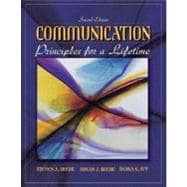
Communication : Principles for a Lifetime
ISBN: 9780205386970 | 0205386970
Edition: 2nd
Format: Paperback
Publisher: Allyn & Bacon
Pub. Date: 1/1/2004

Why Rent from Knetbooks?

Because Knetbooks knows college students. Our rental program is designed to save you time and money. Whether you need a textbook for a semester, quarter or even a summer session, we have an option for you. Simply select a rental period, enter your information and your book will be on its way!

Top 5 reasons to order all your textbooks from Knetbooks:

  • We have the lowest prices on thousands of popular textbooks
  • Free shipping both ways on ALL orders
  • Most orders ship within 48 hours
  • Need your book longer than expected? Extending your rental is simple
  • Our customer support team is always here to help
SummaryTable of Contents
Written by experienced and highly regarded authors and teachers, Communication: Principles for a Lifetime provides readers with all the theory and skills necessary in the introduction to communication in a manner that will help them to apply what they learn throughout their lives.

Each chapter concludes with “Summary.”

I. PRINCIPLES OF COMMUNICATION.

1. Foundations of Human Communication.
Communication Defined.
Why Study Communication?
Communication Models.
Communication Characteristics.
Communication Principles for a Lifetime.
Communicating with Others: Three Situations.

2. Self-Awareness and Communication.
Self-Concept: Who Are You?
Self-Esteem: What Is Your Value?
Communication and the Enh... MORE

3. Understanding Verbal Messages.
Why Focus on Language?
The Nature of Language.
The Power of Words.
Confronting Bias in Language.
Using Words to Establish Supportive Relationships.

4. Understanding Nonverbal Messages.
Why Focus on Nonverbal Communication?
The Nature of Nonverbal Communication.
The Multichanneled Nature of Nonverbal Communication.
Codes of Nonverbal Communication.
How to More Accurately Interpret Nonverbal Cues.

5. Listening and Responding.
How We Listen.
Listening Barriers.
Listening Skills.
Responding Skills.
Responding with Empathy.

6. Adapting to Others: Bridging Culture and Gender Differences.
Culture and Communication.
Gender and Communication.
Barriers to Bridging Differences and Adapting to Others.
Adapting to Others Who Are Different from You.

II. INTERPERSONAL COMMUNICATION.

7. Understanding Interpersonal Communication.
What Is Interpersonal Communication?
Initiating Relationships.
Maintaining Relationships through Interpersonal Communication.

8. Enhancing Relationships.
The Importance of Friendship.
The Importance of Family.
The Importance of Colleagues.
Stages of Relationship Development.
Managing Interpersonal Conflict.

III. COMMUNICATING IN GROUPS AND TEAMS.

9. Understanding Group and Team Performance.
Groups and Teams Defined.
Understanding Types of Groups and Teams.
Understanding Group and Team Dynamics.
Understanding Group and Team Phases of Development.
Understanding Diversity in Groups and Teams: Adapting to Differences.

10. Enhancing Group and Team Performance.
What Effective Group Members Do.
Structuring Group and Team Problem Solving.
Enhancing Team Leadership.
Enhancing Group and Team Meetings.

IV. PRESENTATIONAL SPEAKING.

11. Developing Your Presentation.
An Overview of the Presentational Speaking Process.
Understanding Speaker Anxiety.
Managing Speaker Anxiety.
Selecting and Narrowing Your Topic.
Identifying Your Purpose.
Developing Your Central Idea.
Generating Main Ideas.
Gathering Supporting Material.

12. Organizing and Outlining Your Presentation.
Organizing Your Main Ideas.
Organizing Your Supporting Material.
Organizing Your Presentation for the Ears of Others.
Introducing and Concluding Your Presentation.
Outlining Your Presentation.

13. Delivering Your Presentation.
Methods of Delivery.
Effective Verbal Delivery.
Effective Nonverbal Delivery.
Effective Presentation Aids.
Some Final Tips for Rehearsing and Delivering Your Presentation.

14. Speaking to Inform.
Types of Informative Presentations.
Strategies for Making Your Informative Presentation Clear.
Strategies for Making Your Informative Speech Interesting.
Strategies for Making Your Presentation Memorable.

15. Speaking to Persuade.
Persuasion Defined.
Motivating Your Audience: The Psychology of Persuasion.
Selecting and Narrowing Your Persuasive Topic.
Identifying Your Persuasive Purpose.
Developing Your Central Idea as a Persuasive Proposition.
Supporting Your Presentation with Credibility, Logic, and Emotion: Strategies for Persuading Your Audience.
Organizing Your Persuasive Message.
How to Adapt Ideas to People and People to Ideas.

Appendix A. Interviewing.

Appendix B. Sample Speeches for Discussion and Evaluation.

Related Products


  • Communication : Principles for a Lifetime
    Communication : Principles for...
  • Communication : Principles for a Lifetime
    Communication : Principles for...
  • Communication : Principles for a Lifetime (With Interactive Companion Pin)
    Communication : Principles for...
  • Communication : Principles For Lifetime
    Communication : Principles For...
  • Communication Principles for a Lifetime Plus NEW MyCommunicationLab with eText -- Access Card Package
    Communication Principles for a...
  • Communication: Principles for a Lifetime
    Communication: Principles for ...
  • Communication: Principles for a Lifetime (Book alone)
    Communication: Principles for ...
  • MyCommunicationLab Pegasus with Pearson eText Student Access Code Card for Communication (standalone)
    MyCommunicationLab Pegasus wit...
  • MyCommunicationLab with Pearson eText -- Standalone Access Card -- for Communication
    MyCommunicationLab with Pearso...
  • Outlines and Highlights for Communication : Principles for Lifetime by Steven A. Beebe, ISBN
    Outlines and Highlights for Co...


Please wait while this item is added to your cart...