Because Knetbooks knows college students. Our rental program is designed to save you time and money. Whether you need a textbook for a semester, quarter or even a summer session, we have an option for you. Simply select a rental period, enter your information and your book will be on its way!
| Chapter 1: Thinking about Religion |
| Chapter 2: Talking about Religion |
| Chapter 3: Hinduism: The Eternal Law |
| Chapter 4: Hinduism: Law and Life |
| Chapter 5: Buddhism: Becoming Awake |
| Chapter 6: Buddhism: Awakening the World | ... MORE
| Chapter 7: East Asian Sacred Ways: The Eternal Dao |
| Chapter 8: East Asian Sacred Ways: Harmony in the World |
| Chapter 9: Judaism: A Chosen People Choosing God |
| Chapter 10: Judaism: Israel in the Diaspora |
| Chapter 11: Christianity: The God-Man Messiah |
| Chapter 12: Christianity: Communion and Community |
| Chapter 13: Islam: Submission and Faith |
| Chapter 14: Islam: The Pillars and the Umma |
| Chapter 15: Religions of Place: A Sacred World Around Us |
| Chapter 16: New Religions: A Quest for the Sacred |
In This Section:
I. Author Bio
II. Author Letter
I. Author Bio
Roy R. Robson is Professor of History and Director of the Honors Program at University of the Sciences in Philadelphia. He teaches courses on modern Europe, Russia, and world religions. His interdisciplinary teaching includes “Intellectual Heritage: Time” and “Views of the Cosmos." Robson writes extensively on Russian history and world religions. His last book, Solovki, won praise from the New Yorker, The Times (London), Condé Nast Traveler, and the Journal of Modern History. Robson serves as the series editor on Orthodox Christianity for Northern Illinois University Press. This year, the National Endowment for the Humanities honored the University’s Intellectual Heritage program by granting Dr. Robson a fellowship to expand his course on Time. Dr. Robson is president-elect of the Southern Conference on Slavic Studies, the largest regional association of Slavic scholars in America.
I. Author Letter
Dear Colleagues,
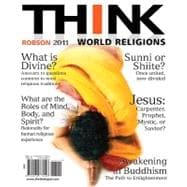
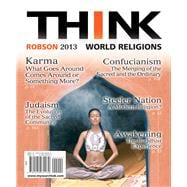
Over the past year, I’ve started to call Think World Religions the "anti-textbook." The term came to me, frankly, after a very tough reader review on Amazon.com. In it, a professor said that TWR was not a true textbook because it lured students with bright graphics, bold photographs, and a magazine format.
After losing a couple of nights sleep, I decided to respond. I sent the professor a heads-up that I would be replying, asked for feedback on ways to improve the book, and posted a response online. As I wrote about TWR, I realized that the reviewer was right. My goal all along has been to create a new kind of textbook: lively, accessible, affordable, and true to a spirit of dialog. Thus—the "anti-textbook."
As a scholar of lived religion focusing on Orthodox Christianity, I seek ways to help students understand how religion interacts with every aspect of human life. Theology and ideology are important. So are relations of power, domination, and revolution. But to me, those cannot take the place of colors, smells, movements, bodies, music, and art that infuse sacred experiences for people around the world.
With those ideas in mind, I have written TWR with some traits unusual for world religion textbooks. My prose is unabashedly personal, I tell stories about my experiences and my work. By keeping the prose anecdotal, active, and narrative, I hope students will consider TWR to be one voice in a conversation that includes me, them, and people around the world.
In the introduction, I describe TWR as a guidebook. No textbook is truly encyclopedic, and I hope that students will see this text pointing them toward their own learning rather than pretending omniscience. In asking students to consider football (especially my beloved Pittsburgh Steelers) as a form of religion, TWR acknowledges how difficult it can be to define and discuss religion.
By asking the same four questions to each sacred tradition, TWR offers students a path toward comparison and analysis. Photographs and diagrams consistently enhance critical thinking and discussion. How, for example, might a Greek Orthodox cross, a medieval Spanish crucifix, and a Chagall painting of the Crucifixion offer different visions of Christianity?
By including both sacred places and contemporary problems, TWR helps students to see the sacred all around them, part of both their own landscape and that of foreign lands.
As I wrote the first draft of each chapter, I asked my Honors Introduction to World Religions class to read and comment on the text. That dialog helped me to create Think World Religions, and I hope that you and your students will continue that conversation.
Please do contact me if you have any questions, comments, or improvements for Think World Religions. My email address is r.robson@usciences.edu.
Sincerely
Roy R. Robson
University of the Sciences