FREE SHIPPING BOTH WAYS
ON EVERY ORDER!
LIST PRICE:
$69.00

OUR PRICE:
$27.32

You may extend rentals at any time.


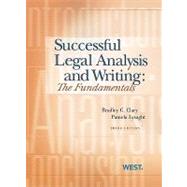
Successful Legal Analysis and Writing : The Fundamentals, 3d

ISBN: 9780314908049 | 0314908048
Edition: 3rd
Format: Paperback
Publisher: West Group
Pub. Date: 3/22/2010

Why Rent from Knetbooks?

Because Knetbooks knows college students. Our rental program is designed to save you time and money. Whether you need a textbook for a semester, quarter or even a summer session, we have an option for you. Simply select a rental period, enter your information and your book will be on its way!

Top 5 reasons to order all your textbooks from Knetbooks:

  • We have the lowest prices on thousands of popular textbooks
  • Free shipping both ways on ALL orders
  • Most orders ship within 48 hours
  • Need your book longer than expected? Extending your rental is simple
  • Our customer support team is always here to help
SummaryTable of Contents
This work is a practical legal analysis and writing handbook. Designed for first-year students, it is also a valuable refresher text for more advanced students, and for practitioners. The book features fundamental advice, a problem-solving perspective, illustrative examples and templates, and an easy-to-read approach. Each chapter is designed to stand on its own or be supplemented by a professor's own materials. The third edition includes additional examples and models, and a chapter on oral argument.
Prefacep. i
Road Mappingp. 1
Where, Whatp. 2
Whyp. 2
Whop. 2
Whenp. 3
Howp. 3
Examplep. 4
Comparison to Legal Writingp. 7
The Role of Facts in Resolving Legal Problemsp. 11
Story Identificationp. 12
Additional Story Identification Principles... MORE
The Role of Rules in Resolving Legal Problemsp. 19
The Sources of Rules: Enacted Law and Casesp. 19
Enacted Lawp. 20
Casesp. 23
Basic Principles for Understanding Primary Authorityp. 25
Considerations When Working with Statutes and Casesp. 28
Determining the Rule in Typical, Simple Scenariosp. 31
Pulling Apart a Rulep. 31
Common Mistakes in Parsing a Rulep. 35
Assembling a Rule from a Single Court Decisionp. 38
Determining the Rule in Typical, Complex Scenariosp. 47
Assembling a Rule from Multiple Court Decisionsp. 47
Common Mistakes in Assembling a Rule from Multiple Casesp. 59
Determining the Rule in Atypical Scenariosp. 61
Assembling Rules in Atypical Settings: Direct Conflictsp. 61
Assembling Rules in Atypical Settings: Cases of First Impressionp. 65
Determining the Meaning of a Statutory Rulep. 71
Interpreting Statutory Languagep. 71
Understand Issues of Statutory Interpretation in Contextp. 73
Basic Organizing Principles in Legal Analysis and Writingp. 81
IRAC: The Basic Componentsp. 84
Introductionp. 84
Rulep. 86
Applicationp. 88
Conclusionp. 91
Linking Discrete IRACsp. 91
Basic Writing Principlesp. 97
Prefer Simplicityp. 98
Prefer the Familiarp. 98
Prefer Concisionp. 98
Prefer Actionp. 99
Avoid Overuse of Adjectives and Adverbsp. 100
Pay Attention to Flowp. 100
Be Meticulousp. 101
Common Mistakes to Avoidp. 101
Citation and Quotation Basicsp. 103
ALWD Citation Manualp. 105
General Citation Rulesp. 105
Full and Short Citationsp. 105
Pinpoint Referencesp. 106
Citation Placement and Usep. 106
Abbreviationsp. 107
Capitalizationp. 110
Citing to Primary Authorityp. 110
Constitutions currently in forcep. 110
Statutes currently in forcep. 110
Casesp. 113
Citing to Secondary Authorityp. 115
Restatementsp. 115
Legal Periodicals (Law Reviews)p. 116
Booksp. 117
Working with Signalsp. 118
The Bluebookp. 120
General Citation Rulesp. 120
Full and Short Citationsp. 120
Pinpoint Referencesp. 121
Citation Placement and Usep. 121
Abbreviationsp. 122
Capitalizationp. 125
Citing to Primary Authorityp. 125
Constitutions currently in forcep. 125
Statutes currently in forcep. 126
Casesp. 128
Citing to Secondary Authorityp. 130
Restatementsp. 130
Legal Periodicals (Law Reviews)p. 131
Booksp. 132
Working with Signalsp. 133
General Rules on Quoting Authorityp. 135
Block Quotationsp. 135
Shorter Quotationsp. 136
Alterations and Omissionsp. 136
Common Questions about When and What to Citep. 139
Communicating a Predictive Analysisp. 143
Common Features of Good Predictive Writingp. 144
The Office Memorandum Templatep. 151
The Client Advice Letter Templatep. 172
Communicating a Persuasive Analysisp. 185
Common Features of Good Persuasive Writingp. 186
The Trial Court Brief Templatep. 191
The Appellate Brief Templatep. 236
Oral Argumentp. 261
A Way to Prepare the Argumentp. 261
A Way to Begin the Argumentp. 263
A Way to Approach the Middle of the Argumentp. 265
A Way to Approach the Conclusion of the Argumentp. 269
Table of Contents provided by Ingram. All Rights Reserved.


Please wait while this item is added to your cart...