FREE SHIPPING BOTH WAYS
ON EVERY ORDER!
LIST PRICE:
$215.85

OUR PRICE:
$117.53

You may extend rentals at any time.


Statistics: Principles and Methods, 5th Edition
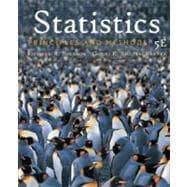
ISBN: 9780471656821 | 0471656828
Edition: 5th
Format: Hardcover
Publisher: WILEY
Pub. Date: 11/1/2005

Why Rent from Knetbooks?

Because Knetbooks knows college students. Our rental program is designed to save you time and money. Whether you need a textbook for a semester, quarter or even a summer session, we have an option for you. Simply select a rental period, enter your information and your book will be on its way!

Top 5 reasons to order all your textbooks from Knetbooks:

  • We have the lowest prices on thousands of popular textbooks
  • Free shipping both ways on ALL orders
  • Most orders ship within 48 hours
  • Need your book longer than expected? Extending your rental is simple
  • Our customer support team is always here to help
SummaryTable of Contents
Easy to read, easy to understand Now revised with updated exercises, Johnson and Bhattacharyya's Fifth Edition of Statistics: Principles and Applications once again offers an easy-to-read, easy-to-understand introduction to statistics. The authors use real-world examples, fresh hands-on exercises, and crystal clear explanations to motivate students to explore the powerful ideas of modern statistics. Fresh exercisesExercises and data sets are updated throughout for currency. Each major section and chapter in the text ends with a set of exercises... MORE
1. Introduction.
1. What is Statistics?
2. Statistics in Our Everyday Life.
... MORE3. Statistics in Aid of Scientific Inquiry.
4. Two Basic Concepts- Population and Sample.
5. The Purposeful Collection of Data.
6. Statistics in Context.
7. Objectives of Statistics.
8. Review Exercises.
2. Organization and Description of Data.
1. Introduction.
2. Main Types of Data.
3. Describing Data by Tables and Graphs.
4. Measures of Center.
5. Measures of Variation.
6. Checking the Stability of the Observations over Time.
7. More on Graphics.
8. Statistics in Context.
9. Review Exercises.
3. Descriptive Study of Bivariate Data.
1. Introduction.
2. Summarization of Bivariate Categorical Data.
3. A Designed Experiment for Making a Comparison.
4. Scatter Diagram of Bivariate Measurement Data.
5. The Correlation Coefficient- A Measure of Linear Relation.
6. Prediction of One Variable from Another (Linear Regression).
7. Review Exercises.
4. Probability.
1. Introduction.
2. Probability of an Event.
3. Methods of Assigning Probability.
4. Event Relations and Two Laws of Probability.
5. Conditional Probability and Independence.
6. Random Sampling from a Finite Population.
7. Review Exercises.
5. Probability Distributions.
1. Introduction.
2. Random Variables.
3. Probability Distribution of a Discrete Random Variable.
4. Expectation (Mean) and Standard Deviation of a Probability Distribution.
5. Success and Failures- Bernoulli Trials.
6. The Binomal Distribution.
7. The Binomal Distribution in Context.
8. Review Exercises.
6. The Normal Distribution.
1. Probability Model for a Continuous Random Variable.
2. The Normal Distribution-Its General Features.
3. The Standard Normal Distribution.
4. Probability Calculations with Normal Distributions.
5. The Normal Approximation to the Binomial.
6. Checking the Plausibility of a Normal Model.
7. Transforming Observations to Attain Near Normality.
8. Review Exercises.
7. Variation in Repeated Samples-Sampling Distribution.
1. Introduction.
2. The Sampling Distribution of a Statistic.
3. Distribution of the Sample Mean and the Central Limit Theorem.
4. Statistics in Context.
5. Review Exercises.
8. Drawing Inferences From Large Samples.
1. Introduction.
2. Point Estimation of Population Mean.
3. Confidence Interval for a Population Mean.
4. Testing Hypotheses about a Population Mean.
5. Inferences about a Population Proportion.
6. Review Exercises.
9. Small-Sample Inferences for Normal Populations.
1. Introduction.
2. Independent Random Samples from Two Populations.
3. Inferences about -Small Sample Size.
4. Relationship between Tests and Confidence Intervals.
5. Inferences about Standard Deviation (The Chi-Square Distribution).
6. Robustness of Inference Procedures.
7. Review Exercises.
10. Comparing Two Treatments.
1. Introduction.
2. Independent Random Samples from Two Populations.
3. Randomization and Its Role Inference.
4. Matched Pair Comparisons.
5. Choosing Between Independent Samples and a Matched Pair Sample.
6. Comparing Two Population Proportions.
7. Review Exercises.
11. Regression Analysis.
1. Introduction.
2. Regression with a Single Predictor.
3. A Straight-Line Regression Model.
4. The Method of Least Squares.
5. The Sampling Variability of the Least Squares Estimators- Tools for Inference.
6. Important Inference Problems.
7. The Strength of a Linear Relation.
8. Remarks About the Straight Line Model Assumptions.
9. Review Exercises.
12. Regression Analysis- II.
Multiple Linear Regression and Other Topics.
1. Introduction.
2. Nonlinear Relations and Linearizing Transformations.
3. Multiple Linear Regression.
4. Residual Plots to Check the Adequacy of a Statistical Model.
5. Review Exercises.
13. Analysis of Categorical Data.
1. Introduction.
2. Pearson's x^2 Test for Goodness of Fit.
3. Contingency Table with One Margin Fixed (Test of Homogeneity).
4. Contingency Table with Neither Margin Fixed (Test of Independence).
5. Review Exercises.
14. Analysis of Variance (ANOVA).
1. Introduction.
2. Comparison of Several Treatments- The Completely Randomized Design.
3. Population Model and Inferences for a Completely Randomized Design.
4. Simultaneous Confidence Intervals.
5. Graphical Diagnostics and Displays to Supplement ANOVA.
6. Randomized Block Experiments for Comparing k Treatments.
7. Using Statistics Wisely.
8. Key Ideas and Formulas.
9. Technology.
10. Review Exercises.
15. Nonparametric Inference.
1. Introduction.
2. The Wilcoxon Rank-Sum Test for Comparing Two Teatments.
3. Matched Pair Comparisons.
4. Measure of Correlation Based on Ranks.
5. Concluding Remarks.
6. Using Statistics Wisely.
7. Key Ideas and Formulas.
8. Technology.
9. Review Exercises.
Appendix A: Summation Notation.
Appendix B: Rules for Counting.
Appendix C: Expectation and Standard Deviation—Properties.
Appendix D: The Expectived Value and Standard Deviation0f X.
Appendix E: Tables.
Data Bank.
Answers to Selected Odd-Numbered Exercises.
Index.


Related Products


  • Outlines and Highlights for Statistics : Principles and Methods by Richard A. Johnson, Gouri K. Bhattacharyya, ISBN
    Outlines and Highlights for St...


Please wait while this item is added to your cart...