FREE SHIPPING BOTH WAYS
ON EVERY ORDER!
LIST PRICE:
$178.67

OUR PRICE:
$25.24

You may extend rentals at any time.


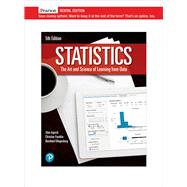
Statistics : The Art and Science of Learning from Data
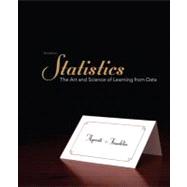
ISBN: 9780321755940 | 0321755944
Edition: 3rd
Format: Hardcover
Publisher: Pearson
Pub. Date: 12/27/2011

Why Rent from Knetbooks?

Because Knetbooks knows college students. Our rental program is designed to save you time and money. Whether you need a textbook for a semester, quarter or even a summer session, we have an option for you. Simply select a rental period, enter your information and your book will be on its way!

Top 5 reasons to order all your textbooks from Knetbooks:

  • We have the lowest prices on thousands of popular textbooks
  • Free shipping both ways on ALL orders
  • Most orders ship within 48 hours
  • Need your book longer than expected? Extending your rental is simple
  • Our customer support team is always here to help
SummaryTable of ContentsAuthor Biography
Alan Agresti and Chris Franklin have merged their research and classroom experience to develop this successful introductory statistics text. Statistics: The Art and Science of Learning from Data, Third Edition, helps students become statistically literate by encouraging them to ask and answer interesting statistical questions. It takes the ideas that have turned statistics into a central science in modern life and makes them accessible and engaging to students without compromising necessary rigor. The Third Edition has been edited for concisene... MORE

Part 1: Gathering and Exploring Data


1. Statistics: The Art and Science of Learning from Data

1.1 Using Data to Answer Statistical Questions

1.2 Sample Versus Population

1.3 Using Calculators and Computers

Chapter Summary

Chapter Problems


... MORE

2.1 Different Types of Data

2.2 Graphical Summaries of Data

2.3 Measuring the Center of Quantitative Data

2.4 Measuring the Variability of Quantitative Data

2.5 Using Measures of Position to Describe Variability

2.6 Recognizing and Avoiding Misuses of Graphical Summaries

Chapter Summary

Chapter Problems


3. Association: Contingency, Correlation, and Regression

3.1 The Association Between Two Categorical Variables

3.2 The Association Between Two Quantitative Variables

3.3 Predicting the Outcome of a Variable

3.4 Cautions in Analyzing Associations

Chapter Summary

Chapter Problems


4. Gathering Data

4.1 Experimental and Observational Studies

4.2 Good and Poor Ways to Sample

4.3 Good and Poor Ways to Experiment

4.4 Other Ways to Conduct Experimental and Nonexperimental Studies

Chapter Summary

Chapter Problems


Part 1 Review

Part 1 Questions

Part 1 Exercises


Part 2: Probability, Probability Distributions, and Sampling Distributions


5. Probability in Our Daily Lives

5.1 How Probability Quantifies Randomness

5.2 Finding Probabilities

5.3 Conditional Probability: The Probability of A Given B

5.4 Applying the Probability Rules

Chapter Summary

Chapter Problems


6. Probability Distributions

6.1 Summarizing Possible Outcomes and Their Probabilities

6.2 Probabilities for Bell-Shaped Distributions

6.3 Probabilities When Each Observation Has Two Possible Outcomes

Chapter Summary

Chapter Problems


7. Sampling Distributions

7.1 How Sample Proportions Vary Around the Population Proportion

7.2 How Sample Means Vary Around the Population Mean

7.3 The Binomial Distribution Is a Sampling Distribution (Optional)

Chapter Summary

Chapter Problems


Part 2 Review

Part 2 Questions

Part 2 Exercises


Part 3: Inferential Statistics


8. Statistical Inference: Confidence Intervals

8.1 Point and Interval Estimates of Population Parameters

8.2 Constructing a Confidence Interval to Estimate a Population Proportion

8.3 Constructing a Confidence Interval to Estimate a Population Mean

8.4 Choosing the Sample Size for a Study

8.5 Using Computers to Make New Estimation Methods Possible

Chapter Summary

Chapter Problems


9. Statistical Inference: Significance Tests about Hypotheses

9.1 Steps for Performing a Significance Test

9.2 Significance Tests about Proportions

9.3 Significance Tests about Means

9.4 Decisions and Types of Errors in Significance Tests

9.5 Limitations of Significance Tests

9.6 The Likelihood of a Type II Error (Not Rejecting H0, Even Though It’s False)

Chapter Summary
Chapter Problems


10. Comparing Two Groups

10.1 Categorical Response: Comparing Two Proportions

10.2 Quantitative Response: Comparing Two Means

10.3 Other Ways of Comparing Means and Comparing Proportions

10.4 Analyzing Dependent Samples

10.5 Adjusting for the Effects of Other Variables

Chapter Summary
Chapter Problems


Part 3 Review

Part 3 Questions

Part 3 Exercises


Part 4: Analyzing Association and Extended Statistical Methods


11. Analyzing the Association Between Categorical Variables

11.1 Independence and Association

11.2 Testing Categorical Variables for Independence

11.3 Determining the Strength of the Association

11.4 Using Residuals to Reveal the Pattern of Association

11.5 Small Sample Sizes: Fisher’s Exact Test

Chapter Summary
Chapter Problems


12. Analyzing the Association Between Quantitative Variables: Regression Analysis

12.1 Model How Two Variables Are Related

12.2 Describe Strength of Association

12.3 Make Inference About the Association

12.4How the Data Vary Around the Regression Line

12.5 Exponential Regression: A Model for Nonlinearity

Chapter Summary
Chapter Problems


13. Multiple Regression

13.1 Using Several Variables to Predict a Response

13.2 Extending the Correlation and R-squared for Multiple Regression

13.3 Using Multiple Regression to Make Inferences

13.4 Checking a Regression Model Using Residual Plots

13.5 Regression and Categorical Predictors

13.6 Modeling a Categorical Response

Chapter Summary
Chapter Problems


14. Comparing Groups: Analysis of Variance Methods

14.1 One-Way ANOVA: Comparing Several Means

14.2 Estimating Differences in Groups for a Single Factor          

14.3 Two-Way ANOVA

Chapter Summary
Chapter Problems


15. Nonparametric Statistics

15.1 Compare Two Groups by Ranking

15.2 Nonparametric Methods For Several Groups and for Matched Pairs

Chapter Summary
Chapter Problems


PART 4 Review

Part 4 Questions

Part 4 Exercises


Tables

Answers

Index

Index of Applications

Photo Credits

Alan Agresti is Distinguished Professor Emeritus in the Department of Statistics at the University of Florida. He taught statistics there for 38 years, including the development of three courses in statistical methods for social science students and three courses in categorical data analysis. He is author of over 100 refereed articles and five texts including "Statistical Methods for the Social Sciences" (with Barbara Finlay, Prentice Hall, 4th edition 2009) and "Categorical Data Analysis" (Wiley, 2nd edition 2002). He is a Fellow of the American Statistical Association and recipient of an Honorary Doctor of Science from De Montfort University in the UK. In 2003 Alan was named "Statistician of the Year" by the Chicago chapter of the American Statistical Association and in 2004 he was the first honoree of the Herman Callaert Leadership Award in Biostatistical Education and Dissemination awarded by the University of Limburgs, Belgium. He has held visiting positions at Harvard University, Boston University, London School of Economics, and Imperial College and has taught courses or short courses for universities and companies in about 30 countries worldwide. Alan has also received teaching awards from UF and an excellence in writing award from John Wiley & Sons.


Christine Franklin is a Senior Lecturer and Lothar Tresp Honoratus Honors Professor in the Department of Statistics at the University of Georgia. She has been teaching statistics for more than 30 years at the college level. Chris has been actively involved at the national and state level with promoting statistical education at Pre-K–16 since the 1980s. She is a past Chief Reader for AP Statistic. She has developed three graduate level courses at the University of Georgia in statistics for elementary, middle, and secondary teachers. Chris served as the lead writer for the ASA-endorsed Guidelines for Assessment and Instruction in Statistics Education (GAISE) Report: A Pre- K–12 Curriculum Framework.


Chris has been honored by her selection as a Fellow of the American Statistical Association, the 2006 Mu Sigma Rho National Statistical Education Award recipient for her teaching and lifetime devotion to statistics education, and numerous teaching and advising awards at the University of Georgia including election to the UGA Teaching Academy. Chris has written more than 50 journal articles and resource materials for textbooks.

Related Products


  • Statistics : The Art and Science of Learning from Data Value Pack (includes Technology Manual for Statistics: the Art and Science of Learning from Data and Student Solutions Manual for Statistics: the Art and Science of Learning from Data)
    Statistics : The Art and Scien...
  • Student Solutions Manual for Statistics The Art and Science of Learning from Data
    Student Solutions Manual for S...
  • Outlines and Highlights for Statistics : The Art and Science of Learning from Data by Agresti, ISBN
    Outlines and Highlights for St...
  • Statistics : The Art and Science of Learning from Data
    Statistics : The Art and Scien...
  • Statistics : The Art and Science of Learning from Data
    Statistics : The Art and Scien...
  • Studyguide for Statistics : The Art and Science of Learning from Data by Agresti and Franklin, ISBN 9780130083692
    Studyguide for Statistics : Th...
  • Statistics plus MyStatLab -- Access Card Package
    Statistics plus MyStatLab -- A...
  • Statistics, Books a la Carte Edition plus MyStatLab -- Access Card Package
    Statistics, Books a la Carte E...
  • Technology Manual for Statistics The Art and Science of Learning from Data
    Technology Manual for Statisti...


Please wait while this item is added to your cart...