FREE SHIPPING BOTH WAYS
ON EVERY ORDER!
LIST PRICE:
$95.33

Sorry, this item is currently unavailable.

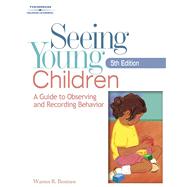
Seeing Young Children : A Guide to Observing and Recording Behavior

ISBN: 9781401865566 | 1401865569
Edition: 5th
Format: Paperback
Publisher: Wadsworth Publishing
Pub. Date: 6/18/2004

Why Rent from Knetbooks?

Because Knetbooks knows college students. Our rental program is designed to save you time and money. Whether you need a textbook for a semester, quarter or even a summer session, we have an option for you. Simply select a rental period, enter your information and your book will be on its way!

Top 5 reasons to order all your textbooks from Knetbooks:

  • We have the lowest prices on thousands of popular textbooks
  • Free shipping both ways on ALL orders
  • Most orders ship within 48 hours
  • Need your book longer than expected? Extending your rental is simple
  • Our customer support team is always here to help
SummaryTable of Contents
Seeing Young Children is an extensive guide to observing and recording behavior in children from birth through age eight. It begins by addressing the basic meaning of observation and why it is so important. This includes a discussion of the theoretical and practical aspects of observing and recording behavior. Detailed information on development, behavior and functioning in children in this age group enables parents and professionals to make meaningful observation, recordings, and evaluations. A large portion of the book concentrates on in-dept... MORE
Prefacexi
PART ONE Overview
1(92)
Introduction
3(17)
... MORE
3(7)
Observation and Theory
10(3)
You and the Observation Process
13(7)
An Introduction to Growth and Development
20(35)
Growth and Development: Some General Considerations
21(6)
Development: Some Basic Meanings and Concepts
27(3)
Development: Some Theoretical Considerations
30(6)
Developmental Theories: A General Overview
36(7)
Explanations or Interpretation of Growth and Development: The Practical Side to Observing Behavior
43(12)
General Guidelines for Observing Children
55(38)
Preparation for Observing
55(23)
Group or Individual Observation
78(4)
Group Components
82(3)
Some Approaches to Group Observation
85(8)
PART TWO The Elements of Observation
93(124)
Introduction and Preparation
94(1)
Methods, Behavior, Plans, and Contexts
95(9)
How to Do It: Some Preliminary Thoughts and Cautions
95(9)
An Introduction to Observation and Recording Methods
104(8)
Methods of Observing and Recording Behavior: Some General Characteristics
104(8)
Narrative Descriptions
112(7)
General Description
112(7)
Time Sampling
119(18)
General Description
119(18)
Event Sampling
137(6)
General Description
137(6)
Diary Description
143(6)
General Description
143(2)
The Diary Description and the Case Study--A Brief Comparison
145(4)
Anecdotal Records
149(6)
General Description
149(6)
Frequency Counts or Duration Records
155(6)
General Description
155(6)
Checklists and Rating Scales
161(25)
General Description
161(11)
Rating Scales: General Description
172(7)
Videotaping and Audiotaping as Observation Tools?
179(7)
Application: Recording Methods in Action
186(6)
Interpretation of Observations, Implementation of Findings, and Ongoing Evaluation
192(25)
Interpretation of Observations
192(3)
Dealing with Observation and Interpretation in a Multicultural Setting
195(12)
Implementation of Findings
207(10)
PART THREE Observation Exercises
217(136)
Introduction and Preparation
217(2)
Observing the Newborn: Birth to One Month
219(23)
Exercise 15-1: Physical Characteristics of the Newborn
219(2)
Exercise 15-2: Infant States and Responsiveness to Stimulation
221(3)
Exercise 15-3: Individual Differences and the Newborn
224(3)
Exercise 15-4: Motor Responses of the Newborn
227(3)
Exercise 15-5: Perceptual Responses of the Newborn
230(3)
Exercise 15-6: Emotional Functioning of the Newborn
233(9)
Observing the Infant: One to 24 Months
242(54)
Introduction
242(9)
Exercise 16-1: Physical Characteristics and Motor Abilities of the Infant/Toddler (One to 24 Months)
251(12)
Exercise 16-2: Social Behavior of The Infant (One to 24 Months)
263(8)
Exercise 16-3: Cognitive and Language Behavior of the Infant (One to 24 Months)
271(9)
Exercise 16-4: Emotional Development and Behavior in the Infant (Two to 18 Months)
280(16)
The Young Child: Ages Two through Five
296(57)
Introduction
296(1)
Exercise 17-1: The Preschool Child in the Physical Environment
297(2)
Exercise 17-2: Physical Growth and Motor Functioning
299(9)
Exercise 17-3: Cognitive and Intellectual Development and Behavior
308(6)
Exercise 17-4: Language Development
314(1)
Piaget's and Vygotsky's Views on Children's Private Speech: A Brief Comparison and Overview
314(7)
Exercise 17-5: Play
321(9)
Exercise 17-6: Emotional Behavior
330(6)
Exercise 17-7: Social Development and Peer Interactions
336(17)
PART FOUR Middle Childhood--The School-Age Years
353(76)
Introduction and Preparation
354(3)
The School--Age Years: The Six--Year-Old Child
357(42)
Physical Growth and Motor Functioning
357(3)
Cognitive and Intellectual Development and Behavior
360(5)
Language
365(6)
Social and Emotional Development
371(6)
Observation Exercise 18-1: Physical Growth and Motor Functioning
377(1)
Observation Exercise 18-2: Cognitive and Intellectual Development and Behavior
378(3)
Observation Exercise 18-3: Language
381(2)
Observation Exercise 18-4: Social and Emotional Development
383(16)
The School-Age Years: The Seven- and Eight-Year-Old Child
399(30)
Physical Growth and Motor Development
399(4)
Cognitive and Intellectual Development and Behavior
403(4)
Language
407(3)
Social and Emotional Behavior
410(3)
Observation Exercise 19-1: Physical and Motor Skills
413(2)
Observation Exercise 19-2: Cognitive and Intellectual Development and Behavior
415(1)
Observation Exercise 19-3: Language
416(1)
Observation Exercise 19-4: Social and Emotional Development and Behavior
417(2)
Epilogue
419(10)
Appendix 1 Developmental Checklists429(6)
Appendix 2 Social-Emotional Checklist435(2)
Appendix 3 Areas for Notice in Observing an Individual Child437(2)
Appendix 4 Emotional Dependency Behavior: Time Sample Procedure439(2)
Appendix 5 Observation Record (Social Skills)441(1)
Appendix 6 Observational Records442(2)
Appendix 7 Summary of Piaget's First Two Stages of Cognitive Development444(1)
Appendix 8 Havighurst's Developmental Tasks--Infancy through Middle-Childhood445(2)
Glossary447(12)
References459(7)
Annotated Bibliography466(3)
Index469

Related Products


  • Seeing Young Children : A Guide to Observing and Recording Behavior
    Seeing Young Children : A Guid...
  • Seeing Young Children : A Guide to Observing and Recording Behavior
    Seeing Young Children : A Guid...
  • Seeing Young Children : A Guide to Observing and Recording Behavior
    Seeing Young Children : A Guid...
  • Seeing Young Children : A Guide to Observing and Recording Behavior
    Seeing Young Children : A Guid...


Please wait while this item is added to your cart...