FREE SHIPPING BOTH WAYS
ON EVERY ORDER!
LIST PRICE:
$49.95

Sorry, this item is currently unavailable.

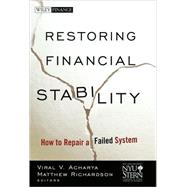
Restoring Financial Stability : How to Repair a Failed System

by: Unknown
ISBN: 9780470499344 | 0470499346
Edition: 1st
Format: Hardcover
Publisher: Wiley
Pub. Date: 3/23/2009

Why Rent from Knetbooks?

Because Knetbooks knows college students. Our rental program is designed to save you time and money. Whether you need a textbook for a semester, quarter or even a summer session, we have an option for you. Simply select a rental period, enter your information and your book will be on its way!

Top 5 reasons to order all your textbooks from Knetbooks:

  • We have the lowest prices on thousands of popular textbooks
  • Free shipping both ways on ALL orders
  • Most orders ship within 48 hours
  • Need your book longer than expected? Extending your rental is simple
  • Our customer support team is always here to help
SummaryTable of ContentsAuthor Biography
Praise for Restoring Financial Stability"The Stern School faculty is making an important contribution to the needed debate about how to go about reforming our broken financial system. Plainly, the insights of financial theory need to be better adapted to the practical requirements of maintaining reasonable stability of markets and institutions. Restoring Financial Stability: How to Repair a Failed System helps point the way." -Paul Volcker, Chairman of Economic Recovery Advisory Board and former Chairman of the Federal Reserve (1979-1987)"Altho... MORE
Forewordp. xi
Acknowledgmentsp. xiii
Prologue: A Bird's-Eye View The Financial Crisis of 2007-2009: Causes and Remediesp. 1
Causes of the Financial Crisis of 2007-2009p. 57
Mortgage Origination and Securitization in the Financial Crisisp. 61
How Banks Played the Leverage Gamep. 83
The Rating Agencies: Is Regulation the Answer?p. 101
Financial Institut... MOREp. 117
What to Do about the Government-Sponsored Enterprises?p. 121
Enhanced Regulation of Large, Complex Financial Institutionsp. 139
Hedge Funds in the Aftermath of the Financial Crisisp. 157
Governance, Incentives, and Fair Value Accounting Overviewp. 179
Corporate Governance in the Modern Financial Sectorp. 185
Rethinking Compensation in Financial Firmsp. 197
Fair Value Accounting: Policy Issues Raised by the Credit Crunchp. 215
Derivatives, Short Selling, and Transparencyp. 229
Derivatives: The Ultimate Financial Innovationp. 233
Centralized Clearing for Credit Derivativesp. 251
Short Sellingp. 269
The Role of the Federal Reservep. 277
Regulating Systemic Riskp. 283
Private Lessons for Public Banking: The Case for Conditionality in LOLR Facilitiesp. 305
The Bailoutp. 323
The Financial Sector Bailout: Sowing the Seeds of the Next Crisis?p. 327
Mortgages and Householdsp. 341
Where Should the Bailout Stop?p. 353
International Coordinationp. 363
International Alignment of Financial Sector Regulationp. 365
About the Authorsp. 377
Indexp. 381
Table of Contents provided by Ingram. All Rights Reserved.

Viral V. Acharya is Professor of Finance at New York University Stern School of Business and London Business School. He is Academic Advisor to the Federal Reserve Banks of New York and Philadelphia and Academic Director of the Coller Institute of Private Equity. Professor Acharya earned a Bachelor of Technology in computer science and engineering from the Indian Institute of Technology, Mumbai, and a PhD in finance from NYU Stern. He lives in New York City with his wife and son.

Matthew Richardson is the Charles E. Simon Professor of Financial Economics and the Sidney Homer Director of the Salomon Center for the Study of Financial Institutions at New York University Stern School of Business. Professor Richardson received his PhD in finance from Stanford University and his MA and BA in economics concurrently from the University of California at Los Angeles. He lives in New York City with his wife and three children.


Please wait while this item is added to your cart...