FREE SHIPPING BOTH WAYS
ON EVERY ORDER!
LIST PRICE:
$44.95

OUR PRICE:
$17.80

You may extend rentals at any time.


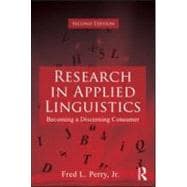
Research in Applied Linguistics : Becoming a Discerning Consumer

ISBN: 9780415885713 | 041588571X
Edition: 1st
Format: Nonspecific Binding
Publisher: Routledge
Pub. Date: 3/28/2011

Why Rent from Knetbooks?

Because Knetbooks knows college students. Our rental program is designed to save you time and money. Whether you need a textbook for a semester, quarter or even a summer session, we have an option for you. Simply select a rental period, enter your information and your book will be on its way!

Top 5 reasons to order all your textbooks from Knetbooks:

  • We have the lowest prices on thousands of popular textbooks
  • Free shipping both ways on ALL orders
  • Most orders ship within 48 hours
  • Need your book longer than expected? Extending your rental is simple
  • Our customer support team is always here to help
SummaryTable of ContentsAuthor Biography
Newly updated and revised, this popular text provides a solid introduction to the foundations of research methods, with the goal of enabling students and professionals in the field of applied linguistics to become not just casual consumers of research who passively read bits and pieces of a research article, but discerning consumers able to effectively use published research for practical purposes in educational settings. All issues important for understanding and using published research for these purposes are covered. Key principles are illustrated with research studies published in refereed journals across a wide spectrum of applied linguistics. Exercises throughout the text encourage readers to engage interactively with what they are reading at the point when the information is fresh in their minds.Changes in the Second Edition:New examples in chapter 2 reflecting formatting changes made by ERICMajor reordering in chapter 4 to better represent the sample typesReorganization of chapters 6 and 7 to enhance cohesion of the themes being discussedUpdated references and recommended reading lists in all chapters
Forewordp. xi
Prefacep. xiii
Acknowledgmentsp. xix
List of Figuresp. xxi
List of Text Boxesp. xxiii
List of Tablesp. xxiv
List of Acronyms and Abbreviationsp. xxv
Fundamentals for Discerning Consumersp. 1
Understanding the Nature of Researchp. 3
Introductionp. 3
What Is All ... MOREp. 3
Who Is All This Research For?p. 4
Is All of this Research Really That Important?p. 4
If Applied Linguistics Research Is So Important, How Can We Understand It Better?p. 4
Overviewp. 5
Why Be a Consumer of Research?p. 6
The Motivation Behind Researchp. 7
Demythologizing Researchp. 7
The Meaning of True Researchp. 8
Identifying Important Questionsp. 9
Where Are the Answers?p. 12
Key Terms and Conceptsp. 19
Additional Recommended Readingp. 20
How to Locate Researchp. 21
Chapter Overviewp. 21
Where to Look and What to Look Forp. 21
Preliminary Sourcesp. 22
Secondary Sourcesp. 27
Tables of References/Bibliographiesp. 30
Is All Primary Research of Equal Weight?p. 30
Differentiating Primary From Secondaryp. 33
How to Obtain Research Articlesp. 35
What Journals Are Related to Applied Linguistics?p. 36
Key Terms and Conceptsp. 36
Additional Recommended Readingp. 37
The Major Components of Published Researchp. 39
Understanding the Framework of a Primary Research Articlep. 41
Chapter Overviewp. 41
The Framework of a Research Articlep. 41
The Titlep. 41
The Abstractp. 43
The Introduction of a Studyp. 45
Methodp. 48
Resultsp. 54
Discussion/Conclusionp. 54
Key Terms and Conceptsp. 55
Additional Recommended Readingp. 55
Understanding Where Data Come From: The Samplep. 56
Chapter Overviewp. 56
Sampling Terminologyp. 56
Sampling Paradigmsp. 57
The Representative Sampling Paradigmp. 59
The Purposeful Sampling Paradigm: Sample Strategies for Maximizing Informationp. 65
Ethics in Sampling of Human Participantsp. 71
Key Terms and Conceptsp. 72
Additional Recommended Readingp. 73
Understanding Research Designsp. 75
Chapter Overviewp. 75
Classifying Research Designsp. 75
The BasicùApplied Continuump. 76
The QualitativeùQuantitative Continuump. 78
The ExploratoryùConfirmatory Continuump. 85
Questions and Designsp. 87
The What Questionsp. 88
The Why Questionsp. 91
Internal Validityp. 96
Key Terms and- Conceptsp. 111
Additional Recommended Readingp. 112
Understanding Data Gatheringp. 115
Chapter Overviewp. 115
Collecting and Evaluating VerbalDatap. 116
Observational Proceduresp. 116
Evaluating the Dependability of Verbal Data Proceduresp. 126
Collecting and Evaluating Numerical Datap. 131
Procedures for Gathering Numerical Datap. 132
Evaluating the Qualities of Numerical Data Gathering Proceduresp. 142
Reliabilityp. 142
Validityp. 149
Key Terms and Conceptsp. 157
Additional Recommended Readingp. 158
Understanding Research Resultsp. 159
Chapter Overviewp. 159
Introduction to Data Analysisp. 159
Numerical Versus Verbal Datap. 159
Common Practicep. 160
Analysis of Verbal Datap. 160
Evaluating Patterns and Themesp. 163
Evaluating Explanations and Conclusionsp. 165
Analysis of Numerical Datap. 170
Overview of Statisticsp. 171
Understanding Descriptive Statisticsp. 172
Understanding Inferential Statisticsp. 174
Statistical Proceduresp. 178
Key Terms and Conceptsp. 198
Additional Recommended Readingp. 198
Discerning Discussions and Conclusions: Completing the Picturep. 199
Chapter Overviewp. 199
The Needed Ingredientsp. 200
Questions Every Consumer Should Askp. 200
Summarizing Researchp. 207
Review of Researchp. 207
Where to Beginp. 209
Abstracting Primary Literaturep. 211
Writing a Review of Researchp. 212
eta-Analysisp. 214
Going to the Next Level of Statisticsp. 216
More About Descriptive Statisticsp. 216
Types of Scalesp. 216
Shape of the Data Distributionp. 219
The Averagep. 222
Data Variancep. 224
More About Inferential Statisticsp. 225
Univariate Versus Multivariate Proceduresp. 225
More on Univariate ANOVAsp. 226
Multivariate ANOVAsp. 228
Degrees of Freedomp. 230
Type II Error and Powerp. 231
Effect Sizep. 233
More on the Null Hypothesisp. 234
The Logic of Testing the Null Hypothesisp. 234
Key Terms and Conceptsp. 236
Journals Related to Applied Linguisticsp. 237
Glossaryp. 250
Notesp. 260
Referencesp. 263
Website Referencep. 276
Author Indexp. 277
Subject Indexp. 282
Table of Contents provided by Ingram. All Rights Reserved.
Professor Fred L. Perry, Jr. has spent over half his life outside of the U.S.A., where he and his family have lived and worked in nine countries. He is Professor Emeritus at the American University in Cairo, Egypt, where he taught research methods and language assessment in the M.A. TEFL program and also headed their Testing Evaluation Service over a 19-year period.


Please wait while this item is added to your cart...