FREE SHIPPING BOTH WAYS
ON EVERY ORDER!
LIST PRICE:
$80.40

OUR PRICE:
$21.49

You may extend rentals at any time.


Readings in Social Psychology : General, Classic, and Contemporary Selections
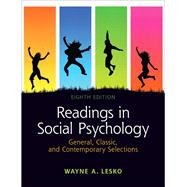
ISBN: 9780205179671 | 0205179673
Edition: 8th
Format: Paperback
Publisher: Pearson
Pub. Date: 6/23/2011

Why Rent from Knetbooks?

Because Knetbooks knows college students. Our rental program is designed to save you time and money. Whether you need a textbook for a semester, quarter or even a summer session, we have an option for you. Simply select a rental period, enter your information and your book will be on its way!

Top 5 reasons to order all your textbooks from Knetbooks:

  • We have the lowest prices on thousands of popular textbooks
  • Free shipping both ways on ALL orders
  • Most orders ship within 48 hours
  • Need your book longer than expected? Extending your rental is simple
  • Our customer support team is always here to help
SummaryTable of ContentsAuthor Biography
Readings in Social Psychology: General, Classic, and Contemporary Selectionsis a collection of readings in social psychology that systematically exposes the reader to a variety of articles in social psychology accompanied by critical thinking and integrative questions.   Other books of readings in social psychology tend to use articles from just one type of publication (e.g., general readership articles such as those in Psychology Today) or they use articles from professional publications that have been edited and shortened by the book author. ... MORE

IN THIS SECTION:

1.) BRIEF

2.) COMPREHENSIVE


BRIEF TABLE OF CONTENTS:


Chapter 1: The Field of Social Psychology

Chapter 2: Social Perception

Chapter 3: Social Cognition
Chapter 4: Attitudes

... MORE

Chapter 6: Prejudice and Discrimination

Chapter 7: Interpersonal Attraction

Chapter 8: Close Relationships

Chapter 9: Social Influence

Chapter 10: Prosocial Behavior

Chapter 11: Aggression

Chapter 12: Group Behavior

Chapter 13: Business Psychology

Chapter 14: Forensic Psychology

Chapter 15: Health Psychology


COMPREHENSIVE TABLE OF CONTENTS:


Chapter 1: The Field of Social Psychology

Article 1 How to be a wise consumer of psychological research, by The American Psychological Association

Article 2 Human use of human subjects: The problem of deception in social psychological research, by Herbert C. Kelman

Article 3 Social influences on paranormal belief: Popular versus scientific support, by Heather Ridolfo, Amy Baxter, and Jeffrey W. Lucas


Chapter 2: Social Perception

Article 4 The once-over: Can you trust first impressions?  by Carlin Flora

Article 5 The warm-cold variable in first impressions of persons, by Harold H. KelleyArticle 6 Indirect detection of deception: Looking for change, by Christian L. Hart, Derek G. Fillmore, and James D. Griffith


Chapter 3: Social Cognition

Article 7 Some systematic biases in everyday judgment, by Thomas Gilovich

Article 8 Cognitive, social, and physiological determinants of emotional states, by Stanley Schachter and Jerome E. Singer

Article 9 Lasting false beliefs and their behavioral consequences, by Elke Geraerts, Daniel M. Bernstein, Harald Merckelbach, Christel Linders, Linsey Raymackers, and Elizabeth F. LoftusChapter Four: Attitudes

Article 10 Changing behavior by degrees, by Michael Price

Article 11 Cognitive consequences of forced compliance, by Leon Festinger and James M. Carlsmith

Article 12 The origins of cognitive dissonance: Evidence from children and monkeys, by Louisa C. Egan, Laurie R. Santos, and Paul Bloom


Chapter 5: Social Identity

Article 13 The many me’s of the self-monitor, by Mark Snyder

Article 14 The measurement of psychological androgyny, by Sandra L. Bem

Article 15 Reducing narcissistic aggression by buttressing self-esteem: An experimental field study, by Sander Thomaes, Brad J. Bushman, Bram Orobio de Castro, Geoffrey L. Cohen, and Jaap J.A. Denissen


Chapter 6: Prejudice and Discrimination

Article 16 Unmasking "racial micro aggressions", by Tori DeAngelis

Article 17 Attitudes vs. actions, by Richard T. LaPiere

Article 18 Interracial roommate relationships: An experimental field test of the contact hypothesis, by Natalie J. Shook and Russell H. Fazio


Chapter 7: Interpersonal Attraction

Article 19 Why I hate beauty, by Michael Levine with Hara Estroff Marano

Article 20 What is beautiful is good, by Karen Dion,m Ellen Berscheid, and Elaine Walster

Article 21 The ability to judge the romantic interest of others, by Skyler S. Place, Peter M. Todd, Lars Penke, and Jens B. Asendorpf


Chapter 8: Close Relationships

Article 22 Great expectations, by Polly Shulman

Article 23 "Playing hard to get": Understanding an elusive phenomenon, by Elaine Hatfield, G. William Walster, Jane Piliavin, and Lynn SchmidtArticle 24 Does a long-term relationship kill romantic love?, by Bianca P. Acevedo and Arthur Aron


Chapter 9: Social Influence

Article 25 Revisiting the Stanford Prison Experiment: A lesson in the power of the situation, by Phillip G. Zimbardo

Article 26 Behavioral study of obedience, by Stanley Milgram

Article 27 The constructive, destructive, and reconstructive power of social norms, by P. Wesley Schultz, Jessica M. Nolan, Robert B. Cialdini, Noah J. Goldstein, and Vladus Griskevicius


Chapter 10: Prosocial Behavior

Article 28 Nice by nature?  by Sadie F. Dingfelder

 Article 29 "From Jerusalem to Jericho": A study of situational and dispositional variables in helping behavior, by John M. Darley and C. Daniel Batson

Article 30 Comfortably numb: Desensitizing effects of violent media on helping others, by Brad J. Bushman and Craig A. Anderson


Chapter 11: Aggression

Article 31 Understanding terrorism, by Tori DeAngelis

Article 32 Transmission of aggression through imitation of aggressive models, by Albert Bandura, Dororthea Ross, and Sheila A. Ross

Article 33 School violence and the culture of honor, by Ryan P. Brown, Lindsey L. Osterman, and Collin D. Barnes


Chapter 12: Group Behavior

Article 34 Group decision fiascoes continue: Space Shuttle Challenger and a revised groupthink framework, by Gregory Moorhead, Richard Ference, and Chris P. Neck

Article 35 The effect of threat upon interpersonal bargaining, by Morton Deutsch and Robert M. Krause

Article 36 Can high group cohesion be harmful? A case study of a junior ice-hockey team, by Esa Rovio, Jari Eskola, Stephen A. Kozub, Joan L. Duda, and Taru Lintuner  


Chapter 13: Business Psychology

Article 37 When followers become toxic, by Lynn R. Offerman

Article 38  One more time: How do you motivate employees? by Fredrick Herzberg

Article 39  Impact of emotional intelligence and other factors on perception of ethical behavior of peers, by Jacob Joseph, Kevin Berry, and Satish P. Deshpande


Chapter 14: Forensic Psychology

Article 40 The psychology and power of false confessions, by Ian Herbert

Article 41 Beautiful but dangerous: Effects of offender attractiveness and nature of the crime on juridic judgment, by Harold Sigall and Nancy Ostrove

Article 42 Attractive but guilty:  Deliberation and the physical attractiveness bias, by Mark W. Patry


Chapter 15: Health Psychology

Article 43 Understanding the have-knots, by Eric Wargo

Article 44 The social readjustment rating scale, by Thomas H. Holmes and Richard H. Rahe

Article 45  Psychosocial predictors of resilience after the September 11, 2001 terrorist attacks, by Lisa D. Butler, Cheryl Koopman, Jay Azarow, Christine M. Blasey, Juliette C. Magadalene, Sue DiMiceli, David A. Seagraves, T. Anderew Hastings, Xin-HuaChen, Robert W. Garlan, Helena C. Kraemer, and David Spiegel

Wayne A. Lesko received his doctorate and master’s degrees from the University of Windsor in social psychology. He taught first for the University of Maryland University College and then for Marymount University in Arlington. During his time at Marymount he has served as the chair of the psychology department, Associate Dean of the School of Education and Human Services, and most recently as the Dean of the School. His work in the latter capacity has resulted in the creation of a variety of new degree programs, including forensic psychology, criminal justice, and counseling. While primarily being involved with administrative work, Dr. Lesko has continued to teach courses in social psychology and a senior seminar in the undergraduate psychology program. His most recent scholarship centers on issues pertaining to pedagogical issues.

Related Products


  • Mysearchlab
    Mysearchlab
  • Readings in Social Psychology : General, Classic, and Contemporary Selections
    Readings in Social Psychology ...
  • Readings in Social Psychology : General, Classic, and Contemporary Selections
    Readings in Social Psychology ...
  • Readings in Social Psychology : General, Classic, and Contemporary Selections
    Readings in Social Psychology ...
  • Readings in Social Psychology : General, Classic, and Contemporary Selections
    Readings in Social Psychology ...
  • Readings in Social Psychology : General, Classic, and Contemporary Selections
    Readings in Social Psychology ...
  • Readings in Social Psychology : General, Classicnd Contemporary Selections- (Value Pack W/MySearchLab)
    Readings in Social Psychology ...


Please wait while this item is added to your cart...