FREE SHIPPING BOTH WAYS
ON EVERY ORDER!
LIST PRICE:
$57.00

Sorry, this item is currently unavailable.

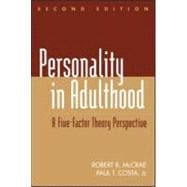
Personality in Adulthood, Second Edition : A Five-Factor Theory Perspective

ISBN: 9781572308275 | 1572308273
Edition: 2nd
Format: Trade Book
Publisher: The Guilford Press
Pub. Date: 12/18/2002

Why Rent from Knetbooks?

Because Knetbooks knows college students. Our rental program is designed to save you time and money. Whether you need a textbook for a semester, quarter or even a summer session, we have an option for you. Simply select a rental period, enter your information and your book will be on its way!

Top 5 reasons to order all your textbooks from Knetbooks:

  • We have the lowest prices on thousands of popular textbooks
  • Free shipping both ways on ALL orders
  • Most orders ship within 48 hours
  • Need your book longer than expected? Extending your rental is simple
  • Our customer support team is always here to help
SummaryTable of ContentsAuthor Biography
Now in a revised and expanded second edition, this influential work argues for the enduring stability of personality across adult development. It also offers a highly accessible introduction to the five-factor model of personality.

Updated and revised with an emphasis on stability in personality through adulthood. The Five-Factor theory is explained and includes new evidence, particularly cross-cultural and longitudinal findings. Previous edition: c1990.
Facts and Theories of Adult Development
1(19)
The Pendulum of Opinion on Personality Stability
3(3)
In Search of a Pheno... MORE
6(3)
A Note on Psychotherapy
9(1)
When Does Adulthood Begin?
10(1)
Other Views: Theories of Change
11(9)
A Trait Approach to Personality
20(17)
Perspectives on Human Nature
21(3)
Basic Principles of Trait Psychology
24(13)
How Many Traits? Which Ones?
29(3)
The Quest for a Unified System
32(2)
Natural Languages and the Five-Factor Model
34(3)
Measuring Personality
37(21)
From Concepts to Data
37(3)
Self-Reports and Observer Ratings
40(5)
A Questionnaire Measure: The NEO Personality Inventory
45(7)
Facets of N, E, and O
47(3)
Facets of A and C
50(1)
Making Distinctions
51(1)
The Comprehensiveness of the Five-Factor Model
52(6)
The Search for Growth or Decline in Personality
58(26)
Cross-Sectional Studies of Personality Differences
59(7)
Sampling Bias
62(2)
Cohort Effects
64(2)
Longitudinal Designs: Tracking Changes over Time
66(4)
Stability in the 16PF
67(3)
Sequential Strategies: Avoiding Practice and Time Effects
70(4)
An Integrated Approach
74(4)
Recent Developments
78(3)
Small, Slow Changes
78(2)
Another Mystery
80(1)
A Different Analysis
80(1)
Implications: Debunking Some Myths of Aging
81(3)
Cross-Cultural Perspectives on Personality and Aging
84(14)
A Universal Structure
86(4)
Adult Development across Cultures
90(8)
History, Culture, and Cross-Sectional Comparisons
92(2)
Some Possible Interpretations
94(2)
Cross-Cultural Evidence on Stability
96(2)
The Course of Personality Development in the Individual
98(18)
Two Different Questions: Stability and Change in Groups and in Individuals
98(3)
Developmental Patterns in Individuals
101(5)
Investigating the Course of Personality Traits
106(10)
Longitudinal Evidence
108(4)
The Time Course of Stability
112(4)
Stability Reconsidered: Qualifications and Rival Hypotheses
116(23)
Methodological Issues in the Assessment of Stability
116(8)
The Self-Concept and Stability
119(3)
Accounting for Variance and Correcting for Unreliability
122(2)
Retrospection and Self-Perceived Change
124(4)
Moderators of Change
128(5)
Psychological Characteristics
128(2)
Life Events
130(1)
Physical and Mental Health
131(2)
Case Studies in Stability
133(4)
Implications: Planning for the Future
137(2)
A Different View: Ego Psychologies and Projective Methods
139(25)
Dynamic or Ego Psychologies
140(4)
Developmental Sequences
141(2)
Dynamic Dispositions
143(1)
Contrasting Traits with Ego Processes
144(2)
Conflict and Its Resolution
144(2)
Temporal Organization
146(1)
Individual Differences in Ego Processes
146(3)
Traits and Metatraits?
148(1)
Developmental Changes in Ego Processes
149(2)
Projective Assessments of Personality
151(5)
Problems in Projective Methods
153(2)
Conscious versus Unconscious Elements
155(1)
Projective Testing and the Stability of Personality
156(8)
Inkblot Tests
157(1)
TAT Studies
158(3)
Age and the Spontaneous Self-Concept
161(3)
Adult Development as Seen through the Personal Interview
164(20)
Form and Content in Psychological Interviews
168(1)
Interview-Based Theories of Adult Development
169(9)
Levinson's Seasons
170(5)
Gould's Transformations
175(3)
In Search of the Midlife Crisis
178(6)
A Five-Factor Theory of Personality
184(22)
The Birth of a Theory
185(2)
Five-Factor Theory
187(13)
Components of the Personality System
187(2)
Postulates of FFT: How the System Works
189(4)
The Origins of Traits
193(4)
Trait Development and the FFT
197(2)
Changes in Individual Differences
199(1)
Evaluating Five-Factor Theory
200(6)
The Influences of Personality on the Life Course
206(31)
What Changes?
207(9)
The Objective Biography
208(1)
Characteristic Adaptations
209(5)
The Self-Concept
214(2)
Studying Life Structure and Life Course
216(11)
Psychological Adjustment across the Lifespan
218(2)
Personal Projects, Social Clocks, and Psychobiography
220(4)
Marriage and Divorce
224(1)
Careers
225(2)
Trait Influences on the Self-Concept
227(10)
Identity
228(3)
The Life Narrative
231(6)
References237(24)
Index261
Robert R. McCrae, PhD, is Research Psychologist at the Gerontology Research Center of the National Institute on Aging. He received his doctorate in personality psychology from Boston University in 1976, and has since conducted research on personality structure, assessment, and development. His recent work has centered on cross-cultural studies of personality. He has authored or coauthored over 250 articles and chapters, and with Paul T. Costa, Jr., he is author of the Revised NEO Personality Inventory.

Paul T. Costa, Jr., PhD, is Chief of the Laboratory of Personality and Cognition at the National Institute on Aging's Intramural Research Program in Baltimore, Maryland. His enduring interests are in the structure and measurement of personality and in lifespan development, psychopathology, and neurobiological bases of personality. He has authored or coauthored over 300 papers and chapters and has served as President of APA Divisions 5 and 20, the Association for Research in Personality, and the International Society for the Study of Individual Differences.

Related Products


  • Personality in Adulthood
    Personality in Adulthood
  • Personality in Adulthood, Second Edition; A Five-Factor Theory Perspective
    Personality in Adulthood, Seco...


Please wait while this item is added to your cart...