FREE SHIPPING BOTH WAYS
ON EVERY ORDER!
LIST PRICE:
$39.99

OUR PRICE:
$31.67

You may extend rentals at any time.


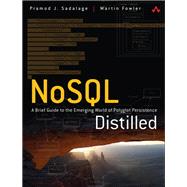
NoSQL Distilled : A Brief Guide to the Emerging World of Polyglot Persistence
ISBN: 9780321826626 | 0321826620
Edition: 1st
Format: Paperback
Publisher: Addison-Wesley Professional
Pub. Date: 8/8/2012

Why Rent from Knetbooks?

Because Knetbooks knows college students. Our rental program is designed to save you time and money. Whether you need a textbook for a semester, quarter or even a summer session, we have an option for you. Simply select a rental period, enter your information and your book will be on its way!

Top 5 reasons to order all your textbooks from Knetbooks:

  • We have the lowest prices on thousands of popular textbooks
  • Free shipping both ways on ALL orders
  • Most orders ship within 48 hours
  • Need your book longer than expected? Extending your rental is simple
  • Our customer support team is always here to help
SummaryTable of ContentsAuthor Biography
Modeled after UML Distilled, Martin Fowler's international best-seller, NoSQL Distilled is designed to provide you with enough background on how NoSQL databases work, so that you can choose the right data store without having to trawl the whole web to do it. Fowler and Sadalage deliberately made this a small book, so you can get this overview pretty quickly. It won't answer your questions definitively, but it should narrow down the range of options you have to consider and help you understand what questions you need to ask in more detail. The b... MORE

Preface xiii


Part I: Understand  1


Chapter 1: Why NoSQL? 3

1.1 The Value of Relational Databases 3

1.2 Impedance Mismatch 5

1.3 Application and Integration Databases 6

1.4 Attack of the Clusters 8

1.5 The E... MORE

1.6 Key Points 12


Chapter 2: Aggregate Data Models 13

2.1 Aggregates 14

2.2 Key-Value and Document Data Models 20

2.3 Column-Family Stores 21

2.4 Summarizing Aggregate-Oriented Databases 23

2.5 Further Reading 24

2.6 Key Points 24


Chapter 3: More Details on Data Models 25

3.1 Relationships 25

3.2 Graph Databases 26

3.3 Schemaless Databases 28

3.4 Materialized Views 30

3.5 Modeling for Data Access 31

3.6 Key Points 36


Chapter 4: Distribution Models 37

4.1 Single Server 37

4.2 Sharding 38

4.3 Master-Slave Replication 40

4.4 Peer-to-Peer Replication 42

4.5 Combining Sharding and Replication 43

4.6 Key Points 44


Chapter 5: Consistency 47

5.1 Update Consistency 47

5.2 Read Consistency 49

5.3 Relaxing Consistency 52

5.4 Relaxing Durability 56

5.5 Quorums 57

5.6 Further Reading 59

5.7 Key Points 59


Chapter 6: Version Stamps 61

6.1 Business and System Transactions 61

6.2 Version Stamps on Multiple Nodes 63

6.3 Key Points 65


Chapter 7: Map-Reduce 67

7.1 Basic Map-Reduce 68

7.2 Partitioning and Combining 69

7.3 Composing Map-Reduce Calculations 72

7.4 Further Reading 77

7.5 Key Points 77


Part II: Implement 79


Chapter 8: Key-Value Databases 81

8.1 What Is a Key-Value Store 81

8.2 Key-Value Store Features 83

8.3 Suitable Use Cases 87

8.4 When Not to Use 87


Chapter 9: Document Databases 89

9.1 What Is a Document Database? 90

9.2 Features 91

9.3 Suitable Use Cases 97

9.4 When Not to Use 98


Chapter 10: Column-Family Stores 99

10.1 What Is a Column-Family Data Store? 99

10.2 Features 100

10.3 Suitable Use Cases 107

10.4 When Not to Use 109


Chapter 11: Graph Databases 111

11.1 What Is a Graph Database? 111

11.2 Features 113

11.3 Suitable Use Cases 120

11.4 When Not to Use 121


Chapter 12: Schema Migrations 123

12.1 Schema Changes 123

12.2 Schema Changes in RDBMS 123

12.3 Schema Changes in a NoSQL Data Store 128

12.4 Further Reading 132

12.5 Key Points 132


Chapter 13: Polyglot Persistence 133

13.1 Disparate Data Storage Needs 133

13.2 Polyglot Data Store Usage 134

13.3 Service Usage over Direct Data Store Usage 136

13.4 Expanding for Better Functionality 136

13.5 Choosing the Right Technology 138

13.6 Enterprise Concerns with Polyglot Persistence 138

13.7 Deployment Complexity 139

13.8 Key Points 140


Chapter 14: Beyond NoSQL 141

14.1 File Systems 141

14.2 Event Sourcing 142

14.3 Memory Image 144

14.4 Version Control 145

14.5 XML Databases 145

14.6 Object Databases 146

14.7 Key Points 146


Chapter 15: Choosing Your Database 147

15.1 Programmer Productivity 147

15.2 Data-Access Performance 149

15.3 Sticking with the Default 150

15.4 Hedging Your Bets 150

15.5 Key Points 151

15.6 Final Thoughts 152


Bibliography 153

Index 157


Pramod J. Sadalage, Principal Consultant at ThoughtWorks, enjoys the rare role of bridging the divide between database professionals and application developers. He regularly consults with clients who have particularly challenging data needs requiring new technologies and techniques. He developed pioneering techniques that allowed relational databases to be designed in an evolutionary manner based on version-controlled schema migrations. With Scott Ambler, he coauthored Refactoring Databases(Addison-Wesley, 2006).


Martin Fowler, Chief Scientist at ThoughtWorks, focuses on better ways to design software systems and improve developer productivity. His books include Patterns of Enterprise Application Architecture; UML Distilled, Third Edition; Domain-Specific Languages (with Rebecca Parsons); and Refactoring: Improving the Design of Existing Code (with Kent Beck, John Brant, and William Opdyke). All are published by Addison-Wesley.


Please wait while this item is added to your cart...