FREE SHIPPING BOTH WAYS
ON EVERY ORDER!
LIST PRICE:
$155.00

OUR PRICE:
$25.74

You may extend rentals at any time.


Mechanical and Electrical Equipment for Buildings
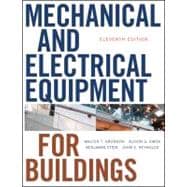
ISBN: 9780470195659 | 0470195657
Edition: 11th
Format: Hardcover
Publisher: Wiley
Pub. Date: 11/24/2009

Why Rent from Knetbooks?

Because Knetbooks knows college students. Our rental program is designed to save you time and money. Whether you need a textbook for a semester, quarter or even a summer session, we have an option for you. Simply select a rental period, enter your information and your book will be on its way!

Top 5 reasons to order all your textbooks from Knetbooks:

  • We have the lowest prices on thousands of popular textbooks
  • Free shipping both ways on ALL orders
  • Most orders ship within 48 hours
  • Need your book longer than expected? Extending your rental is simple
  • Our customer support team is always here to help
SummaryTable of ContentsAuthor Biography
The foremost guide to the design of environmental control systems Updated and expandedFor more than seven decades, Mechanical and Electrical Equipment for Buildings has been the preeminent teaching and practice reference for building environmental control systems. Now this classic text has been updated and expanded, and continues to help prepare generations of students for their careers in architecture, architectural engineering, and construction management, and to supply professionals with in-depth information to assist them with their decisio... MORE
Preface.

Acknowledgments.

PART I DESIGN CONTEXT.

Chapter 1 Design Process.

Chapter 2 Environmental Resources.

Chapter 3 Sites and Resources.

Chapter 4 Comfort and Design Strategies.

Chapter 5 Indoor Air Quality.

PART II THERMAL CONTROL.

Chapter 6 Solar Geometry and Shading Devices.

Chapter 7 Heat Flow.

Chapter 8 Designing For Heating and Cooling.

Chapter 9 HVAC for Smaller Buildings.

Chapter 10 Large Building HVAC Systems.

PART III ILLUMINATION.

Chapter 11 Lighting Fundamentals.

Chapter 12 Li... MORE

Chapter 13 Lighting Design Process.

Chapter 14 Daylighting Design.

Chapter 15 Electric Lighting Design.

Chapter 16 Electric Lighting Applications.

PART IV ACOUSTICS.

Chapter 17 Fundamentals of Architectural Acoustics.

Chapter 18 Sound in Enclosed Spaces.

Chapter 19 Building Noise Control.

PART V WATER AND WASTE.

Chapter 20 Water and Basic Design.

Chapter 21 Water Supply.

Chapter 22 Liquid Waste.

Chapter 23 Solid Waste.

PART VI FIRE PROTECTION.

Chapter 24 Fire Protection.

PART VII ELECTRICITY.

Chapter 25 Principles of Electricity.

Chapter 26 Electrical Systems and Materials. Service and Utilization.

Chapter 27 Electrical Systems and Materials. Wiring and Raceways.

Chapter 28 Electric Wiring Design.

Chapter 29 Photovoltaic Systems.

PART VIII SIGNAL SYSTEMS.

Chapter 30 Signal Systems.

PART IX TRANSPORTATION.

Chapter 31 Vertical Transportation: Passenger Elevators.

Chapter 32 Vertical Transportation. Special Topics.

Chapter 33 Moving Stairways and Walks.

PART X APPENDICES.

Appendix A Metrication, SI Units, and Conversions.

Appendix B Climatic Conditions for the United States, Canada, and Mexico.

Appendix C Solar and Daylighting Design Data.

Appendix D Solar Geometry.

Appendix E Thermal Properties of Materials and Assemblies.

Appendix F Heating and Cooling Design Guidelines and Information.

Appendix G Standards/Guidelines for Energy- and Resource-Efficient Building Design.

Appendix H Annual Solar Performance.

Appendix I Economic Analysis.

Appendix J Lamp Data.

Appendix K Sound Transmission Data for Walls.

Appendix L Sound Transmission and Impact Insulation Data for Floor/Ceiling Constructions.

Appendix M Design Analysis Software.

Index.

Walter T. Grondzik, PE, LEED AP, is Professor of Architecture at Ball State University, Muncie, Indiana. Grondzik is a Fellow of ASHRAE, a Fellow of the American Solar Energy Society, and a past president of the Society of Building Science Educators and the Architectural Research Centers Consortium. He holds an MS in mechanical engineering (building environmental systems) and a bachelor of architectural engineering.

Alison G. Kwok, PhD, AIA, LEED AP, is Professor of Architecture at the University of Oregon, Eugene, teaches design studios, seminars in building performance, as well as courses in environmental technology. Kwok has served as a board member for the Arch-itectural Research Centers Consortium and is a past president of the Society of Building Science Educators, a member of several ASHRAE committees, and a member of the USGBC's Formal Education Committee.

Benjamin Stein is a consulting engineer with more than fifty years of experience in all phases of environmental control system design. He currently resides in Jerusalem, Israel.

John S. Reynolds, AIA, is Professor Emeri-tus of Architecture at the University of Oregon, Eugene, and is a registered architect in private practice.

Related Products


  • Mechanical and Electrical Equipment for Buildings, 12/E
    Mechanical and Electrical Equi...


Please wait while this item is added to your cart...