FREE SHIPPING BOTH WAYS
ON EVERY ORDER!
LIST PRICE:
$61.00

OUR PRICE:
$24.16

You may extend rentals at any time.


To Measure the Sky : An Introduction to Observational Astronomy
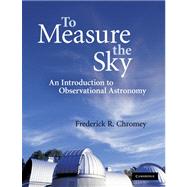
ISBN: 9780521747684 | 0521747686
Edition: 1st
Format: Paperback
Publisher: Cambridge University Press
Pub. Date: 7/5/2010

Why Rent from Knetbooks?

Because Knetbooks knows college students. Our rental program is designed to save you time and money. Whether you need a textbook for a semester, quarter or even a summer session, we have an option for you. Simply select a rental period, enter your information and your book will be on its way!

Top 5 reasons to order all your textbooks from Knetbooks:

  • We have the lowest prices on thousands of popular textbooks
  • Free shipping both ways on ALL orders
  • Most orders ship within 48 hours
  • Need your book longer than expected? Extending your rental is simple
  • Our customer support team is always here to help
SummaryTable of ContentsAuthor Biography
With a lively yet rigorous and quantitative approach, this textbook introduces the fundamental topics in optical observational astronomy for undergraduates. It explains the theoretical foundations for observational practices and reviews essential physics to support students' mastery of the subject. Student understanding is strengthened through over 120 exercises and problems.
Prefacep. xi
Lightp. 1
The storyp. 1
The evidence: astronomical datap. 3
Models for the behavior of lightp. 6
Measurements of light raysp. 13
Spectrap. 16
Magnitudesp. 26
Summaryp. 31
Exercisesp. 32
Uncertaintyp. 35
Accuracy and precisionp.... MORE
Populations and samplesp. 41
Probability distributionsp. 47
Estimating uncertaintyp. 51
Propagation of uncertaintyp. 53
Additional topicsp. 56
Summaryp. 56
Exercisesp. 57
Place, time, and motionp. 60
Astronomical coordinate systemsp. 61
The third dimensionp. 77
Timep. 83
Motionp. 88
Summaryp. 93
Exercisesp. 95
Names, catalogs, and databasesp. 98
Star namesp. 99
Names and catalogs of non-stellar objects outside the Solar Systemp. 108
Objects at non-optical wavelengthsp. 112
Atlases and finding chartsp. 112
Websites and other computer resourcesp. 114
Solar System objectsp. 114
Summaryp. 116
Exercisesp. 117
Optics for astronomyp. 118
Principles of geometric opticsp. 118
Lenses, mirrors, and simple optical elementsp. 127
Simple telescopesp. 135
Image quality: telescopic resolutionp. 137
Aberrationsp. 143
Summaryp. 154
Exercisesp. 155
Astronomical telescopesp. 157
Telescope mounts and drivesp. 157
Reflecting telescope opticsp. 160
Telescopes in spacep. 168
Ground-based telescopesp. 175
Adaptive opticsp. 180
The next stage: ELTs and advanced AOp. 190
Summaryp. 192
Exercisesp. 193
Matter and lightp. 196
Isolated atomsp. 196
Isolated moleculesp. 204
Solid-state crystalsp. 205
Photoconductorsp. 218
The MOS capacitorp. 219
The p--n junctionp. 221
The vacuum photoelectric effectp. 227
Superconductivityp. 229
Summaryp. 232
Exercisesp. 233
Detectorsp. 235
Detector characterizationp. 236
The CCDp. 243
Photo-emissive devicesp. 260
Infrared arraysp. 265
Thermal detectorsp. 269
Summaryp. 272
Exercisesp. 273
Digital images from arraysp. 275
Arraysp. 275
Digital image manipulationp. 281
Preprocessing array data: bias, linearity, dark, flat, and fringep. 286
Combining imagesp. 297
Digital aperture photometryp. 309
Summaryp. 320
Exercisesp. 321
Photometryp. 323
Introduction: a short historyp. 323
The response functionp. 326
The idea of a photometric systemp. 336
Common photometric systemsp. 337
From source to telescopep. 344
The atmospherep. 350
Transformation to a standard systemp. 360
Summaryp. 363
Exercisesp. 364
Spectrometersp. 368
Dispersive spectrometryp. 369
Dispersing optical elementsp. 371
Spectrometers without slitsp. 380
Basic slit and fiber spectrometersp. 382
Spectrometer design for astronomyp. 385
Spectrometric datap. 393
Interpreting spectrap. 399
Summaryp. 402
Exercisesp. 404
Appendicesp. 407
Referencesp. 437
Indexp. 441
Table of Contents provided by Ingram. All Rights Reserved.
Frederick R. Chromey is Professor of Astronomy on the Matthew Vassar Junior Chair at Vassar College, and Director of the Vassar College Observatory. He has almost 40 years' experience in observational astronomy research in the optical, radio and near infrared on stars, gaseous nebulae and galaxies, and has taught astronomy to undergraduates for 35 years at Brooklyn College and Vassar.


Please wait while this item is added to your cart...

