Because Knetbooks knows college students. Our rental program is designed to save you time and money. Whether you need a textbook for a semester, quarter or even a summer session, we have an option for you. Simply select a rental period, enter your information and your book will be on its way!
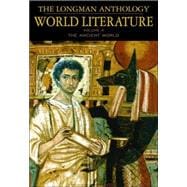
| Volume A: The Ancient World | |
| The Ancient Near East | |
| The Babylonian Theogony (c. 2nd millennium B.C.E) | |
| A Memphite Theology (c. 2500 B.C.E.) | |
| Genesis: Chapters 1-11 (1st millennium B.C.E.) | |
| Translations: Genesis | |
| Poetry Of Love And Devotion (c. 3rd to 2nd millennium B.C.E.) | |
| Last night, as I, the queen, was shining ... MORE | |
| Egyptian Love Songs | |
| Distracting is the foliage of my pasture | |
| I sail downstream in the ferry by the pull of the current | |
| The voice of the turtledove speaks out | |
| I embrace her, and her arms open wide | |
| One, the lady love without a duplicate | |
| How well the lady knows to cast the noose | |
| Why need you hold converse with your heart? | |
| I passed by her house in the dark | |
| The Song Of Songs (1st millennium B.C.E.) | |
| The Epic Of Gilgamesh (c. 1200 B.C.E.) | |
| Perspectives: Death and Immortality | |
| The Descent of Ishtar to the Underworld (late 2nd millennium B.C.E) | |
| from The Book of the Dead (2nd millennium B.C.E.) | |
| Letters to the Dead (2nd to 1st millennium B.C.E.) | |
| Kabti-Ilani-Marduk: Erra and Ishum (8th century B.C.E.) | |
| Crosscurrents | |
| The Book Of Job (6th century B.C.E.), (trans. Revised Standard Version) | |
| Resonances from The Babylonian Theodicy | |
| Psalm 22 "My God, my God, why hast thou forsaken me?" | |
| Psalm 102 "Hear my prayer, O Lord; let my cry come unto thee!" | |
| Perspectives: Strangers in a Strange L and The Story of Sinuhe (c. 1925 B.C.E.) | |
| The Two Brothers (c. 1200 B.C.E.) | |
| The Joseph Story (1st millennium B.C.E.), (New International Version) Genesis 37-50 | |
| The Book of Ruth (c. late 6th century B.C.E.), (New International Version) | |
| Crosscurrents | |
| Classical Greece | |
| Homer (8th century B.C.E.) from The Iliad | |
| The Wrath of Achilles | |
| Achilles' Sheild | |
| The Death of Hektor | |
| Achilles and Priam | |
| Resonance | |
| Filip Visnjic: The Death of Kraljevic Marko | |
| The Odyssey | |
| Athena Inspires the Prince | |
| Telemachus Sets Sail | |
| King Nestor Remembers | |
| Book 4. The King and Queen of Sparta | |
| Odysseus - Nymph and Shipwreck | |
| The Princess and the Stranger | |
| Phaeacia's Halls and Gardens | |
| A Day for Songs and Contests | |
| In the One-Eyed Giant's Cave | |
| The Bewitching Queen of Aeaea | |
| The Kingdom of the Dead | |
| The Cattle of the Sun | |
| Book 13. Ithaca at Last | |
| The Loyal Swineherd | |
| The Prince Sets Sail for Home | |
| Father and Son | |
| Stranger at the Gates | |
| The Beggar-King of Ithaca | |
| Penelope and Her Guest | |
| Portents Gather | |
| Odysseus Strings His Bow | |
| Slaughter in the Hall | |
| The Great Rooted Bed | |
| Peace | |
| Resonances | |
| Franz Kafka: The Silence of the Sirens | |
| George Seferis: Upon a Foreign Verse | |
| Derek Walcott: from Omeros | |
| Archaic Lyric Poetry | |
| Arkhilokhos (7th century B.C.E) | |
| Encounter in a Meadow | |
| The Fox and the Hedgehog | |
| Elegies | |
| Sappho (early 7th century B.C.E) | |
| Rich-throned immortal Aphrodite | |
| Come, goddess | |
| Some think a fleet | |
| He looks to me to be in heaven | |
| Love shakes my heart | |
| Honestly, I wish I were dead | |
| ...she worshipped you | |
| Like a sweet-apple | |
| The doorman's feet | |
| Resonance | |
| Alejandra Pizarnik: Poem, Lovers, Recognition, Meaning of His Absence, Dawn, Falling | |
| Alkaios (7th - 6th century B.C.E) | |
| And fluttered Argive Helen's heart | |
| They tell that Priam and his sons | |
| The high hall is agleam | |
| I can't make out the lie of the winds | |
| Pindar (518-438 B.C.E.) | |
| First Olympian Ode | |
| Resonances | |
| John Keats: Ode on a Grecian Urn | |
| Rainer Maria Rilke: Archaic Torso of Apollo | |
| AESCHYLUS (525-456 B.C.E.) | |
| Agamemnon | |
| Resonance | |
| W. B. Yeats: Leda and the Swan | |
| Sophocles (496-406 B.C.E.) | |
| Oedipus the King | |
| Antigone | |
| Resonance | |
| Aristotle: from Poetics | |
| Perspectives: Tyranny and Democracy | |
| Solon (c. 640-558 B.C.E.) | |
| Our state will never fail | |
| The commons I have granted | |
| Those aims for which I called the public meeting | |
| Thucydides (c. 460-400 B.C.E.) from The Peloponnesian War | |
| Plato (c. 429-347 B.C.E) | |
| Apology | |
| Euripides (c. 480-405 B.C.E.) | |
| The Medea | |
| Resonance | |
| Friedrich Nietzsche: from The Birth of Tragedy | |
| Crosscurrents | |
| Aristophanes (445-c.380 B.C.E.) | |
| Lysistrata | |
| Early South Asia | |
| The Mahabharata Of Vyasa (last centuries B.C.E.-early centuries C.E.) | |
| The Friendly Dice Game | |
| The Temptation of Karna | |
| from The Bhagavad Gita | |
| Translations: The Bhagavad Gita | |
| Resonances | |
| Kautilya: from The Treatise on Power | |
| Asoka: from Inscriptions | |
| The Ramayana Of Valmiki (last centuries B.C.E.) | |
| The Exile of Rama | |
| The Abduction of Sita | |
| The Death of Ravana and The Fire Ordeal of Sita | |
| Resonances from A Public Address, 1989: The Birthplace of God Cannot Be Moved | |
| Daya Pawar, et al.: We Are Not Your Monkeys | |
| Perspectives: What is "Literature"? | |
| The Ramayana of Valmiki | |
| The Invention of Poetry | |
| Rajashekhara (early 900s) from Inquiry into Literature | |
| Anandavardhana (mid-800s) from Light on Suggestion | |
| Crosscurrents | |
| Love In A Courtly Langauge | |
| The Tamil Anthologies (2nd -3rd century) | |
| Orampokiyar: What Her Girl Friend Said | |
| Anonymous: What Her Girl Friend Said to Him | |
| Kapliar: What She Said | |
| Uruttiran: What She Said to Her Girl Friend | |
| Maturaittamilkkutta Katuvan Mallanar: What the Servants Said to Him | |
| Vanmanipputi: What She Said to Her Girl Friend | |
| The Seven Hundred Songs Of Hala (2nd-3rd century) | |
| At night, cheeks blushed | |
| After a quarrel | |
| His form | |
| While the bhikshu | |
| Though he's wronged me | |
| Tight lads in fields | |
| He finds the missionary position | |
| When she bends to touch | |
| As though she'd glimpsed | |
| Those men | |
| The Hundred Poems Of Amaru (7th century) | |
| She is the child, but I the one of timid heart | |
| You will return in an hour? | |
| As he came to bed the knot fell open of itself | |
| At first our bodies knew a perfect oneness | |
| Your palm erases from your cheek the painted ornament | |
| They lay upon the bed each turned aside | |
| If you are angry with me, you of lotus eyes | |
| You listened not to words of friends | |
| At day's end as the darkness crept apace | |
| Held her | |
| Lush clouds in | |
| Kalidasa (4th -5th century) | |
| Shakuntala and the Ring of Recollection | |
| Resonances | |
| Kuntaka: from The Life-force of Literary Beauty | |
| Johann Wolfgang von Goethe: On Shakuntala | |
| Rabindranath Tagore: from Shakuntala: Its Inner Meaning | |
| China: The Classical Tradition | |
| The Book Of Songs (1000-600 B.C.E.) | |
| The Ospreys Cry | |
| Locusts | |
| Plop Fall the Plums | |
| In the Wilds is a Dead Doe | |
| Resonances | |
| In the wilds there is a dead deer | |
| Lies a dead deer on younder plain | |
| Cypress Boar | |
| Northern Wind | |
| Of Fair Girls | |
| Cypress Boat | |
| I Beg You, Zhong | |
| The Lady Says | |
| Out in the Bushlands a Creeper Grows | |
| Resonances | |
| In the open grounds there is the creeping grass | |
| Mid the bind-grass on the plain | |
| The Cock Has Crowed | |
| Big Rat | |
| Tall Pear Tree | |
| Tall is the Pear Tree | |
| Moon Rising | |
| The Seventh Month | |
| May Heaven Guard | |
| Resonances | |
| Heaven protects and secures you | |
| Heaven conserve thy course in quietness | |
| The Beck | |
| What Plant is not Faded? | |
| Oak Clumps | |
| Birth to the People | |
| So They Appeared | |
| Resonances | |
| Confucius: from The Analects | |
| Wei Hong: from Preface to The Book of Songs | |
| Confucius (551-479 B.C.E.) from The Analects | |
| Perspectives: Daoism and its Ways from Dao De Jing | |
| from Zhuangzi | |
| Liezi (4th century C.E.): from The Book of Liezi | |
| Xi Kang (223-262 C.E.): from Letter to Shan Tao | |
| Liu Yiqing (403-444 C.E.): from A New Account of the Tales of the World | |
| Crosscurrents | |
| Rome And The Roman Empire | |
| Virgil (70-19 B.C.E.) | |
| Aeneid | |
| from Book 1: A Fateful Haven | |
| from Book 2: How They Took the City | |
| The Passion of the Queen | |
| from Book 6: The World Below | |
| from Book 8: Evander | |
| from Book 12: The Death of Turnus | |
| Resonances | |
| Horace: from Odes: 1.24: Why should our grief for a man so loved | |
| Macrobius: from Saturnalia | |
| Ovid (43 B.C.E.-18 C.E.) | |
| Metamorphoses | |
| Phaethon | |
| Tiresias | |
| Narcissus and Echo | |
| Book 6 | |
| Book 8 | |
| Daedalus and Icarus | |
| Book 10 | |
| Orpheus' Song: Ganymede, Hyacinth, Pygmalion | |
| Book 11 | |
| Book 15 | |
| Perspectives: The Culture of Rome and the Beginnings of Christianity | |
| Catullus (84-54 B.C.E.) | |
| "Cry out lamenting, Venuses and Cupids" | |
| "Lesbia, let us live only for loving" | |
| "You will dine well with me, my dear Fabullus" | |
| "To me that man seems like a god in heaven" | |
| "If any pleasure can come to a man through recalling" | |
| "If ever something which someone with no expectation" | |
| Translations: Catullus' Poem 85 | |
| Horace (65-8 B.C.E.) | |
| Satire 1.8 "Once I was wood from a worthless old fig tree" | |
| Satire 1.5 "Leaving the big city behind I found lodgings at Aricia" | |
| Ode 1.25 "The young bloods are not so eager now" | |
| Ode 1.9 "Soracte standing white and deep" | |
| Ode 2.13 "Not only did he plant you on an unholy day" | |
| Ode 2.14 "Ah how quickly, Postumus, Postumus" | |
| Petronius (d. 65 C.E.) | |
| from Satyricon | |
| Paul (c. 10- c. 67 C.E.) from Epistle to the Romans (trans. New Revised Standard Version) | |
| Luke (fl. 80-110 C.E.) from The Gospel According to Luke (trans. New Revised Standard Version) from The Acts of the Apostles (trans. New Revised Standard Version | |
| Roman Responses to Early Christianity | |
| Suetonius (c. 70 - after 122 C.E.): from The Twelve Caesars | |
| Tacitus (c. 56 - after 118 C.E.): from The Annals of Imperial Rome | |
| Pliny the Younger (c. 60 - c. 112 C.E.): Letter to Emperor Trajan | |
| Trajan (Emperor of Rome, 98-117 C.E.): Response to Pliny | |
| Crosscurrents | |
| Augustine (354-430 C.E.) | |
| Confessions | |
| Book 1 | |
| Grammar school | |
| Book 2 | |
| Book 3 | |
| Book 5 | |
| Book 8 | |
| Pick up and read | |
| Book 9 | |
| Book 11 | |
| Resonances | |
| Michel de Montaigne: from Essays (trans. Frame) | |
| Jean-Jacques Rousseau: from The Confessions (trans. Cohen) | |
| Bibliography | |
| Credits | |
| Index | |
| Table of Contents provided by Publisher. All Rights Reserved. |