FREE SHIPPING BOTH WAYS
ON EVERY ORDER!
LIST PRICE:
$122.00

Sorry, this item is currently unavailable.

Introductory Chemical Engineering Thermodynamics
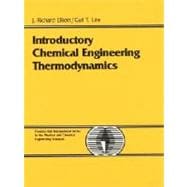
ISBN: 9780130113863 | 0130113867
Edition: 1st
Format: Hardcover
Publisher: Prentice Hall
Pub. Date: 1/1/1999

Why Rent from Knetbooks?

Because Knetbooks knows college students. Our rental program is designed to save you time and money. Whether you need a textbook for a semester, quarter or even a summer session, we have an option for you. Simply select a rental period, enter your information and your book will be on its way!

Top 5 reasons to order all your textbooks from Knetbooks:

  • We have the lowest prices on thousands of popular textbooks
  • Free shipping both ways on ALL orders
  • Most orders ship within 48 hours
  • Need your book longer than expected? Extending your rental is simple
  • Our customer support team is always here to help
SummaryTable of ContentsAuthor Biography
For undergraduate courses in Applied Thermodynamics.Written in a style and at a level that is accessible to undergraduates, this introduction to applied thermodynamics covers the first and second law for process applications, molecular concepts, equations of state, activity models, and reaction equilibria all in a tightly integrated, pedagogical progression of topics. It addresses the on-going evolution in applied thermodynamics and computer technology, and integrates several widely-accessible computational tools to allow exploration of model behavior e.g., programs for HP and TI calculators, Microsoft Excel spreadsheets, and PC's. Includes background and comparison on many of the popular thermodynamic models.
Prefacexv
Notationxix
UNIT I FIRST AND SECOND LAWS1(170)
Introduction
3(32)
... MOREThe Molecular Nature Of Energy
5(5)
Intermolecular potentials for mixtures
10(1)
The Molecular Nature Of Entropy
10(1)
Brief Summary Of Several Thermodynamic Quantities
11(4)
Basic Concepts
15(15)
Introduction to steam tables
22(1)
Interpolation
23(1)
Double interpolation
24(1)
Double interpolation using different tables
25(1)
Double interpolation using Excel
26(2)
Quality calculations
28(1)
Constant volume cooling
29(1)
Summary
30(1)
Homework Problems
31(4)
The Energy Balance
35(52)
Expansion/Contraction Work
35(1)
Shaft Work
36(1)
Work Associated With Flow
37(1)
Lost Work VS. Reversibility
38(3)
Isothermal compression of an ideal gas
41(1)
Path Properties And State Properties
41(2)
Work as a path function
42(1)
Heat Flow
43(1)
The Closed-System Energy Balance
43(4)
Internal energy and heat
45(2)
The Open-System, Steady-State Balance
47(2)
The Complete Energy Balance
49(2)
Internal Energy, Enthalpy, And Heat Capacities
51(7)
Enthalpy of H2O above its saturation pressure
53(3)
Adiabatic compression of an ideal gas in a piston/cylinder
56(1)
Transformation of kinetic energy into enthalpy
57(1)
Kinetic And Potential Energy
58(1)
On the relative magnitude of kinetic, potential, internal energy and enthalpy changes
58(1)
Energy Balances For Process Equipment
59(6)
The integral representing shaft work
64(1)
Strategies For Solving Process Thermodynamics Problems
65(1)
Closed And Steady-State Open Systems
66(6)
Adiabatic, reversible expansion of an ideal gas
66(2)
Continuous adiabatic, reversible compression of an ideal gas
68(1)
Continuous, isothermal, reversible compression of an ideal gas
69(1)
Heat loss from a turbine
70(2)
Unsteady-State Open Systems (Optional)
72(3)
Adiabatic expansion of an ideal gas from a leaky tank
72(1)
Adiabatically filling a tank with an ideal gas
73(1)
Adiabatic expansion of steam from a leaky tank
74(1)
Details Of Terms In The Energy Balance (Optional)
75(2)
Summary
77(1)
Practice Problems
77(3)
Homework Problems
80(7)
Entropy
87(54)
The Concept Of Entropy
87(2)
Microscopic View Of Entropy
89(7)
Entropy change vs. volume change
93(1)
Entropy change of mixing ideal gases
94(2)
The Macroscopic Definition Of Entropy
96(8)
Ideal gas entropy changes in a piston/cylinder
100(2)
Steam entropy changes in a piston/cylinder
102(1)
Entropy generation in a temperature gradient
102(1)
Entropy generation and lost work in a gas expansion
103(1)
The Entropy Balance
104(6)
Steady-state entropy generation
105(2)
Reversible work between heat reservoirs, lost work
107(2)
Entropy change of quenching
109(1)
The Carnot Engine
110(2)
Carnot Heat Pump
112(1)
Internal Reversibility
113(1)
Maximum/Minimum Work In Real Process Equipment
114(2)
Entropy Balance For Process Equipment
116(1)
Charts Including Entropy
117(2)
Turbine Calculations
119(2)
Turbine efficiency
120(1)
Multistage Turbines
121(1)
Pumps And Compressors
122(1)
Strategies For Applying The Entropy Balance
123(1)
Additional Steady-State Examples
124(3)
Heat pump analysis
124(1)
Entropy in a heat exchanger
125(2)
Unsteady-State Open Systems (Optional)
127(2)
Entropy change in a leaky tank
127(1)
An ideal gas leaking through a turbine (unsteady-state)
128(1)
The Entropy Balance In Brief
129(1)
Summary
129(1)
Practice Problems
130(1)
Homework Problems
131(10)
Thermodynamics Of Processes
141(30)
The Carnot Cycle
141(2)
The Rankine Cycle
143(3)
Rankine cycle
144(1)
Two-phase turbine output
145(1)
Rankine Modifications
146(3)
Rankine with reheat
146(2)
Regenerative Rankine cycle
148(1)
Refrigeration
149(5)
Refrigeration by vapor-compression cycle
151(3)
Liquefaction
154(2)
Liquefaction of methane by the Linde process
155(1)
Internal Combustion Engines
156(5)
Air-standard Brayton cycle thermal efficiency
157(1)
Thermal efficiency of the Otto engine
158(2)
Thermal efficiency of a Diesel engine
160(1)
Fluid Flow
161(3)
Problem-Solving Strategies
164(1)
Practice Problems
165(1)
Homework Problems
165(6)
UNIT II GENERALIZED ANALYSIS OF FLUID PROPERTIES171(112)
Classical Thermodynamics---Generalization To Any Fluid
173(20)
The Fundamental Property Relation
174(6)
Derivative Relations
180(6)
Pressure dependence of H
176(5)
Entropy change with respect to T at constant P
181(1)
Entropy as a function of T and P
182(1)
Entropy change for an ideal gas
183(1)
Entropy change for a simple non-ideal gas
183(1)
Application of the triple product relation
184(1)
for an ideal gas
184(1)
Volumetric dependence of Cv for ideal gas
185(1)
Master equation for an ideal gas
185(1)
Relating Cp to Cv
186(1)
Advanced Topics (Optional)
186(3)
Summary
189(1)
Homework Problems
190(3)
Engineering Equations Of State For PVT Properties
193(36)
Experimental Measurements
194(1)
Three-Parameter Corresponding States
195(3)
Generalized Compressibility Factor Charts
198(2)
Application of the generalized charts
198(2)
The Virial Equation Of State
200(2)
Application of the virial equation
201(1)
Cubic Equations Of State
202(3)
Solving The Equation Of State For Z
205(5)
Solution of the Peng-Robinson equation for molar volume
207(1)
Application of the Peng-Robinson equation
208(2)
Implications Of Real Fluid Behavior
210(1)
Derivatives of the Peng-Robinson equation
210(1)
The Molecular Theory Behind Equations Of State
210(10)
Deriving your own equation of state
217(3)
Matching The Critical Point
220(1)
Critical parameters for the van der Waals equation
220(1)
Summary And Concluding Remarks
220(1)
Practice Problems
221(1)
Homework Problems
222(7)
Departure Functions
229(28)
The Departure Function Pathway
230(1)
Internal Energy Departure Function
231(3)
Entropy Departure Function
234(1)
Other Departure Functions
234(1)
Summary Of Density-Dependent Formulas
235(6)
Enthalpy and entropy departures from the Peng-Robinson equation
236(2)
Real entropy in an engine
238(2)
Enthalpy departure for the Peng-Robinson equation
240(1)
Gibbs departure for the Peng-Robinson equation.
241(1)
Pressure-Dependent Formulas
241(2)
Application of pressure-dependent formulas in compression of methane
242(1)
Reference States
243(4)
Enthalpy and entropy from the Peng-Robinson equation
245(1)
Liquefaction revisited
245(2)
Adiabatically filling a tank with propane (optional)
247(1)
Generalized Charts For The Enthalpy Departure
247(1)
Summary
247(2)
Practice Problems
249(1)
Homework Problems
250(7)
Phase Equilibrium In A Pure Fluid
257(26)
Criteria For Equilibrium
258(1)
The Clausius-Clapeyron Equation
258(2)
Clausius-Clapeyron equation near or below the boiling point
260(1)
Shortcut Estimation Of Saturation Properties
260(4)
Vapor pressure interpolation
261(1)
Application of the shortcut vapor pressure equation
262(1)
General application of the Clapeyron equation
263(1)
Changes In Gibbs Energy With Pressure
264(2)
Fugacity And Fugacity Coefficient
266(2)
Fugacity Criteria For Phase Equilibria
268(1)
Calculation Of Fugacity (Gases)
268(3)
Calculation Of Fugacity (Liquids)
271(2)
Calculation Of Fugacity (Solids)
273(1)
Saturation Conditions From An Equation Of State
274(3)
Vapor pressure from the Peng-Robinson equation
274(1)
Acentric factor for the van der Waals equation
275(2)
Summary
277(1)
Temperature Effects On G And f (Optional)
278(1)
Practice Problems
278(1)
Homework Problems
279(4)
UNIT III FLUID PHASE EQUILIBRIA IN MIXTURES283(198)
Introduction To Multicomponent Systems
285(34)
Phase Diagrams
285(3)
Concepts
288(8)
Ideal Solutions
296(5)
Vapor-Liquid Equilibrium (VLE) Calculations
301(6)
Bubble and dew temperatures and isothermal flash of ideal solutions
305(2)
Emission Modeling
307(3)
Non-Ideal Systems
310(3)
Advanced Topics (Optional)
313(1)
Summary And Concluding Remarks
314(1)
Practice Problems
315(1)
Homework Problems
315(4)
Phase Equilibria In Mixtures By An Equation Of State
319(36)
The virial equation for vapor mixtures
321(1)
A Simple Model For Mixing Rules
321(3)
Fugacity And Chemical Potential From An EOS
324(5)
K-values from the Peng-Robinson equation
328(1)
Differentiation Of Mixing Rules
329(6)
Fugacity coefficient from the virial equation
331(1)
Fugacity coefficient for van der Waals equation
332(2)
Fugacity coefficient from the Peng-Robinson equation
334(1)
VLE Calculations By An Equation Of State
335(9)
Bubble point pressure from the Peng-Robinson equation
336(1)
Isothermal flash using the Peng-Robinson equation
337(2)
Phase diagram for azeotropic methanol + benzene
339(1)
Phase diagram for nitrogen + methane
340(2)
Ethane + heptane phase envelopes
342(2)
Strategies For Applying VLE Routines
344(1)
Summary And Concluding Remarks
345(1)
Practice Problems
345(1)
Homework Problems
346(9)
Activity Models
355(68)
Excess Properties
356(1)
Modified Raoult's Law And Excess Gibbs Energy
357(6)
Activity coefficients and the Gibbs-Duhem relation (optional)
359(1)
VLE prediction using UNIFAC activity coefficients
360(3)
Determination Of GE From Experimental Data
363(4)
Gibbs excess energy for system 2-propanol + water
363(2)
Activity coefficients by the one-parameter Margules equation
365(1)
VLE predictions from the Margules one-parameter equation
365(2)
The Van Der Waals' Perspective
367(12)
Application of the van Laar equation
370(1)
Infinite dilution activity coefficients from van Laar theory
371(2)
VLE predictions using regular-solution theory
373(2)
Scatchard-Hildebrand versus van Laar theory for methanol + benzene
375(3)
Combinatorial contribution to the activity coefficient
378(1)
Polymer mixing
378(1)
Flory-Huggins & Van Der Waals' Theories (Optional)
379(2)
Local Composition Theory
381(19)
Local compositions in a 2-dimensional lattice
383(5)
Application of Wilson's equation to VLE
388(9)
Calculation of group mole fractions
397(1)
Detailed calculations of activity coefficients via UNIFAC
397(3)
Fitting Activity Models To Data (Optional)
400(3)
Using Excel for fitting model parameters
401(2)
T And P Dependence Of Gibbs Energy (Optional)
403(1)
The Molecular Basis Of Solution Models (Optional)
404(6)
Summary
410(1)
Practice Problems
411(1)
Homework Problems
412(11)
Liquid-Liquid Phase Equilibria
423(22)
The Onset Of Liquid-Liquid Instability
423(1)
Simple liquid-liquid-vapor equilibrium (LLVE) calculations
424(1)
Stability And Excess Gibbs Energy
424(6)
LLE predictions using Flory-Huggins theory: polymer mixing
426(1)
LLE predictions using UNIFAC
427(3)
Plotting Ternary LLE Data
430(2)
Vlle With Immiscible Components
432(1)
Steam distillation
432(1)
Critical Points In Binary Liquid Mixtures (Optional)
433(3)
Liquid-liquid critical point of the Margules one-parameter model
434(1)
Liquid-liquid critical point of the Flory-Huggins model
435(1)
Excel Procedure For Binary, Ternary LLE (Optional)
436(2)
Summary
438(1)
Practice Problems
439(1)
Homework Problems
439(6)
Special Topics
445(36)
Phase Behavior
445(14)
Solid-Liquid Equilibria
459(11)
Eutectic behavior of chloronitrobenzenes
463(1)
Eutectic behavior of benzene + phenol
464(1)
Wax precipitation
465(5)
Residue Curves
470(5)
Homework Problems
475(6)
UNIT IV REACTING SYSTEMS481(98)
Reacting Systems
483(46)
Reaction Coordinate
483(3)
Stoichiometry and the reaction coordinate
485(1)
Equilibrium Constraint
486(3)
Calculation of standard state Gibbs energy of reaction
487(2)
Reaction Equilibria For Ideal Solutions
489(3)
Computing the reaction coordinate
489(1)
Butadiene revisited
490(2)
Temperature Effects
492(2)
Equilibrium constant as a function of temperature
493(1)
Shortcut Estimation Of Temperature Effects
494(2)
Application of the shortcut van't Hoff equation
495(1)
Energy Balances For Reactions
496(6)
Adiabatic reaction in an ammonia reactor
498(4)
General Observations About Pressure Effects
502(1)
Multireaction Equilibria
503(7)
Simultaneous reactions that can be solved by hand
503(2)
Solving multireaction equilibrium equations by EXCEL
505(2)
Direct minimization of the Gibbs energy with EXCEL
507(2)
Pressure effects for Gibbs energy minimization
509(1)
Simultaneous Reaction And Phase Equilibrium
510(6)
The solvent methanol process
511(3)
NO2 absorption
514(2)
Electrolyte Thermodynamics
516(4)
Chlorine + water electrolyte solutions
517(3)
Solid components In Reactions
520(1)
Thermal decomposition of methane
521(1)
Summary And Concluding Remarks
521(1)
Practice Problems
522(2)
Homework Problems
524(5)
Molecular Association And Solvation
529(50)
Association And Solvation
529(5)
Equilibrium Criteria
534(2)
Balance Equations
536(1)
Ideal Chemical Theory
537(4)
Compressibility factors in associating/solvating systems
538(1)
Dimerization of carboxylic acids
539(1)
Activity coefficients in a solvated system
540(1)
Chemical-Physical Theory
541(1)
Pure Species With Linear Association
542(5)
A Van Der Waals H-Bonding Model
547(8)
Molecules of H2O in a 100-ml beaker
551(4)
The ESD Equation For Associating Fluids
555(10)
Extension To Complex Mixtures
565(4)
Statistical Associating Fluid Theory (SAFT)
569(2)
Summary Analysis Of Association Models
571(2)
Homework Problems
573(6)
GLOSSARY579(4)
Appendix A SUMMARY OF COMPUTER PROGRAMS583(16)
A.1 HP48 Calculator Programs
583(4)
A.2 TI-85 Programs
587(1)
A.3 PC Programs For Pure Component Properties
587(1)
A.4 PC Programs For Mixture Phase Equilibria
587(1)
A.5 Reaction Equilibria
588(1)
A.6 How To Load Programs
589(1)
A.7 Downloading HP Programs
589(1)
A.8 Using Fortran Programs
589(1)
A.9 Notes On Excel Spreadsheets
590(5)
A.10 Notes On HP Calculator
595(2)
A.11 Disclaimer
597(2)
Appendix B MATHEMATICS599(14)
B.1 Important Relations
599(4)
B.2 Solutions To Cubic Equations
603(3)
B.3 The Dirac Delta Function
606(7)
B.1 The Hard Sphere Equation of State
608(2)
B.2 The Square-Well Equation of State
610(3)
Appendix C STRATEGY FOR SOLVING VLE PROBLEMS613(10)
C.1 EOS Methods
613(5)
C.2 Activity Coefficient (Gamma-PHI) Method
618(5)
Appendix D MODELS FOR PROCESS SIMULATORS623(8)
D.1 Overview
623(1)
D.2 Equations Of State
623(1)
D.3 Solutions Models
624(1)
D.4 Hybrid Models
624(1)
D.5 Recommended Decision Tree
625(1)
D.6 Thermal Properties Of Mixtures
626(2)
D.1 Contamination from a reactor leak
627(1)
D.7 Literature Cited
628(3)
Appendix E PURE COMPONENT PROPERTIES631(24)
E.1 Ideal Gas Heat Capacities
631(3)
E.2 Liquid Heat Capacities
634(1)
E.3 Solid Heat Capacities
634(1)
E.4 Antoine Constants
635(1)
E.5 Latent Heats
636(1)
E.6 Enthalpies And Gibbs Energies Of Formation
637(3)
E.7 Properties Of Water
640(11)
E.8 Pressure-Enthalpy Diagram For Methane
651(1)
E.9 Pressure-Enthalpy Diagram For Propane
652(1)
E.10 Thermodynamic Properties Of HFC-134a
653(2)
Index655
J. Richard Elliott is Associate Professor of Chemical Engineering at the University of Akron in Akron, OH Carl T. Lira is Associate Professor in the Department of Chemical Engineering at Michigan State University

Related Products


  • Introductory Chemical Engineering Thermodynamics
    Introductory Chemical Engineer...


Please wait while this item is added to your cart...

