Free Shipping On Every Order



Amazon no longer offers textbook rentals. We do!
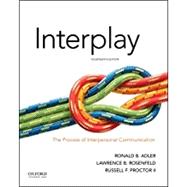
Interplay The Process of Interpersonal Communication

Interplay The Process of Interpersonal Communication
- ISBN 13:
9780195379594
- ISBN 10:
0195379594
- Edition: 11th
- Format: Paperback
- Copyright: 02/04/2009
- Publisher: Oxford University Press
- Newer Edition
Rent
Sorry, this item is currently unavailable.
 Free Shipping On Every Order
Note: Supplemental materials are not guaranteed with Rental or Used book purchases.
Extend or Purchase Your Rental at Any Time
Need to keep your rental past your due date? At any time before your due date you can extend or purchase your rental through your account.
Summary
Now in its eleventh edition, Interplay: The Process of Interpersonal Communication provides a comprehensive and engaging introduction to communication in interpersonal relationships. Blending topics of high student interest with rich pedagogy and an inviting visual format, this leading text shows how scholarship and research can help students understand their own relationships and communicate better in everyday life. NEW TO THE ELEVENTH EDITION * Revised and expanded material discusses hot-button issues including the influence of social networking websites on relationship formation, cultural differences as generalizations, neurobehavioral challenges in perception, linguistic convergence/divergence, the impact of new media on listening, communicating relational commitment, repairing damaged relationships, and constructive criticism. * New "Dark Side of Communication" sidebars--featured in each chapter--examine the more difficult and challenging issues of interpersonal communication, such as verbal abuse, compulsive talking, cyber-bullying, manipulation, the "silent treatment," and discrimination based on people's accents. * Focus on Research sidebars--twenty of which are new to this edition--highlight current scholarship on important and interesting issues, including the impact of TV makeover shows on viewers' self-images, impression management in online dating, the phenomenon known as "gaydar," gender differences in instant messaging habits, and "friends with benefits" relationships. * A new chapter, "Communication in Families and at Work"--drawn from the previous edition's appendices--looks at the dynamics of family and work relationships. * Film Clip sidebars--eighteen of which are new to this edition--profile recent feature films that illustrate communication concepts. Clips include Spanglish (culture and communication), Shark Tale (identity management), Lars and the Real Girl (constructing narratives), The Devil Wears Prada (poor listening habits), The Break-Up (relational stages), and Juno (managing conflict). SUPPLEMENTS * Instructor's Manual (available in paperback and CD-ROM): Includes an extensive Test Bank and suggested class activities. * Student Success Manual: Features study tips, chapter outlines and summaries, review questions, key terms, and critical thinking exercises. * Companion Website: Offers a wealth of resources for both students and instructors, including online self-testing and other study aids, links to a variety of communication-related websites, and "Now Playing" reviews of recent films.
Author Biography
Read moreTable of Contents
Read moreSupplemental Materials
Read moreRelated Products