FREE SHIPPING BOTH WAYS
ON EVERY ORDER!
LIST PRICE:
$122.66

OUR PRICE:
$97.15

You may extend rentals at any time.


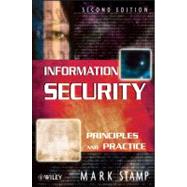
Information Security : Principles and Practice

ISBN: 9780470626399 | 0470626399
Edition: 2nd
Format: Hardcover
Publisher: Wiley
Pub. Date: 5/3/2011

Why Rent from Knetbooks?

Because Knetbooks knows college students. Our rental program is designed to save you time and money. Whether you need a textbook for a semester, quarter or even a summer session, we have an option for you. Simply select a rental period, enter your information and your book will be on its way!

Top 5 reasons to order all your textbooks from Knetbooks:

  • We have the lowest prices on thousands of popular textbooks
  • Free shipping both ways on ALL orders
  • Most orders ship within 48 hours
  • Need your book longer than expected? Extending your rental is simple
  • Our customer support team is always here to help
SummaryTable of ContentsAuthor Biography
Featuring a wide array of new information on the most current security topics, this book provides everything readers need to tackle any information security challenge. Focusing on cryptography, access control, protocols and software, this Second Edition features a greatly expanded set of homework problems; an appendix that covers necessary background information, like networking basics; a solutions manual and a comprehensive set of classroom-tested PowerPoint slides; and many new figures, tables, and graphs to clarify complex topics and problem... MORE
Preface.

About The Author.

Acknowledgments.

1 Introduction.

1.1 The Cast of Characters.

1.2 Alice’s Online Bank.

1.3 About This Book.

1.4 The People Problem.

1.5 Principles and Practice.

1.6 Problems.

I Crypto.

2 Crypto Basics.

2.1 Introduction.

2.2 How to Speak Crypto.

2.3 Classic Crypto.

2.4 Modern Crypto History.

2.5 A Taxonomy of Cryptography.

2.6 A Taxonomy of Cryptanalysis.

2.7 Summary.

2.8 Problems.

3 Symmetric Key Crypto.

3.1 Introduction.

3.2 Stream Ciphers.

... MORE

3.4 Integrity.

3.5 Summary.

3.6 Problems.

4 Public Key Crypto.

4.1 Introduction.

4.2 Knapsack.

4.3 RSA.

4.4 Diffie-Hellman.

4.5 Elliptic Curve Cryptography.

4.6 Public Key Notation.

4.7 Uses for Public Key Crypto.

4.8 Public Key Infrastructure.

4.9 Summary.

4.10 Problems.

5 Hash Functions++.

5.1 Introduction.

5.2 What is a Cryptographic Hash Function?

5.3 The Birthday Problem.

5.4 A Birthday Attack.

5.5 Non-Cryptographic Hashes.

5.6 Tiger Hash.

5.7 HMAC.

5.8 Uses for Hash Functions.

5.9 Miscellaneous Crypto-Related Topics.

5.10 Summary.

5.11 Problems.

6 Advanced Cryptanalysis.

6.1 Introduction.

6.2 Enigma.

6.3 RC4 as Used in WEP.

6.4 Linear and Differential Cryptanalysis.

6.5 Lattice Reduction and the Knapsack.

6.6 RSA Timing Attack.

6.7 Summary.

6.8 Problems.

II Access Control.

7 Authentication.

7.1 Introduction.

7.2 Authentication Methods.

7.3 Passwords.

7.4 Biometrics.

7.5 Something You Have.

7.6 Two-Factor Authentication.

7.7 Single Sign-On and Web Cookies.

7.8 Summary.

7.9 Problems.

8 Authorization.

8.1 Introduction.

8.2 A Brief History of Authorization.

8.3 Access Control Matrix.

8.4 Multilevel Security Models.

8.5 Compartments.

8.6 Covert Channel.

8.8 CAPTCHA.

8.9 Firewalls.

8.10 Intrusion Detection Systems.

8.11 Summary.

8.12 Problems.

III Protocols.

9 Simple Authentication Protocols.

9.1 Introduction.

9.2 Simple Security Protocols.

9.3 Authentication Protocols.

9.4 Authentication and TCP.

9.5 Zero Knowledge Proofs.

9.6 The Best Authentication Protocol?

9.7 Summary.

9.8 Problems.

10 Real-World Security Protocols.

10.1 Introduction.

10.2 SSH.

10.3 SSL.

10.4 IPSec.

10.5 Kerberos.

10.6 WEP.

10.7 GSM.

10.8 Summary.

10.9 Problems.

IV Software.

11 Software Flaws and Malware.

11.1 Introduction.

11.2 Software Flaws.

11.3 Malware.

11.4 Botnets.

11.5 Miscellaneous Software-Based Attacks.

11.6 Summary.

11.7 Problems.

12 Insecurity in Software.

12.1 Introduction.

12.2 Software Reverse Engineering.

12.3 Digital Rights Management.

12.4 Software Development.

12.5 Summary.

12.6 Problems.

13 Operating Systems and Security.

13.1 Introduction.

13.2 OS Security Functions.

13.3 Trusted Operating System.

13.4 Next Generation Secure Computing Base.

13.5 Summary.

13.6 Problems.

Appendix.

A-1. Network Security Basics.

A-2. Math Essentials.

Annotated Bibliography.

Index.

Mark Stamp, PhD, is Professor of Computer Science at San José State University, where he teaches undergraduate and graduate-level information security courses. In addition to his experience gained in private industry and academia, Dr. Stamp has seven years' experience working as a cryptanalyst at the U.S. National Security Agency. He has written dozens of academic papers and two books on the topic of information security.


Please wait while this item is added to your cart...